Some art forms endure for centuries — but Simon Beck’s work is, by its nature, temporary.
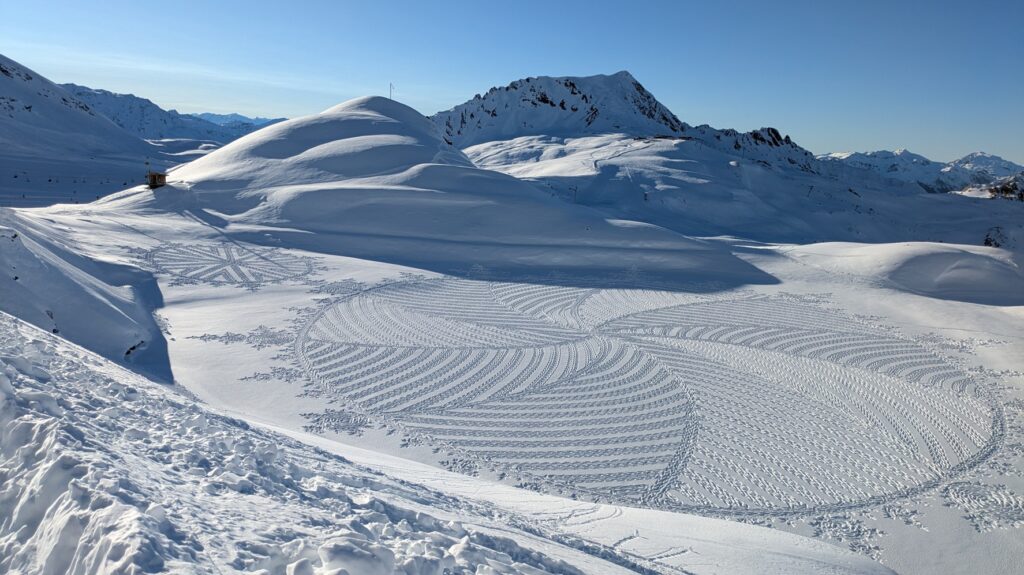
For two decades, Beck has been using his feet to make intricate designs in fresh snow and on beaches. A former mapmaker, Beck designs many of the drawings ahead of time on paper. Then he spends 12 hours alone with a compass, walking in snowshoes to create complex patterns. Some designs resemble snowflakes, stars or flowers. Others include messages or peace signs.
“In mapmaking, you’ve got something in existence on the ground, and you’ve got to reproduce it in small scale on paper by measuring it,” Beck said. “Making one of these drawings is the same process in reverse.” Beck mostly works in France, but his art is seen all over the world on social media.
At 67 years old, Beck has made nearly 700 artworks in sand and snow, and said he aspires to make at least a thousand. The first time he tried making a pattern in the snow, in 2004, it was just an experiment. He started occasionally posting his snow and sand art. After a few years, he realized how many people were connecting with his work, and he started to dedicate himself more seriously. He can only work in the snow from late October until early March, so he has a short season to make as many drawings as he can.
The patterns can be as large as three soccer fields. After they’re done, Beck photographs them, often using a drone or by perching high on a nearby slope. Then, the drawings melt or are swept away by the wind or skiers — or they’re covered by fresh snow. The ephemeral nature of his work is part of the point.
“If the drawing did not get erased, you would never be able to make more than one drawing in the same location,” Beck said. He’s made hundreds of patterns in the same spots, and every time it snows, he has a fresh canvas.
When Beck works in sand on beaches, the timetable is even shorter.
“When the tide starts going down, you have to wait until it’s dry before you can start drawing,” he said. “Typically, you’ve got about five hours to get the drawing done before the tide comes in and starts covering it up. So once it’s dry enough to start, it becomes a race against the incoming tide.”
Beck now works mostly on frozen lakes in the French Alps, and sometimes hikers and skiers happen upon him while he’s creating a snow drawing.
“The record was 75 people watching me,” he said. “It was nearly finished on a sunny day in the ski season, when there were a lot of people around.” The skiing wasn’t very good that day, so dozens of people stopped to watch as Beck completed his work, yelling “Bravo!” and applauding and taking photographs, he recalled.
Often, though, Beck starts working on a snow drawing around 11 a.m. or noon, and doesn’t finish until around midnight, taking pictures of it the next morning. He eats a hearty breakfast before he starts: two big bowls of porridge with banana. He brings snacks with him for when he gets hungry while working, but he doesn’t take breaks.
“I tend to eat while I’m doing the detailed fractals around the edge because it’s less physically demanding,” Beck said. By the time he finishes, he’s pretty hungry. “To be honest, I should take a bit more food out there than I do. I should get better organized.”
Beck usually works alone, but doesn’t mind the solitude. He listens to classical music while he works.
“The Earth is beautiful, and the snow is beautiful, and winter is beautiful,” Beck said.
The post He spends 12 hours making art in the snow, then watches it vanish appeared first on Washington Post.