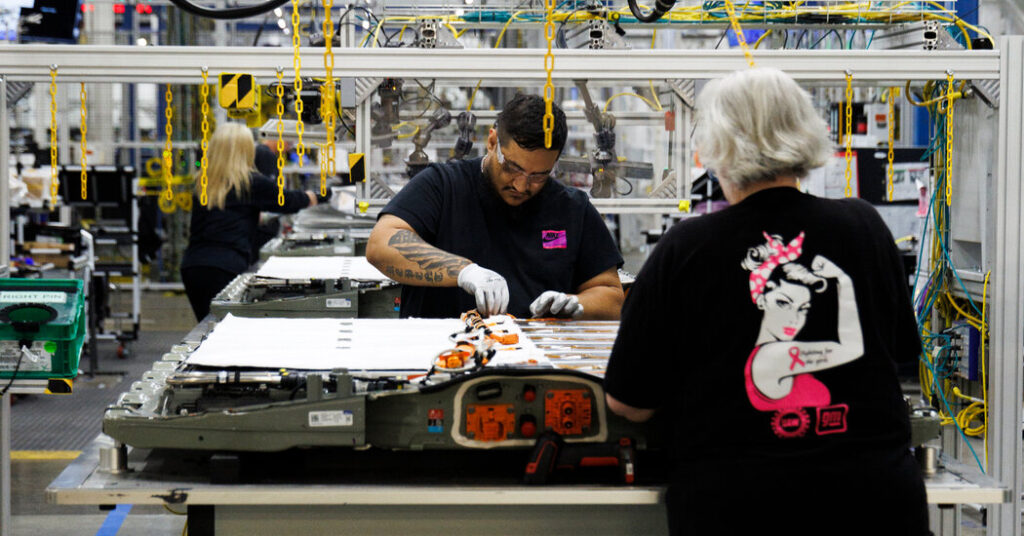
General Motors on Thursday became the latest automaker to announce a big loss from its investments in electric vehicles, as it reckoned with a slump in sales of those cars after Congress and President Trump overhauled federal policy to favor fossil fuels.
G.M., the largest U.S. carmaker, said it would record a $7.1 billion loss for the last quarter of 2025 primarily to reflect the diminished value of its investments in battery factories and electric vehicle assembly lines.
The loss also reflects compensation that G.M. will pay to suppliers for investments they made to produce components that the automaker no longer needs. About $1.1 billion of the total reflects the cost of restructuring G.M. operations in China that are not related to electric vehicles, the company said.
Policies put in place since the start of Mr. Trump’s second term have forced many carmakers to undertake costly changes. Ford Motor said last month that it would take a $19.5 billion hit to its profits related to its electrical vehicle business.
Electric cars have become more difficult to sell after federal tax credits that covered as much as $7,500 of the cost to buy or lease an electric vehicle were eliminated at the end of September. The Trump administration has also loosened environmental and fuel economy standards that had put pressure on carmakers to sell more electric vehicles, which have no tailpipe emissions.
“With the termination of certain consumer tax incentives and the reduction in the stringency of emissions regulations, industrywide consumer demand for E.V.s in North America began to slow in 2025,” G.M. said in a securities filing on Thursday.
In October, G.M. announced a third-quarter loss of $1.6 billion stemming from its electric vehicle assets. The company has scaled back plans for electric vehicles while ramping up production of large sport utility vehicles and pickups, which are far more profitable. A G.M. plant in Orion, Mich., is being converted from electric vehicle manufacturing to production of large vehicles powered by internal combustion engines.
The company warned that it might book further losses related to electric vehicles in the coming months. But those losses “will be significantly less than the E.V.-related charges incurred in 2025,” G.M. said.
General Motors offers one of the broadest selections of electric vehicles of any carmaker outside China, including luxury vehicles like the Cadillac Escalade IQ and models that sell for less than $40,000 like the Chevrolet Equinox EV. But to make money on those cars, G.M. needs to produce and sell them in much larger numbers to benefit from economies of scale.
Industry executives and analysts expect sales of electric vehicles to begin growing again as early as this year as companies begin selling more electric models for $30,000 or less, including a revived version of G.M.’s Chevrolet Bolt.
There is broad agreement in the industry that U.S. carmakers must keep investing in electric vehicles to compete with Chinese carmakers, like BYD, that are selling a lot more cars across Asia, Europe and Latin America. Tariffs effectively ban Chinese cars from the United States, but industry executives say it will be difficult to keep them out forever.
“Our strategic realignment of E.V. capacity does not impact today’s retail portfolio of Chevrolet, GMC and Cadillac E.V.s in production,” G.M. said. “We plan to continue to make these models available to consumers.”
Jack Ewing covers the auto industry for The Times, with an emphasis on electric vehicles.
The post G.M. Books a $7.1 Billion Loss as It Scales Back E.V. Ambitions appeared first on New York Times.