The blows in Minnesota began landing last year, when a fraud scandal in the state’s social services system ripped through the national news and disgusted taxpayers.
Then in December, President Trump laced into Somali refugees, a group that has settled in Minnesota in large numbers, saying they were “garbage” that he did not want in his country.
Just after Christmas, another jolt: A conservative influencer posted a video that went viral online claiming that day care centers in Minneapolis were cheating taxpayers out of more than $100 million. And this week, as federal officials threatened to cut funding for Minnesota’s social service programs and a new surge of federal immigration agents arrived in Minneapolis, the state’s beleaguered governor, Tim Walz, said that he would not run for re-election.
But it was the shooting death of a 37-year-old woman by a federal immigration officer along a Minneapolis street on Wednesday that exposed just how a wide a gulf there is between the Trump administration and Minnesota’s Democratic leaders.
At a news conference, Mr. Walz delivered an angry message to President Trump: “You’ve done enough.” Hours later, Kristi Noem, the homeland security secretary, labeled the woman who was killed a terrorist and vowed to continue aggressive enforcement actions in the city.
The clash left residents expressing anguish and fear over where events might lead next.
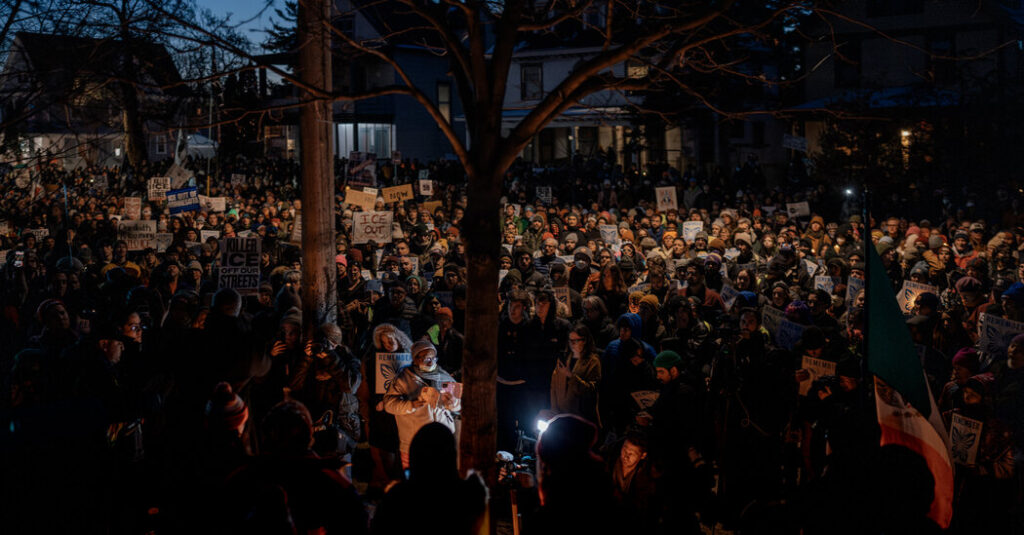
At a candlelight vigil on Wednesday evening, Andy Cuate, a 24-year-old from Cottage Grove, Minn., said that the eyes of the country on Minnesota brought him back to the aftermath of the murder of George Floyd by a police officer in 2020. More than five years later, he said, it still feels raw.
“Now that we’re the center of attention again, it’s just kind of like, ‘When are the people from Minnesota going to catch a break here?’” Mr. Cuate said.
Throughout the day, local and state officials condemned the killing of Renee Nicole Good, a Minneapolis resident who was driving a vehicle when an Immigration and Customs Enforcement fatally shot her on a residential street.
Federal officials had just begun a broad crackdown on immigration in the Twin Cities, with Department of Homeland Security officials promising that 2,000 agents would fan out in search of criminal offenders.
Mayor Jacob Frey, a Democrat, called for immigration agents to get “out of Minneapolis.”
“Now somebody is dead,” he said. “That’s on you. And it’s also on you to leave.”
Mr. Walz urged Minnesotans to be calm in their response to the shooting.
Federal immigration officials said that an ICE agent shot and killed Ms. Good in self-defense. They said her vehicle was driving toward the agent and she had refused to cooperate when ordered to stop.
That explanation was sharply dismissed by many people in Minneapolis, a liberal-leaning city where suspicion of Mr. Trump and his immigration crackdown is fierce.
“More than anything, I feel like we’re prepared as a city for events like these,” said Elliott Payne, the president of the Minneapolis City Council, as he drove to join thousands of people at vigil by nightfall. “And sadly, it’s because we have been through many events like these.”
During the Covid pandemic, when the city was recovering from the civil unrest that followed Mr. Floyd’s death, Minneapolis residents organized community aid to help neighbors who were short on food and money. They formed group chats and community patrols as crime spiked. Many of those networks came back to life when ICE agents flooded into the city in recent days, and neighbors began warning one another if agents were spotted.
“This was just a bystander looking to protect their community,” Mr. Payne said of Ms. Good.
Even outside the Twin Cities, Minnesota residents said it was impossible to ignore the turmoil that had settled over the state.
“It is exhausting,” said Jessie Hennen, a professor of creative writing at Southwest Minnesota State University, who has followed the news of the ICE influx so closely, she wasn’t sure how she would finish preparing for the spring semester. “It’s hard to focus.”
Many people in Minnesota said they were bracing for the weeks ahead, and the protests, investigations and recriminations that were to come.
Hours after Ms. Good’s death, some people had already called for criminal charges to be brought against the ICE agent who shot her, while Ms. Noem said on Wednesday that she will ask the Justice Department to prosecute as domestic terrorism the use of vehicles to block immigration enforcement operations.
Dan Simmons contributed reporting from Minneapolis.
Julie Bosman is the Chicago bureau chief for The Times, writing and reporting stories from around the Midwest.
The post Fatal Shooting by ICE Follows Weeks of Turmoil in Minnesota appeared first on New York Times.