From the beginning of a military campaign targeting boats last summer to the capture of Nicolás Maduro over the weekend, President Trump has consistently justified his moves against Venezuela by citing three factors: drugs, migration and oil.
Mr. Trump, his cabinet members and his government have repeatedly characterized Venezuela as the source of deadly drugs killing Americans; the ousted leader, Mr. Maduro, as the engineer of a mass migration of criminals into the United States; and the country as an unpunished thief of American oil.
None of those claims are accurate. Here’s a fact-check.
What Was Said
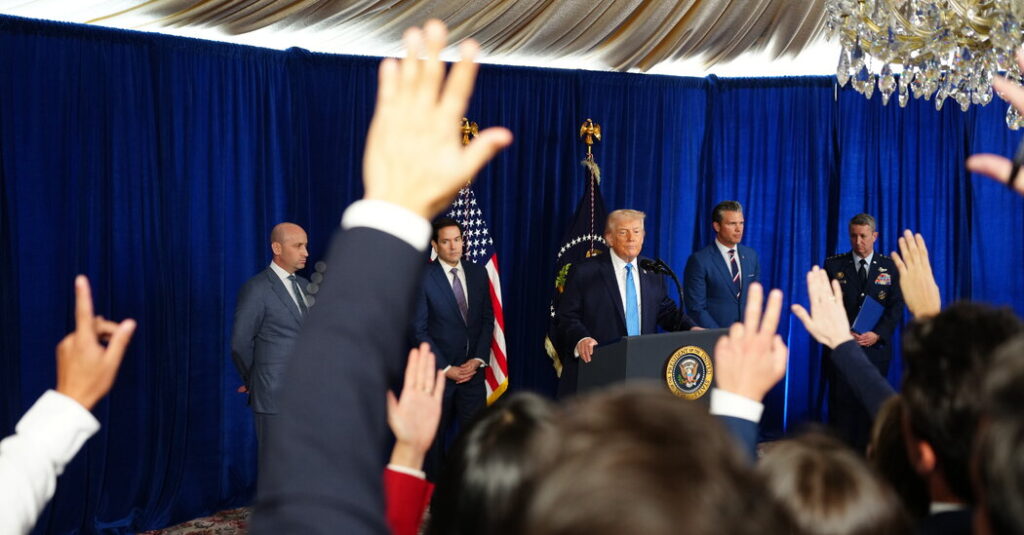
“We’ve knocked out 97 percent of the drugs coming in by sea. Ninety percent. Each boat kills 25 — on average, 25,000 people. We knocked out 97 percent. And those drugs mostly come from a place called Venezuela.” — Mr. Trump, in a news conference on Saturday
This lacks evidence. Mr. Trump authorized more than 30 strikes on at least 36 vessels in the waters off Central and South America from Sept. 2 to Dec. 31, killing more than 110 people. The administration has not offered proof that these strikes, as part of the military’s Operation Southern Spear, saved 900,000 lives, according to Mr. Trump’s math, or amounted to stopping nearly all maritime drug trafficking.
It is possible that the vessels were drug-smuggling boats, as the administration has said, but it has offered little evidence publicly to back that assertion, nor has it offered details on the type or amount of drugs intercepted.
Government officials and law enforcement agencies often herald drug seizures as a proxy for successful enforcement, sometimes expressed as a high number of lethal doses. The U.S. Coast Guard, for example, said in December that it had seized 150,000 pounds of cocaine since August as part of its Operation Pacific Viper, equal to “over 57 million potentially lethal doses.” (One lethal dose is an estimated 1.2 grams.)
A White House spokeswoman argued that just 50 grams of fentanyl, “if that was on board one of those ships,” would amount to 25,000 lethal doses, given the estimated lethal dose of two milligrams.
But one lethal dose is not the same as one life saved from overdose, cautioned Dr. Mark Olfson, a professor of psychiatry, medicine and law at Columbia University and an expert on substance abuse.
“To date, there is no solid epidemiologic evidence demonstrating that removing specific quantities of drugs directly prevents overdoses or proportionally reduces deaths,” Dr. Olfson said. “This may be because seizures typically remove only a small fraction of the total drug supply, drug markets adapt rapidly to replace seized drugs, and only very small quantities of highly potent drugs, such as fentanyl, can be fatal.”
Overdose deaths peaked in 2022 at nearly 110,000 and have since declined. There were more than 73,000 drug overdose deaths from April 2024 to April 2025, the latest available data. So Mr. Trump essentially claimed, improbably, that the boat strikes prevented about a decade’s worth of overdose deaths.
It is also worth noting that the vast majority of overdose deaths involve more than one drug, with opioids like fentanyl — which is primarily routed through Mexico and sourced from China — involved in the majority. Venezuela is considered to be a transit hub for cocaine. A recent study from the Centers for Disease Control and Prevention found that just 6.3 percent of cocaine-involved deaths over a three-year period did not involve other drugs.
“Cocaine alone is a relatively uncommon contributor to U.S. overdose deaths, with most cocaine-related deaths involving a combination with opioids,” Dr. Olfson said, adding that cocaine does nevertheless increase overdose risk.
Mr. Trump’s claim that the boat strikes “knocked out” more than 95 percent of maritime drug trafficking is also unsupported and unlikely.
The primary mode of trafficking drugs to the United States from Venezuela is by air, according to the United Nations Office on Drugs and Crime. Major maritime routes for trafficking cocaine to the United States largely departed from Colombia, Ecuador and Central American countries, traveling through the Eastern Pacific Ocean (which Venezuela does not border). A 2020 report from the Drug Enforcement Administration noted that just 8 percent of documented cocaine was smuggled through the Caribbean corridor.
As the strikes occurred, the Coast Guard and other government agencies continued to conduct other maritime drug enforcement operations. For example, the Coast Guard reported seizing nearly 20,000 pounds of cocaine across 10 days in November as part of Operation Pacific Viper. U.S. Customs and Border Protection also announced the seizure of about 935 pounds of cocaine at the Port of San Juan on Dec. 24.
What Was Said
“As alleged in the indictment, he personally oversaw the vicious cartel known as Cartel de Los Soles, which flooded our nation with lethal poison responsible for the deaths of countless Americans.” — Mr. Trump, in the news conference on Saturday
False. The indictment against Mr. Maduro that was unsealed over the weekend does not say that.
In an earlier indictment against Mr. Maduro in 2020, the Justice Department described Cartel de Los Soles as a “Venezuelan drug-trafficking organization comprised of high-ranking Venezuelan officials who abused the Venezuelan people and corrupted the legitimate institutions of Venezuela.” It asserted that Mr. Maduro “helped manage and, ultimately, lead” the organization, describing Cartel de Los Soles and its trafficking at length.
But former narcotics enforcement officials and experts in Latin American crime have said that Cartel de Los Soles is not an actual organization. Rather, it is a figure of speech used by Venezuelans to pejoratively describe military officials corrupted by drug money. The term refers to the sun insignia on the uniforms of military officers in Venezuela.
In the indictment of Mr. Maduro released on Saturday, which supersedes the 2020 indictment, the Justice Department altered its description of Cartel de Los Soles, instead characterizing it as a “patronage system” and saying that Mr. Maduro “participates in, perpetuates and protects a culture of corruption.”
What Was Said
“What he did was sending hundreds of thousands of Tren de Aragua and drug dealers, and they emptied out their jails into our country.” — Mr. Trump, in an interview with “Fox & Friends” on Saturday
This lacks evidence. For years, Mr. Trump has claimed baselessly that Venezuela had “emptied” its prisons and mental institutions and sent thousands to millions of criminals across the United States’ southern border. And his assertion that Mr. Maduro himself directed a violent gang, Tren de Aragua, to commit crimes in the United States is also without proof.
Neither indictment by the Justice Department accuses Mr. Maduro of engineering a mass migration of Venezuelan inmates to the United States, as Mr. Trump has said. And Saturday’s indictment states that Venezuelan officials, including Mr. Maduro, “partnered” with Tren de Aragua at times — not that Mr. Maduro directed the gang.
The New York Times reported in March that most American intelligence agencies did not believe that Mr. Maduro’s government controlled Tren de Aragua or that the gang was committing crimes on its orders. An April memo from the agencies said that the Maduro regime probably did ”not have a policy of cooperating” with Tren de Aragua and was not directing the gang’s “movement and operations in the United States.”
“Some regime officials are probably willing to capitalize on migration flows for personal, financial or other benefits, even though the Maduro regime probably is not systematically directing Venezuelan outflows, such as to sow chaos in receiving countries,” the memo read.
The Venezuelan Prison Observatory, a nongovernmental organization based in Caracas, the country’s capital, reported that Venezuela’s prisons housed some 22,000 people in 2024 and remained overcrowded — the opposite of emptied — at 145 percent capacity.
What Was Said
“Remember, they stole our property. It was the greatest theft in the history of America. Nobody has ever stolen our property like they have. They took our oil away from us.” — Mr. Trump, in remarks to reporters on Sunday
This is exaggerated. Neither the United States nor American companies have ever owned the oil in Venezuela. Mr. Trump is referring to, and overstating, a 2007 dispute between the Venezuelan government and American oil companies.
In the early part of the 20th century, the Venezuelan government granted foreign oil companies concessions — agreements that allowed them to explore, drill and sell oil — for a cut of the companies’ profits. Venezuelan law stated that the concessions did not confer ownership.
“The Venezuelan state, at every point, always retained control of the subsoil. That means the oil was always Venezuela’s,” said Miguel Tinker Salas, a professor emeritus of history at Pomona College and the author of “The Enduring Legacy: Oil, Culture and Society in Venezuela.”
In the 1970s, the Venezuela government began nationalizing the oil industry. About 20 oil companies, mostly American subsidiaries, were affected and compensated.
In 2007, the Venezuela government, under President Hugo Chávez, took majority control of remaining foreign oil projects, and reached agreements with most companies, including Chevron.
But two American companies, ConocoPhillips and Exxon Mobil, rejected the deal and were pushed out of the country. Each sued the Venezuelan government for unlawful confiscation. A White House spokeswoman cited these disputes as evidence of Mr. Trump’s claims.
ConocoPhillips was awarded $8.7 billion last year by a World Bank tribunal, and $2 billion from a separate tribunal of the International Chamber of Commerce in 2018, while Exxon was awarded $1.4 billion and $908 million. Both companies say they have yet to be fully compensated.
Linda Qiu is a Times reporter who specializes in fact-checking statements made by politicians and public figures. She has been reporting and fact-checking public figures for nearly a decade.
The post Fact-Checking Trump’s Justifications for the Venezuela Operation appeared first on New York Times.