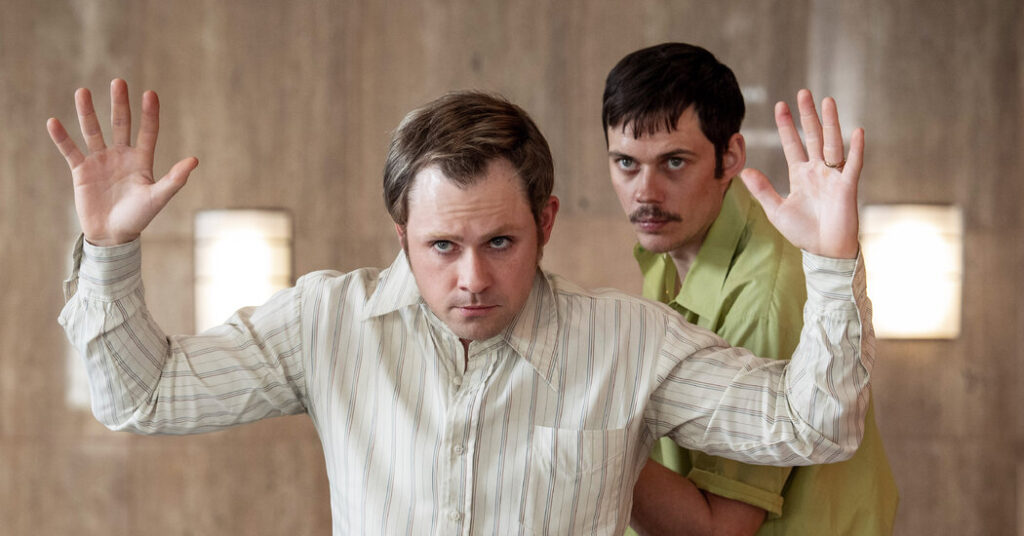
For “Dead Man’s Wire,” Gus Van Sant appears to have proceeded from the notion that somebody ought to make a 1970s-style crime film like they used to. But they used to make them a lot more energetic.
Written by Austin Kolodney, “Dead Man’s Wire” is based on a curious news item from 1977, when an Indianapolis man named Anthony Kiritsis (Bill Skarsgard) abducted a mortgage company executive, Richard Hall (Dacre Montgomery), and demanded an apology for perceived wrongs done to him relating to a commercial land deal.
The main notoriety of this episode — probably the only reason anyone would dramatize it nearly five decades later — stems from Kiritsis’s method of hostage taking: Using wire, he rigged a shotgun to both Hall and himself, so that any effort to separate them would kill Hall. That, and perhaps the fact that some of it was on TV. The outcome, which critic’s rules say should go unspoiled, was also a bit nutty.
Yet something’s off here. Skarsgard, not far removed from his vampiric turn in the recent “Nosferatu,” plays Kiritsis as a gruff, stringy collection of tics; it’s as if he’s imagining how Michael Shannon might have played Kiritsis, then doing an impersonation of that. Montgomery hasn’t been given a personality to work with. Kolodney, faced with two basic options — developing a dynamic between the two men or keeping them in a tense, one-sided standoff, with Kiritsis supplying all the chatter — opts for an unsatisfying balance. Hall’s blathering about his old man (“It wasn’t all sunshine and rainbows growing up as his son”) comes off as a too-little, too-late effort at characterization.
That old man — the top dog at the mortgage company — is played by Al Pacino, phoning in to the other characters from Florida and chewing on each bayou-accented syllable, as if to remind viewers, with every line, that we aren’t watching the Pacino of “Dog Day Afternoon” (a clear inspiration) but a Pacino who is gambling to see how much he can get away with without being cut from the film. “We Halls are stoic people,” he warns Kiritsis, by way of explaining why he won’t apologize. He accuses his son of having Stockholm syndrome. His scenes are terrible, but at least they’re fun.
“Dead Man’s Wire” also features Colman Domingo as a D.J. who gets involved in the negotiations; an unrecognizable Cary Elwes as a cop who knows Kiritsis as a bar buddy; and Myha’la as a TV reporter with a chance to prove her mettle.
Van Sant, doing a fair job of evoking the period with ersatz video footage, augments the mood with a soundtrack of ’70s standards (Deodato, Donna Summer) that have the vague feel of having been sampled from other movies. And when “Dead Man’s Wire” ends with footage of the real Kiritsis and Hall, it is hard not to conclude that a much crazier, livelier film could have been made.
Dead Man’s Wire Rated R. The rating administration cites only “language throughout,” as if the dead man’s wire were a nonissue. Running time: 1 hour 45 minutes. In theaters.
The post ‘Dead Man’s Wire’ Review: When the Action Is Razor Thin appeared first on New York Times.