In between such pistol-packing antiheroes as Bonnie Parker and Luigi Mangione, financially-squeezed Americans rooted for Tony Kiritsis, a working stiff who took his mortgage lender hostage in 1977 Indianapolis, claiming that the loan company cheated him out of his land. “Dead Man’s Wire,” the title of Gus Van Sant’s wonky true crime caper, comes from Kiritsis’ weapon: a shotgun tied to a noose looped around the neck of his prisoner, Richard Hall. His hair-trigger homemade contraption pressured all three major networks into giving Kiritsis airtime to explain his grievances to the public. Pressing a sawed-off barrel to Hall’s head, the hot-tempered chatterbox told the cameras, “I am sorry I humiliated this man this way, even though he must’ve surely had it coming.”
To the establishment’s horror, many viewers sided with Kiritsis. “How about some Tony Kiritsis t-shirts, some Tony Kiritsis badges, a Tony Kiritsis fan club?” one supporter wrote to the local paper, the Indianapolis News.
Or how about a biopic that fires blanks?
Van Sant has long taken aim at the intersection of violence and mass media culture. Over his career, he’s attacked it from several angles, including the fame-seeking satire of “To Die For,” his elegy for the publicly out politician of “Milk” and the clinical ennui of “Elephant,” his take on the Columbine massacre, in which his pair of teen killers numb themselves with grisly entertainment. Kiritsis’ story is an irresistible target: an ignored man thrilled to have the attention of the spanking new Action News squads who barge onto the scene unprepared for the risk they might broadcast an on-air murder.
But this time, Van Sant seems more interested in the period-piece décor and the aesthetics of early video footage (the cinematography is by Arnaud Potier) than he is in the bleak humor of Kiritsis’ televised tirade cutting to a burger commercial. The result is a faintly comic curio that hurtles along without much impact.
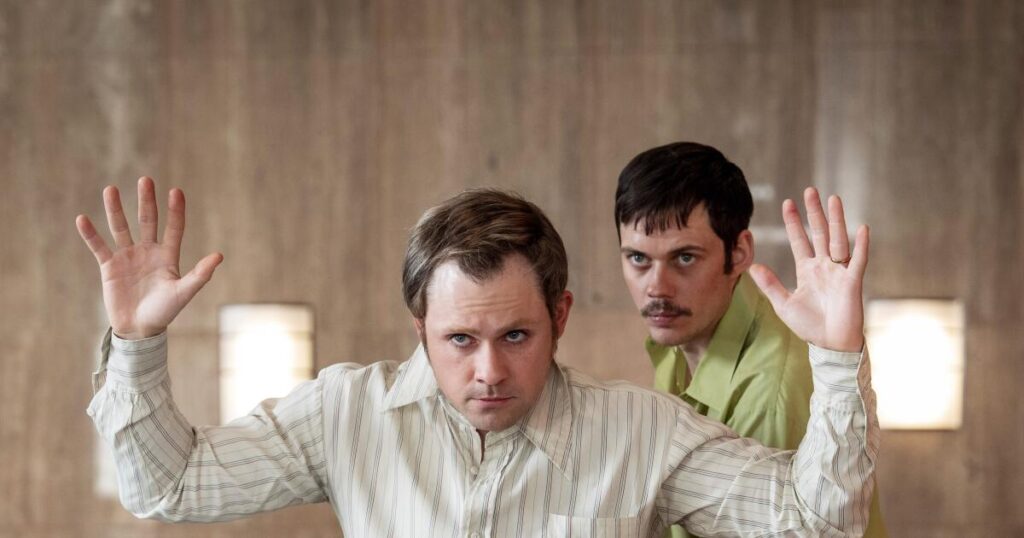
The mishaps start when Kiritsis (Bill Skarsgård) storms Meridian Mortgage’s office only to discover his intended captive, the ruthless M.L. Hall (Al Pacino), is away vacationing in Florida. Hall’s cowed and coddled son Richard (Dacre Montgomery) will have to do, even though the real estate scion is so passive that he barely bothers to fight for his life. If you’ve seen the original footage of the bizarre press conference where Hall, a twitch from assassination, stares blankly past the flashbulbs, then you know that Van Sant and Montgomery (the “Stranger Things” bully cast against type) get their victim exactly right while robbing Kiritsis, and the audience, of a worthy adversary. In one cold yet weightless moment, the boy-man realizes his own dad might not care whether he survives.
At least the younger Hall’s dull demeanor — then coded as dignity, now as soullessness — makes Kiritsis seem more alive. The real Kiritsis was short-statured with a car salesman’s sideburns; he had the kind of face you only see onscreen during competitive bowling. Lanky, hunched and fragile, Skarsgård’s version isn’t quite as salt-of the-earth, although he’s captured his rapid patter and the burning menace in his eyes. He plays the role somewhere between a soapbox preacher and a “Scooby-Doo” episode that imagines Shaggy unmasking a money-grubbing bad guy and threatening to beat him to death.
Kiritsis is so convinced of his righteousness that he genuinely believes the mortgage company’s manipulations, not his own murder threat, to be the big story. When Hall proves too mute to debate, Kiritsis vents to a radio disc jockey named Fred (Colman Domingo), even though Fred is more interested in smooth tunes than hard news. (Springboarding from this and his perky TV host role in “The Running Man,” Domingo needs to star in his own comedy stat.) Won’t someone, even an inessential young reporter played by Myha’la, poke into the alleged scam?
Yet despite how often Austin Kolodney’s script has Kiritsis say he just wants to be heard, the soured mortgage deal is so impossible to follow that even the movie itself deems it unnecessary. Our attention pivots to the futility of this self-described “little guy” trying to get someone with clout to take him seriously. In this period, criminal psychology was just starting to go mainstream. An FBI agent (Neil Mulac) instructs the Indianapolis cops to think deeper about Kiritsis’ motivations, wielding chalk to illustrate how anger is rooted in humiliation and disrespect. Kiritsis is screaming mad and the police’s yawns aren’t helping.
Today, Kiritsis would have a podcast. But cranks like him seem especially at home in the 1970s — the mad-as-hell decade — when their polyester button-downs make them look extra itchy around the collar. It’s easy to picture Kiritsis exiting a double-feature of “Network” and “Dog Day Afternoon” and vowing that he, too, isn’t going to take it anymore.
Van Sant sees the parallels between Kiritsis and “Dog Day Afternoon’s” populist bank robber Sonny Wortzik — heck, he’s even stunt-cast Pacino as the fat-cat financier — but the film doesn’t appear to have the budget to examine how Kiritsis’ anger fires up the cash-strapped masses. It certainly can’t afford to include the real-life scene at an Indianapolis Pacers game where an arena of basketball fans cheered for his not-guilty verdict, although I would have settled for even a bit player who helps us understand why a jury of his peers let him off the hook.
Instead, the movie inexplicably squanders its energy on needle drops that act against the mood: the watery irony of Donna Summer’s “Love to Love You Baby” cooing over an image of Hall handcuffed in a bathtub. Better is Danny Elfman’s spartan and fraught score, particularly the dyspeptic drums.
Was Kiritsis a narcissistic madman or a schmuck who’d put too much trust in the American ideals of hard work and fair treatment? Van Sant alludes to the latter when the televisions keep showing John Wayne on other channels, the gunslinging Duke setting things right in a classic western or winning the 1977 People’s Choice statuette for best actor.
It’s no wonder that Kiritsis figured he’d be a hero, too — and that, in real life, many of the people watching at home agreed — although as obvious as that point is, it would have been nice if Van Sant explored it. At least we get Kiritsis’ sentimental, expletive-laden version of an awards speech which devolves into him thanking his family, Hall’s family and even the police academy before he gets hustled offstage. Kiritsis is certain he’s accomplished something great. We’re glumly aware of how many others are waiting their turn in the wings.
The post ‘Dead Man’s Wire’ faithfully recreates a TV hostage standoff but avoids the messy why appeared first on Los Angeles Times.