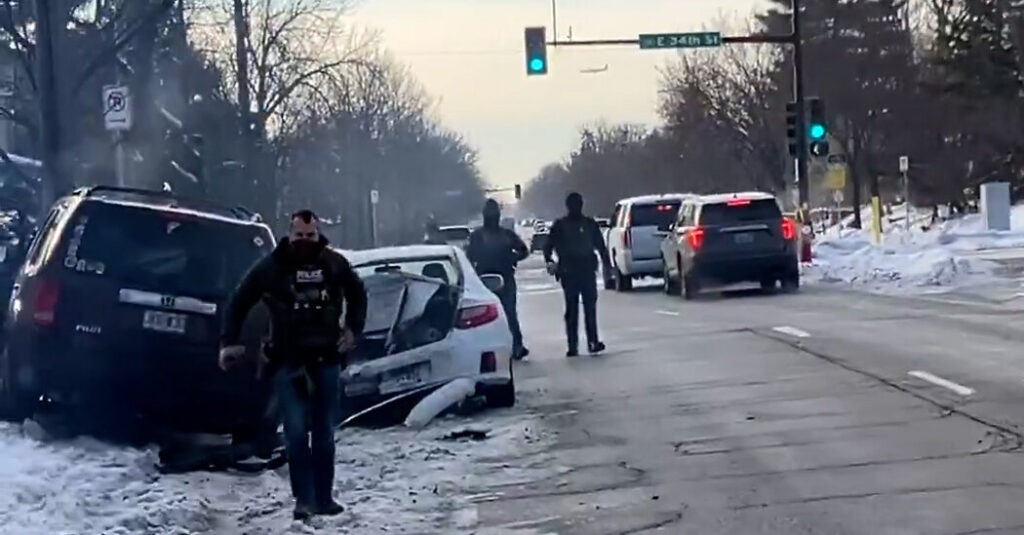
The federal immigration agent who fatally shot a woman in her car this week was dragged about 100 yards by a different driver in Minnesota last year during an immigration operation, interviews and court records show.
The agent, who works for a division of the Immigration and Customs Enforcement agency, was treated for a gash on his forearm that required 20 stitches after the incident, for which the driver was convicted of assault last month.
Now that same agent is at the center of a growing backlash in Minneapolis over the Trump administration’s immigration enforcement efforts, after he shot and killed Renee Good, 37, in the driver’s seat of her car on Wednesday.
Kristi Noem, the homeland security secretary, said at a news conference on Wednesday that the agent, whom she did not name, had feared for his life during the encounter, and noted that he had been dragged by a car in June. Two law enforcement officers with knowledge of the matter, who were not authorized to speak publicly, identified the ICE agent as Jonathan Ross.
It is unclear when the agent, who is part of a division called Enforcement and Removal Operations, returned to work following the June incident, which took place in Bloomington, a Minneapolis suburb.
Representatives of ICE and the Department of Homeland Security could not immediately be reached for comment on the dragging incident.
Mr. Ross and other agents were trying to apprehend a Guatemalan man who had been convicted of sexual abuse in Minnesota, according to court records. The agents followed the man, Roberto Carlos Munoz, as he drove away from his house, and later pulled him over.
When Mr. Ross told the driver to lower his window and open his door, Mr. Munoz refused, an F.B.I. agent wrote in an affidavit. Mr. Ross then pulled his Taser, shattered the rear driver’s side window of Mr. Munoz’s car and reached in with one arm to try to unlock a door. At that point, Mr. Munoz shifted into drive and pulled away.
While being dragged, Mr. Ross fired his Taser at Mr. Munoz, electrocuting him twice, the affidavit said, but Mr. Munoz continued to drive for about 100 yards, weaving back and forth in an apparent effort to shake the agent from the car, which he finally did.
The agent landed on the street, bleeding from his right arm, and photographs taken later and included in court documents show a wound to his arm and blood on his pants and left hand. The cut to his arm required 20 stitches, according to court records.
Mr. Munoz, meanwhile, had called 911 to say that he was assaulted by an immigration agent — a phone call that ultimately helped officers find and arrest him about a mile away.
His trial took place over several days in Minnesota last month. On Dec. 10, a jury deliberated for about two hours before convicting him of assaulting a federal officer with a dangerous or deadly weapon, resulting in injury.
Mr. Munoz has not yet been sentenced, and his lawyer, Eric Newmark, declined to comment on his case.
The Wednesday shooting of Ms. Good, an American citizen, in South Minneapolis has resulted in sharply different interpretations of the event from local and federal officials. President Trump and other federal officials have said that the agent acted in self-defense, while state and local officials described those accounts with terms like “propaganda” and “garbage.”
Minnesota law enforcement officials said on Thursday that they were being denied access to evidence from the shooting by federal agencies, and could no longer participate in the investigation as a result.
Footage of the shooting shows one federal agent grabbing the handle of Ms. Good’s vehicle, which is partially blocking a street in South Minneapolis, while Mr. Ross walks around the front of her car. Ms. Good reverses slightly, then shifts into drive, moving the car toward the agent before turning the wheels to the right, away from him.
Mr. Ross fires one shot, then continues firing as the vehicle moves past him. It appears from the videos that he fired once through the front windshield and twice through the driver’s side window, killing Ms. Good.
Michael Levenson contributed reporting. Kitty Bennett contributed research
Nicholas Bogel-Burroughs reports for The Times on national stories across the United States with a focus on criminal justice.
The post Court Records Reveal Details of ICE Agent’s Previous Dragging Incident appeared first on New York Times.