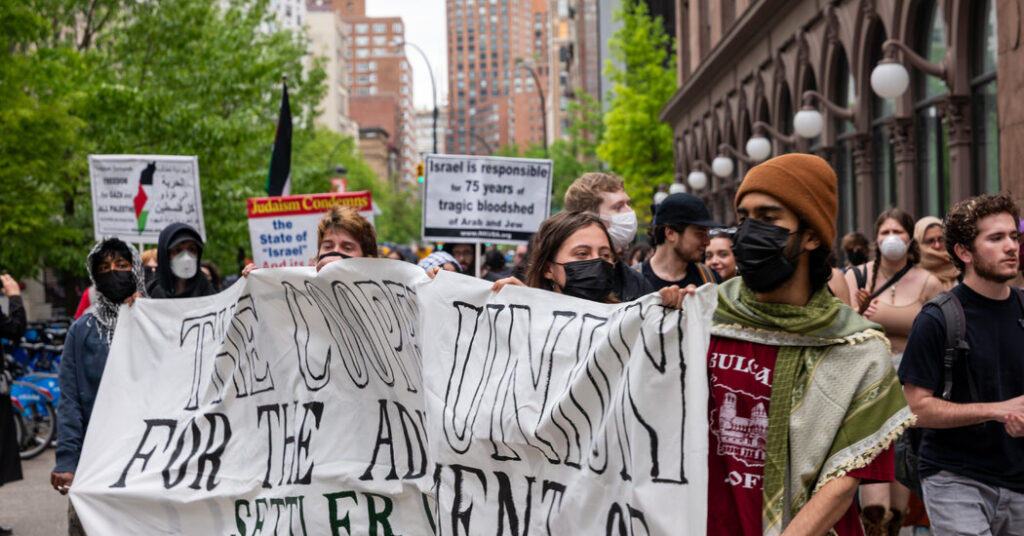
The Cooper Union will make sweeping changes to its anti-discrimination and protest policies to settle a lawsuit brought by Jewish students who accused the New York City college of tolerating antisemitism, most strikingly at a pro-Palestinian protest that briefly trapped them inside the school’s library.
The settlement, which was announced Thursday by lawyers representing 10 Jewish students, will require Cooper Union to recognize that discrimination or harassment based on a person’s Zionist beliefs — in addition to their Jewish identity more broadly — violates its nondiscrimination policies.
The college, formally known as the Cooper Union for the Advancement of Science and Art, is a renowned art, architecture and engineering school in Manhattan with fewer than 1,000 students.
The settlement also requires Cooper Union to bar student protesters from wearing masks intended to conceal their identities and to approve in advance all student posters and fliers to make sure they are not discriminatory. While the First Amendment allows beliefs such as Zionism — the support of the existence of a Jewish state in Israel — to be criticized, such expression can veer into harassment if it is overly pervasive or targeted, said Ziporah Reich, a lawyer with the Lawfare Project, the pro bono law firm that represented the students.
“We’ve taken a fine-tooth comb to what the issues are at Cooper Union and had them agree to institute measures that we thought would literally make the lives of Jewish students on campus that much better,” Ms. Reich said.
Steven W. McLaughlin, who became Cooper Union’s president last July, said in a statement that he welcomed the settlement, which did not require that the institution admit wrongdoing, “as an important step as we move forward.”
“This institution was founded on a bedrock commitment to mutual respect, integrity and diversity,” he said. “Today’s settlement reflects our ongoing commitment to maintaining a campus where every student in our community feels respected, safe and included.”
Cooper Union came to global attention in October 2023 when Jewish students who were stuck in the university library during a raucous pro-Palestinian protest videotaped the episode. The images circulated widely on social media.
The videotape showed protesters banging on the closed door of the library, chanting “Free Palestine,” as Jewish students caught inside looked on nervously. The protest moved to a glass wall of the library and continued there before protesters dispersed about 10 minutes later.
Jewish students inside the library, intimidated by the chanting and banging on doors and wall, repeatedly called the Police Department to ask for help. It turned out that the police had been monitoring the protest the whole time, and later said that there had been no cause to intervene. No one was assaulted or injured in the protest.
“At no time were they yelling out that they wanted to kill people,” Carlos Nieves, then the assistant commissioner for the Police Department, later said.
Still, within minutes, the campus confrontation had taken on a life of its own, embroiling students in a pitched national discussion about free speech and antisemitism on campus.
The lawsuit alleged that the harassment faced by Jewish students in the tense months after the October 2023 Hamas attack on Israel went well beyond the library incident, and included fliers that targeted students’ Zionist identities, along with other protests and acts of exclusion that made it difficult to be a Jewish student at Cooper Union.
The suit highlighted an episode in April 2024 in which pro-Palestinian protesters shouted anti-Zionist slogans during an event for newly admitted students, which the lawsuit said was intended to dissuade students with Zionist beliefs from enrolling. Among other phrases, they shouted: “We don’t want no Zionists here!” — a phrase often heard at pro-Palestinian protests.
As part of the settlement, Cooper Union will appoint a dedicated Title VI coordinator responsible for overseeing the school’s compliance with the Civil Rights Act of 1964, including dealing with anti-Zionist discrimination and harassment. Title VI is the part of the Civil Rights Act that bars discrimination based on race, color or national origin in any program that receives federal financial assistance, including discrimination based on shared ancestry, ethnicity or even foreign accents and names.
Cooper Union will also provide mandatory training for all faculty members, staff, administrators, students and trustees on its nondiscrimination policies, including on how protesting against Zionism can cross the line into antisemitism.
The 10 students who sued will receive monetary compensation, although the amount remains confidential.
In a note Thursday to the college, Mr. McLaughlin said that independent of the settlement, the school would continue to build momentum toward its goal of restoring free tuition for all students, a longstanding policy that ceased in 2013.
“When I became your president in July, I knew that bringing this matter to a conclusion would be a top priority,” he said, referring to the lawsuit. “We have achieved a result that will enable us to learn from this experience and move forward with renewed focus on our core educational mission and on our commitment to upholding the values of the Cooper Union.”
Sharon Otterman is a Times reporter covering higher education, public health and other issues facing New York City.
The post Cooper Union Settles Jewish Students’ Suit and Alters Protest Policies appeared first on New York Times.