After authorizing the removal of Venezuela’s leader, President Trump seemed to turn his sights on other countries, including Colombia. On Sunday, he called its president, Gustavo Petro, a “sick man” who makes cocaine to send to the United States and said that military action against the South American country “sounds good.”
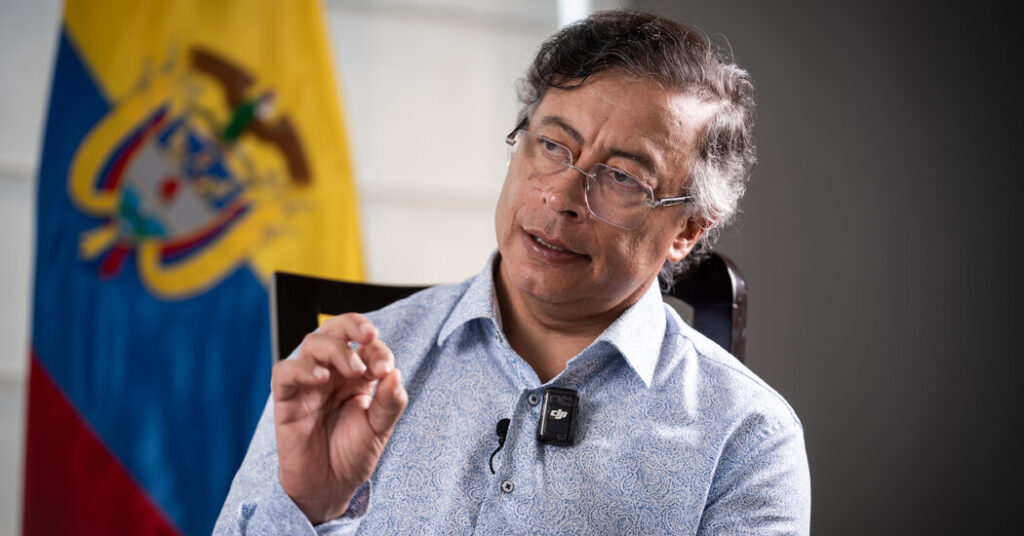
The response from Mr. Petro — a strident 65-year-old leftist who has repeatedly clashed with the American president — was frantic. He called on the people of Colombia to take to the streets to defend him and their country’s sovereignty, issued a storm of indignant social media posts, and gave a rare interview to The New York Times on Wednesday.
“Well, we are in danger,” he said. “Because the threat is real. It was made by Trump.”
Just hours later, while traveling from the Colombian port city of Cartagena back to Bogotá, the capital, Mr. Petro learned that Mr. Trump himself wanted to speak with him, according to an aide who was not authorized to speak publicly on the matter. The call, which took place once Mr. Petro arrived back at the presidential palace, occurred as thousands waited for him outside at a rally he had called for that very same hour.
A U.S. official confirmed that the call had taken place and said it lasted about an hour, which is unusually long for a call between Mr. Trump and another head of state.
In a complete about-face, Mr. Trump took to social media shortly after the call and said it had been a “Great Honor” to speak to Mr. Petro, who he said had “called to explain the situation of drugs and other disagreements that we have had.” Mr. Trump said he appreciated “his call and tone,” and that he looked forwarded to meeting him; a White House visit was being arranged.
The phone call appeared to defuse a crisis and lift a looming sense of peril for the Colombian president, who had told The Times earlier on Wednesday that he feared he might be extracted like Venezuela’s Nicolás Maduro, and that he planned to sleep in the presidential palace next to the sword of Simón Bolívar, the South American independence hero. (Mr. Petro was once a member of an urban guerrilla group that stole the sword in a symbolic act.)
He said he was concerned Mr. Trump would try to justify such an action either by trying to link him to Mr. Maduro or by labeling him a drug trafficker, too, claims he forcefully denied.
“He’s completely mistaken about that,” Mr. Petro said. “I live humbly off my salary, even if it is a relatively high one for Colombia.”
In his storm of social media messages, Mr. Petro said that with Mr. Trump’s incursion in Venezuela on Saturday and his veiled threats toward Colombia and Mexico since, the American president had awakened the “jaguar” — referring not to himself but the anti-imperialist sentiments of the people of Latin America.
His manner was far more subdued in the interview with The Times, which lasted two hours and meandered from the slave rebellions of the 17th century to the ideas of Jürgen Habermas, the German social theorist, while also hinting at the strain he was under. When asked whether he had perhaps drawn the ire of the U.S. president with continuous social media messages, including one on Tuesday in which he referred to his “senile brain,” Mr. Petro somberly said no.
He said he believed that the president’s threats toward Colombia stemmed from a lack of direct communication between the two leaders and that, as a result, Mr. Trump had an “erroneous” image of him. He faulted right-wing figures both in Colombia and in the United States for nurturing that image in the lead-up to presidential elections in May. (Mr. Petro is constitutionally barred from seeking a consecutive second term, and the race to succeed him remains wide open.)
As it turned out, he would have his first phone call ever with Mr. Trump the same day.
After the call, Mr. Petro emerged looking “better” than he had in days, said the aide, who recounted what Mr. Petro said in that moment: “Well, looks like we’re going to Washington.”
That will require some finessing: The U.S. State Department revoked Mr. Petro’s visa last fall after he called on American soldiers to disobey Mr. Trump during a pro-Palestinian rally in New York.
While Mr. Petro’s staff said he had repeatedly requested to speak with Mr. Trump, it was unclear what prompted the phone call on Wednesday. The White House did not immediately respond to a request for comment.
Since Mr. Trump took office about a year ago, relations between the two leaders have been openly hostile. In February, Mr. Petro briefly blocked military flights carrying migrants from the United States, backing down only after Mr. Trump threatened Colombia with crushing tariffs. He has denounced Mr. Trump for his support for Israel.
And more recently, he accused the United States of committing “murder” in the boat strikes off the coast of South America that the Trump administration says are taking out drug traffickers, and of using the strikes to distract from the Epstein scandal. That led Mr. Trump to call Mr. Petro an “illegal drug dealer.”
Mr. Petro has not publicly shown much contrition. Instead, he has seemed to relish his role as the region’s most vocal critic of the Trump administration, even as some Colombians have warned he is spending too much time antagonizing a powerful opponent and could endanger a strong alliance with the United States. Even as Mr. Trump has tried to portray Mr. Petro and his country as unleashing drugs on the United States, the two countries have been deeply intertwined in counternarcotics efforts for decades.
Tens of billions of dollars have flowed to Colombia in U.S. training and equipment over decades, and the United States helped Colombia track down and kill one of the most notorious drug cartel kingpins of all time, Pablo Escobar, in 1993.
Nonetheless, cocaine production has continued to grow in Colombia alongside rising consumption, largely in Western countries. Colombia remains the world’s biggest producer by far.
“Colombia, despite its unusual president, has institutions in that country that work very closely with us, and those ties remain unimpeded and unaffected,” Secretary of State Marco Rubio told reporters last month. “We will not allow the actions of a president whose term will end soon to damage the relationship that exists between the United States and Colombia.”
But when the war of words took a turn this week with Mr. Trump’s thinly veiled threat of military action, that concern turned to widespread fear that the U.S. military might consider airstrikes in Colombian territory or even direct action against Mr. Petro.
Mr. Petro, in turn, had asked Colombians to come out on Wednesday draped in their national flag — and to protect him. His foreign minister stressed a need for diplomacy, but also said Colombia would not rule out a military response if the U.S. attacked.
In the United States, Senator Chuck Schumer, the minority leader, said that in a briefing with top Trump administration officials, including Mr. Rubio, he had asked for assurances that the United States was not planning operations in other countries, including Colombia. “I was very, very disappointed in their answer,” he said.
At a White House press briefing on Wednesday, Press Secretary Karoline Leavitt was asked about the president’s threats to Colombia, and whether Mr. Petro should expect a visit from Delta Force, which is part of the U.S. Army.
“That would be a very unwise question for me to answer,” she responded.
Mr. Petro’s appearance at the rally was delayed by Mr. Trump’s call. When Mr. Petro finally emerged onto the stage around 6:30 p.m., he was greeted by thousands of people chanting his name and hoisting signs that read “Respect Colombia” and “Gringos Go Home.”
He informed the crowd that he had just spoken with Mr. Trump, and read part of Mr. Trump’s Truth Social post aloud. The crowd broke into applause.
“Talking is one thing, being partners is another,” Mr. Petro said. “I talk so we can have fewer deaths, fewer children being recruited into war, fewer coca plantations.”
A few hours later, before calling it a night, Mr. Petro took to X, his preferred social media platform, and posted a picture of a bald eagle and a jaguar seeming to nuzzle each other.
Federico Rios contributed reporting from Cartagena, Colombia. Jorge Valencia contributed reporting from Bogotá, Colombia.
Annie Correal is a Times reporter covering Mexico, Central America and the Caribbean.
The post Colombia’s President Feared a U.S. Attack. Then Trump Called. appeared first on New York Times.