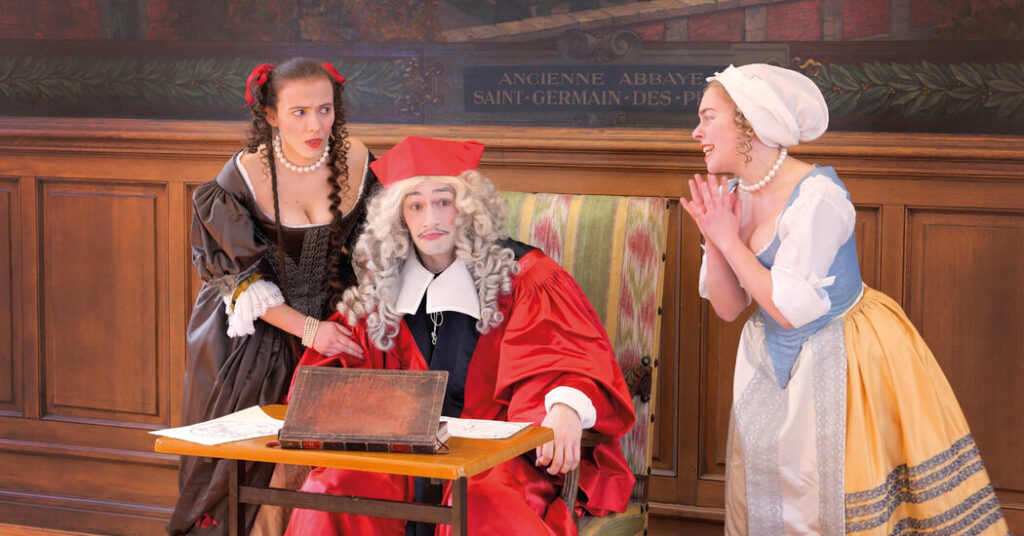
A tyrannical father, duped by a sham astrologer, promises his daughter in marriage — until she and a clever servant expose the fraud with some farcical tricks.
It sounds like a comedic plot by Molière, the 17th-century playwright who thrilled Paris by skewering paternal authority and pseudoscience. Yet the beloved French author didn’t write that one: It’s the scenario for “The Astrologer, or False Omens,” a play written by an artificial intelligence program trained to imitate Molière’s themes, structures and sense of humor.
For the past two years, the French A.I. collective Obvious has been developing the script with the Théâtre Molière Sorbonne, a theater company specializing in historical reconstructions of the 17th-century repertoire. As part of the digital arts festival Némo, an excerpt will be performed on Saturday at the Centquatre, a Paris arts center, before a full staging at the Royal Opera of Versailles in May.
The process was driven by “scientific curiosity,” Mickaël Bouffard, the director of the Théâtre Molière Sorbonne, said. “We’re trying to simulate Molière’s creative process, step by step. Our goal is to be as historically accurate as possible.”
The collaboration was masterminded by the sociologist Pierre-Marie Chauvin, a vice president of Sorbonne University, who said he saw in Obvious “a long-view approach to A.I., and a real interest in cultural heritage.”
The collective is best known for creating visual artworks with algorithms; in 2018, one of its paintings became the first A.I. work sold through the auction house Christie’s, for $432,500. Obvious opened its own research laboratory within Sorbonne University three years ago, and Chauvin brought its three members to see the Théâtre Molière Sorbonne.
Nobody in Obvious is a regular theatergoer: Its members’ experiences of Molière came primarily from their school days, they said in a group interview. Yet they immediately clicked with Georges Forestier, the Théâtre Molière Sorbonne’s founding director, whom Chauvin described as “extraordinarily curious and technophile.”
Forestier came up with the play’s main theme: human credulity, a fitting topic for an A.I.-written pastiche and one that Molière frequently touched on. Coraline Renaux, a Ph.D. student and a member of the theater company, then suggested an astrologer as a viable antihero. Astrologers are mentioned in some of Molière’s plays, and after his death, his collaborator Jean Donneau de Visé wrote a play about astrology, “The Comet.”
After Forestier died from cancer in 2024, Bouffard continued driving the project forward. It turned out to be an arduous process. They creative team experimented with different prompts and programs trained by Obvious on Molière’s body of work, and struggled with the A.I.’s tendency to forget the beginning of the play once the story progressed. After a few months, Bouffard was almost ready to give up, he said, “because it was so laborious.”
“It took Molière two weeks to write a play, whereas we’ve been at it for two years,” said Gauthier Vernier, an Obvious member.
The quick progress of A.I. models provided the consistency needed to sustain long-form writing. Along the way, a team of Molière scholars provided human feedback on the evolving synopsis — which has been revised 15 times — and on the script itself.
Among them is Lise Michel, an associate professor of French literature at Lausanne University. She said she approached reviewing the A.I. synopsis as “a game,” using her in-depth knowledge of Molière’s plays to identify anything that didn’t sound “quite right.”
Molière’s satirical humor, which blends literary wit and slapstick farce, proved especially hard to nail. The A.I. tended to excessively draw out humorous metaphors or make overly naïve jokes. Feedback from actors helped, according to Bouffard, who added that the A.I. also had “strokes of genius”: “We laughed so hard at times,” he said, “because we never thought it would be able to come up with some of these lines.”
Although the team was careful not to bill “The Astrologer” as a “new Molière play,” not everyone is thrilled by the prospect of the production. Bouffard said some colleagues had warned him that he was “taking on a sacred monster” in Molière.
In a recent Facebook post, Aurore Evain, a director and scholar who has revived forgotten plays by women, called the project a “Tartuffery” and criticized the $1.75 million budget attached to it (which came primarily from private French and North American sponsors, according to Sorbonne University).
The funding didn’t go solely to A.I.-powered writing: Three other models were trained to create historically accurate sets, costumes and music based on Molière’s collaborations with designers and composers. The resulting score and designs will be unveiled in full in Versailles in May before touring dates in France.
The show was conceived as a one-off, but the next step for A.I.-powered performing arts research may be to “complete unfinished plays or scores,” said Bouffard, who likened the idea to the restoration of a painting.
“A.I. has no ego, no taste — whether good or bad,” he said, stressing that this makes it more suited to pastiche than humans. “That sense of neutrality is really interesting,” he said. “It all depends on how we activate it.”
The post Can A.I. Match Molière’s Wit? These Researchers Think So. appeared first on New York Times.