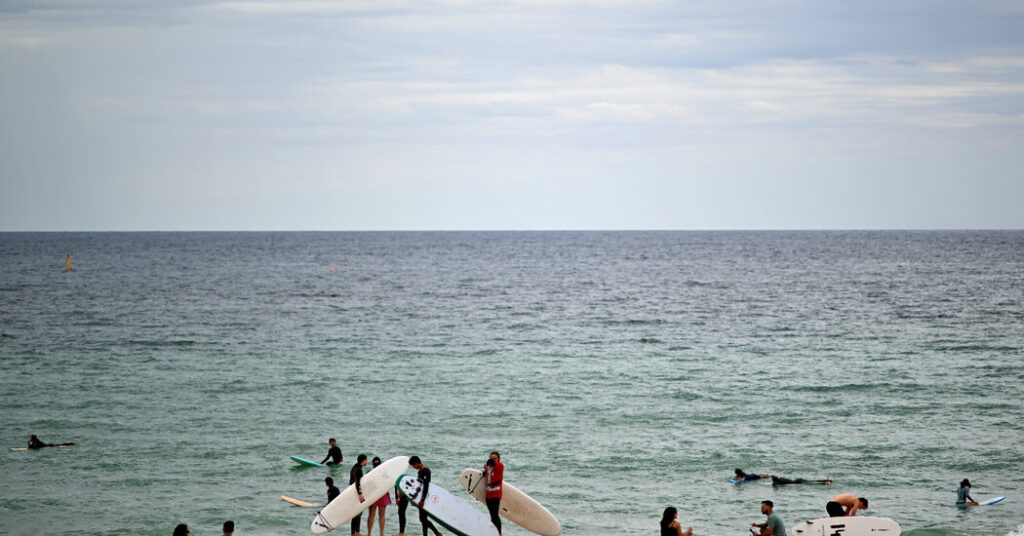
With Australia sweltering under a searing heat wave that has brought record-breaking temperatures this week, forecasters have warned that the parched landscape and the rising temperatures could lead to catastrophic fire conditions.
Officials said that the combination of heat, wind and dryness this week had created the worst conditions since Australia’s devastating Black Summer bush fires of 2019 and 2020, when thousands of hectares of land burned and dozens of people lost their lives.
Every state and territory in Australia, with the exception of Queensland, was under severe or extreme heat warnings, with some of them extending through the weekend. In Victoria, where the fire risk is most pronounced, thousands of residents were being urged to evacuate, and schools will be closed in part of the state on Friday.
Australia’s Bureau of Meteorology described the heat wave as the most significant of the summer season so far and, in some areas, the most prolonged in several years. Temperatures climbed above average by as much as 16 degrees Celsius, or nearly 30 degrees Fahrenheit.
Hot air pulled in from the northwest pushed temperatures to extreme levels on Wednesday, when many locations recorded their highest temperatures in five years. In Onslow, on the Pilbara coast of Western Australia, the temperature reached 49 degrees Celsius, just over 120 degrees Fahrenheit.
Across large swaths of New South Wales, Victoria and South Australia, temperatures soared above 40 degrees Celsius, or 104 degrees Fahrenheit. Melbourne, Adelaide and many other places in Victoria and South Australia recorded their highest temperatures since January 2020.
Forecasters at the Bureau of Meteorology said Friday was expected to be the peak of the heat for South Australia and Victoria, and very dangerous fire weather was also expected.
The bureau issued a catastrophic fire danger warning — the highest level in its four-tier system — for southern areas of Victoria, including the Wimmera, the Northern Country and the North Central districts on Friday. The state declared a total fire ban.
A lower extreme fire danger rating was issued for southern parts of South Australia, and the south of Victoria, including Melbourne.
The extreme heat was just one element of the fire threat. Sarah Scully, a meteorologist with the Bureau of Meteorology, said that the elevated risk on Friday was also being driven by the potential for severe thunderstorms from an approaching weather system moving into the area.
“There’s very little rainfall expected with any of the storms that do form,” she said. “So this creates the risk of dry lightning that could potentially ignite new fires.”
Ms. Scully said that damaging winds, gusting up to 90 kilometers per hour — just over 55 miles per hour — were also expected, which could cause “erratic fire behavior” as sudden gusts hit the ground and make wind direction difficult to predict.
Officials said a number of bush fires were already burning through Victoria, New South Wales, Western Australia and South Australia.
In the state of Victoria — home to Melbourne, the second largest city in Australia — officials urged residents in fire-prone areas, particularly those surrounded by bushland, to leave by 7 a.m. Friday, even if there are no fires near them.
Thousands of residents are in the areas that are being evacuated, and 450 schools and child care centers will close on Friday in the parts of Victoria that are at risk, state officials said.
In a long-range forecast, Dr. Lynette Bettio, a senior climatologist at the Bureau of Meteorology, said the fire risk would be heightened this summer in parts of central northern New South Wales, much of southern Victoria and regions in the west and south of Western Australia.
Forecasters said the increased risk in Victoria, away from the east of the state, was largely driven by below-average rainfall over the past year, which has left landscapes parched and vegetation highly flammable. Drier landscapes, they said, also make it easier for wildfires to spread rapidly once they start.
Forecasters said the heat and fire risk was expected to ease in South Australia and Victoria on Saturday, with a shift to several days of cooler, below-average temperatures next week.
Nazaneen Ghaffar is a Times reporter on the Weather team.
The post Australia Faces Critical Fire Warnings Amid Record-Breaking Heat Wave appeared first on New York Times.