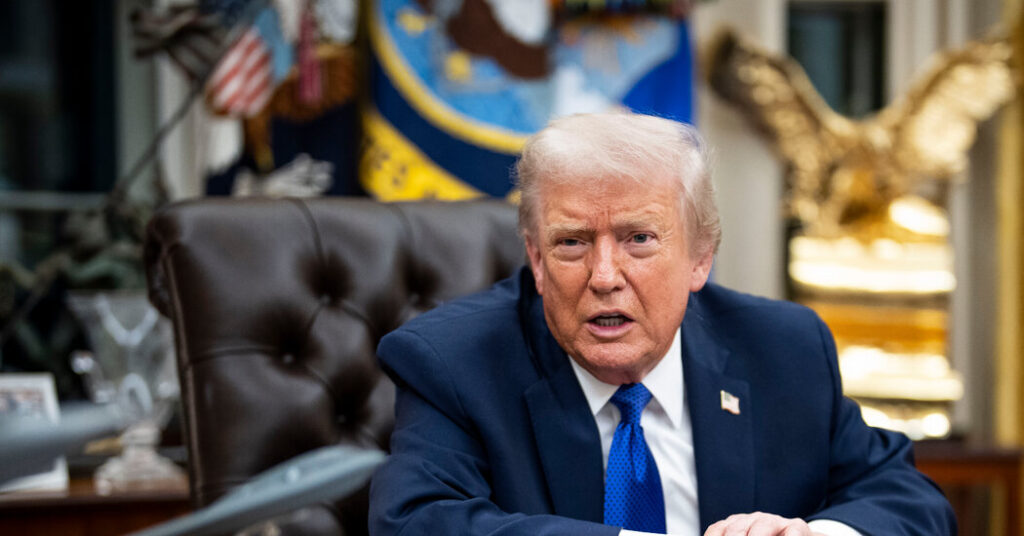
This week, four of my colleagues sat down with President Trump for a rare, wide-ranging interview that lasted nearly two hours. They listened in on a lengthy call Trump took from Gustavo Petro, the president of Colombia. They watched, along with the president, a video of an immigration agent fatally shooting a 37-year-old woman in Minnesota. Then they were led on a walk through the residence.
Trump talked about last weekend’s attack on Venezuela and his plans to annex Greenland. And he made clear that, in his mind, he could — and would — continue to make use of American power for profit and political supremacy. More below.
‘The only thing that can stop me’
President Trump did not hold back.
Sitting behind his desk in the Oval Office, where he keeps a model of the B-2 bombers used in last year’s strike on Iran’s nuclear program, Trump told The New York Times that the United States would remain in charge of Venezuela for as long as he wanted — maybe for years. He said he wouldn’t be happy with anything short of “ownership” of Greenland. He said Europe had to “shape up” and that NATO was useless without the United States.
And he said that he did not feel constrained by any international laws, norms, checks or balances.
Asked by my colleagues if there were any limits on his ability to use American military might, he said: “Yeah, there is one thing. My own morality. My own mind. It’s the only thing that can stop me.”
“I don’t need international law,” he added. “I’m not looking to hurt people.”
It was the most blunt acknowledgment yet of Trump’s worldview: It is national strength alone that should be the deciding factor when nations’ interests collide. Past U.S. presidents, he believes, have been too cautious when it comes to exercising American power.
Trump sounded emboldened by his recent successful Venezuela operation. He was dismissive of the norms of the post-World War II order, which the U.S. helped establish, as an unnecessary burden.
Asked whether his actions might provide a precedent in Ukraine or Taiwan, he shrugged off the idea. President Xi Jinping of China, he said, wouldn’t dare attack Taiwan on his watch.
“He may do it after we have a different president, but I don’t think he’s going to do it with me as president,” he said.
We’ve rounded up some more highlights from the interview below. You can follow our coverage here.
Venezuela
Trump said he expected that the U.S. would run Venezuela and extract oil from its huge reserves for years, insisting that the interim government of the country — run by loyalists aligned with the now-imprisoned Nicolás Maduro — is “giving us everything that we feel is necessary.”
“We will rebuild it in a very profitable way,” Trump said. “We’re going to be using oil, and we’re going to be taking oil. We’re getting oil prices down, and we’re going to be giving money to Venezuela, which they desperately need.”
Yesterday, the Senate voted to take up the resolution that would rein in Trump’s power to use military force in Venezuela, a striking rebuke. Senator Rand Paul of Kentucky said the president’s comments to The New York Times may have tipped the vote.
Greenland
Trump talked about his designs on Greenland, which is controlled by Denmark, a NATO ally.
It was not enough, in his view, to exercise the U.S. right, under a 1951 treaty, to reopen long-closed military bases on the huge landmass.
“Ownership is very important,” Trump said. “Because that’s what I feel is psychologically needed for success. I think that ownership gives you a thing that you can’t do with, you’re talking about a lease or a treaty. Ownership gives you things and elements that you can’t get from just signing a document.”
When asked which was his higher priority, obtaining Greenland or preserving NATO, Trump declined to answer directly, but acknowledged that “it may be a choice.”
Colombia
During the interview, Trump took a lengthy call from President Gustavo Petro of Colombia, who was clearly concerned after repeated threats that Trump was considering an attack on the country similar to the one on Venezuela. Trump invited my colleagues to stay and listen, though what they heard was off the record.
“Well, we are in danger,” Petro told a separate set of my colleagues just before the Trump call. “Because the threat is real. It was made by Trump.”
The ICE shooting
On Wednesday, just hours before the interview, an Immigration and Customs Enforcement agent shot a 37-year-old woman in Minneapolis. Trump said she had been at fault because she had tried to “run over” the officer.
Trump stuck to his position even as my colleagues pointed out the inconsistencies in his account and the lack of clarity in videos circulating on social media. “She behaved horribly,” Trump said. “And then she ran him over. She didn’t try to run him over. She ran him over.”
After the interview, a Times analysis of footage from three camera angles showed the motorist had been driving away from — not toward — a federal officer when he opened fire. The Times analysis showed that the officer had not actually been run over.
Our White House correspondent Zolan Kanno-Youngs has more in the video above about how the president reacted to the shooting.
OTHER NEWS
-
Iran is suffering a nationwide internet blackout, monitoring groups said, as the government cracked down on protests.
-
Venezuela announced the release of political prisoners, a gesture of change by the new administration in Caracas.
-
Russian strikes on energy sites in Ukraine left more than half a million households without heat and power in the region around Dnipro.
-
Trump announced that the U.S. was withdrawing from the U.N. Framework Convention on Climate Change, which forms the basis for countries to rein in global warming.
-
The Lebanese military said that it completed the first phase of a plan to disarm militant groups like Hezbollah.
-
Saudi Arabia accused the United Arab Emirates of helping a separatist leader escape Yemen, escalating the feud between the two U.S. allies.
-
Cambodia extradited a man accused of running a crypto scam to China, a sign that the country may be yielding to pressure to crack down.
-
Forecasters in Australia warned of potentially catastrophic fire conditions from a searing heat wave.
TREND OF THE DAY
Ear seeds
— An acupressure tool, ear seeds are tiny objects gently pressed into different points on the ear. Proponents claim that they help to manage symptoms of anxiety, stress and addiction, but their effectiveness is understudied. Flashier versions are now a favorite of influencers, athletes and models.
MORNING READ
The director Abel Ferrara is a folk hero of New York’s independent film scene for cult classics like “King of New York” and “Bad Lieutenant,” which depict the city’s bygone, sleazier days. But over the past decade, he has made a new life for himself in Rome, where he continues to make movies.
“Here, they call me ‘maestro,’” Ferrara, 74, said. “They know I’m a filmmaker. That’s special to them. In New York, who cares?”
Ferrara discussed his recently published memoir, “Scene,” which provides a harrowing account of the heroin addiction that was nearly his undoing, and his role as a vengeful gangster in the buzziest film of the season, “Marty Supreme.” Read more.
AROUND THE WORLD
A city rises, slowly, in an Indonesian jungle
A new metropolis is rising from scratch in a remote corner of Borneo. But three years after the project began, many Indonesians describe it as a ghost city.
The city, Nusantara, is billed as Indonesia’s future capital. The project was part of a pitch by Joko Widodo, when he was president, to move the capital from Jakarta, which is sinking into the Java Sea. For now, the area is still mostly trees. And for all of its greenery, there is very little shade, making the midafternoon heat unbearable. The availability of water is uncertain.
“It’s impossible to turn back now,” said a former minister, who initiated the relocation of the capital. “Canceling it would only make everything that’s been built go to waste.” Read more.
THE WELL CHALLENGE
For Day 4 of the challenge, we want you to push yourself out of your cognitive comfort zone.
Research shows that people who have more years of education, more cognitively demanding jobs or more mentally stimulating hobbies all tend to have a reduced risk of cognitive impairment as they age. Check out an online lecture or visit a museum. Or try your hand at a new game.
Have brain health tips to share from your country? Email me at [email protected].
RECIPE
You may have seen this treat featured on Netflix’s “Squid Game.” Crunchy with a light snap, dalgona candy has a distinctive, toasty sweetness. You can make it at home with only two ingredients and attention at the stove.
WHERE IS THIS?
Where is this snowy scene?
BEFORE YOU GO …
I spent New Year’s Eve with old friends in Portugal. We danced on the roof, watching a sky lit up by fireworks. Happy. That was 10 days ago. It feels like another era.
I was utterly charmed by Lisbon. I had never been. The food, the views, the history, the ocean, made this one of my favorite cities in Europe.
Did I mention the food? Try brunch at Hello, Kristof in Bairro Alto, and dinner at O Palmeiral, a tiny restaurant in Príncipe Real. Also: A Cevicheria, a Peruvian local spot with a massive octopus hanging from the ceiling.
The surprise highlight of our trip, though, was a museum focused on the 1755 earthquake, which swallowed up Lisbon and accelerated the demise of the Portuguese empire. It took place on All Saints’ Day, when everyone was in church. A quarter of Lisbon’s population died. A tsunami that followed 90 minutes later finished off what the quakes and raging fires hadn’t already destroyed.
The museum is awesome. Totally immersive and compelling. You become part of a mission to recover some 18th century documents and take a trip in a time machine to experience the quake yourself, learning about tectonic plates and colonialism along the way. Think “Indiana Jones” meets “Back to the Future.” My kids loved it. Even the grumpy teens.
It was also a reminder that the one constant throughout history is radical change. Who knows what this year will bring? That’s why my New Year’s resolution is to dance on more roofs.
If you want to practice your moves, here’s an irresistible gem of Brazilian funk: “Compacto” by Curumin.
Have a peaceful weekend. — Katrin
TIME TO PLAY
Here are today’s Spelling Bee, Mini Crossword, Wordle and Sudoku. Find all our games here.
We welcome your feedback. Send us your suggestions at [email protected].
Katrin Bennhold is the host of The World, the flagship global newsletter of The New York Times.
The post An Interview With Donald Trump appeared first on New York Times.