When Michael Mann has been asked about how he became a director, he has often pointed to his experience seeing the G.W. Pabst drama “The Joyless Street” (1925) in a college film-history course.
It was “a freezing, crystal-clear night, where you could see every star in the sky,” he recalled in a talk at the Brooklyn Academy of Music in 2016. “And it just suddenly struck me, ‘you’re going to make film.’ And it’s one of the two or three times in my life that you’re kind of assaulted with total knowingness.”
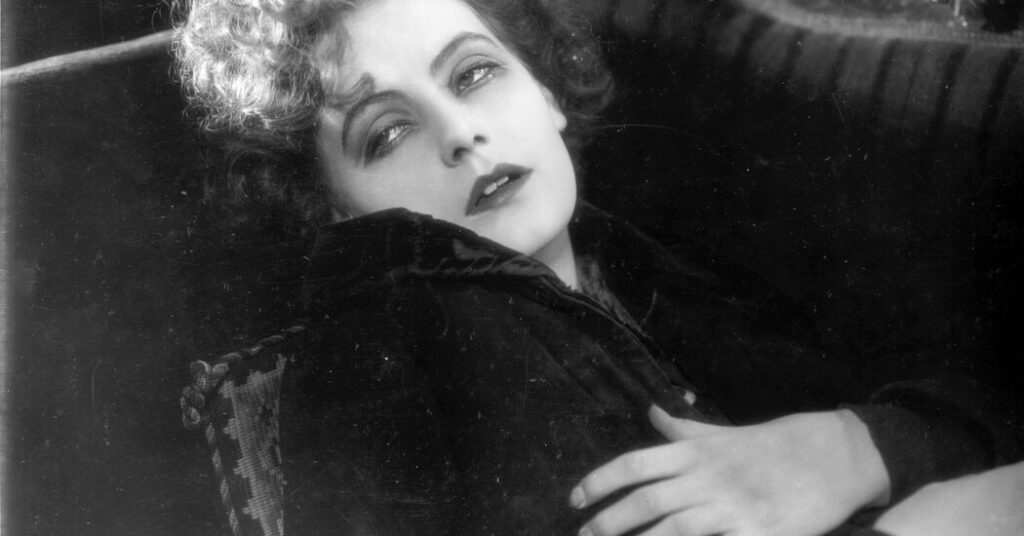
But what Mann saw that night in the 1960s was almost certainly just a fraction of Pabst’s movie. The Weimar-era landmark, starring Greta Garbo, is notorious in film circles for the many different ways it was cut up, nearly from the start of its existence.
The latest restoration will screen in the Museum of Modern Art’s annual To Save and Project series, which is devoted to film preservation.
There are many must-see titles in this year’s edition, which begins Thursday: “Mazurka” (1935), a Pola Negri melodrama from Willi Forst, an Austrian director with a sophisticated visual sense; “Bashu, the Little Stranger” (1986), from the Iranian filmmaker Bahram Beyzaie, who died last month; and MoMA’s own restoration of Russ Meyer’s “Vixen!” (1968), a superlative skin flick that turns into a lunatic Vietnam-era satire.
But “The Joyless Street,” showing Jan. 19 and 22, illustrates how the concept of preservation is often a moving target. This centennial effort is the fourth time the Munich Filmmuseum has tried to reconstitute Pabst’s original vision, after restorations in 1989, the 1990s and 2009.
This one — fingers crossed — is definitive, but who knows? Compared with the film length documented by the German censors in 1925, three days before the premiere in Berlin, perhaps 15 or 20 minutes are still lost. “But we have no idea what could be missing,” Stefan Drössler, the head of the film museum, said by video call. “We cannot find in the screenplay a scene where we know it was shot and it is not in the film.”
The making of “The Joyless Street” was a tumultuous saga of its own. The film was based on a novel by the Jewish newspaperman Hugo Bettauer, who was murdered by a Nazi-aligned student at the time of the shoot. The production was so hurried, Drössler said, that the premiere was postponed from April until May. The screenplay was by the renowned Jewish author and film critic Willy Haas, who later fled Germany. Today, Pabst is best known for his subsequent collaborations with Louise Brooks — and, after that, for making movies under the Third Reich.
Whether “The Joyless Street” was ever shown in Pabst’s ideal version is a bit murky. That was probably the case at the premiere, Drössler said, although the show times from that night don’t align with what we know about the film’s length, unless the film was run very rapidly. The German censors kept detailed notes on original intertitles and reel lengths, sending cards to theaters so that they could know they were showing the approved version. But no censorship cards for “The Joyless Street” have ever been found. If they were, Drössler said, they “would help us a lot.” And by the time “The Joyless Street” was resubmitted to German censors in early 1926, it had already been cut.
If you’ve encountered any version of “The Joyless Street” in the United States, you know it as a film in which Garbo’s character, Grete, faces repeated humiliations in post-World War I Vienna — waiting in line for hours at a butcher shop or taking degrading work after her father loses his pension in an investment.
In 2022, the George Eastman Museum in Rochester, N.Y., screened an original American release print from 1927, when the film was known here as “Street of Sorrow.” It ran only 75 minutes at 17 frames per second. Circulating versions — including, probably, the one Mann saw in the 1960s — have run at similarly abbreviated lengths. (Mann declined to comment.)
By contrast, the version playing at MoMA runs 155 minutes at 19 frames per second. Grete is now part of a societal panorama, built around an ensemble of five women. The others are Marie (Asta Nielsen), who is spurned by a bank clerk; Regina (Agnes Esterhazy), the daughter of the clerk’s boss; Lia (Dorothea Thiele), an unfaithful upper-crust wife; and Else (Hertha von Walther), a starving mother who is raped — offscreen — by the butcher. The plot includes not one but two murders that some versions excise. And the ending is different from the one many have seen, although Drössler said there was some ambiguity about the correct order of the closing scenes.
It is, in other words, a completely transformed movie.
“There were many versions of this strange film. And in my eyes, it is maybe the worst-butchered German silent film of the time — worse than ‘Metropolis,’” Drössler said, referring to Fritz Lang’s science-fiction classic. “‘Metropolis’ was only cut down once by the censors. Here we have the censorship of all the countries where it was shown. Every country cut out something.”
The big jump in running time, Drössler said, came almost immediately, when a predecessor, Enno Patalas, added material from a Russian print in the 1989 effort. Jan-Christopher Horak followed Patalas and detailed in a 1998 essay his meticulous reconstruction of the narrative using prints from London, Paris, Milan, Moscow and Rochester. Then and now, some subjective decisions were involved. Among other difficulties, “The Joyless Street” adhered to the silent-era practice of making multiple negatives to create sufficient prints. The shots in each negative were slightly different.
The 2009 version, Drössler said, further refined the structure in light of new evidence and improved the intertitles and tinting. The latest version, a two-year effort, took advantage of digital tools to better integrate the materials, so that it’s no longer as apparent to viewers that the film has been Frankensteined.
“We went really frame by frame, repairing images, to get stability into it, so that you can focus more on many little details,” Drössler said. “And of course we found little editing things. There are some shots which are 15 frames longer than they were before. There was even a scene — and we were very proud — now you can see a person really leaving the room. Before, she was only going to the door. Cut!”
Probably all the film material that exists has been discovered, Drössler said, but it’s hard to say. “We were all very, very convinced that ‘Metropolis’ came to an endpoint when the restoration was done around 2001.” Seven years later, he added, “suddenly, in Buenos Aires, the 16-millimeter print showed up — and was available all the years it was shown!”
To Save and Project runs through Feb. 2 at the Museum of Modern Art. For more information, go to moma.org.
The post An Astonishing New Look at the Movie That Inspired Michael Mann to Direct appeared first on New York Times.