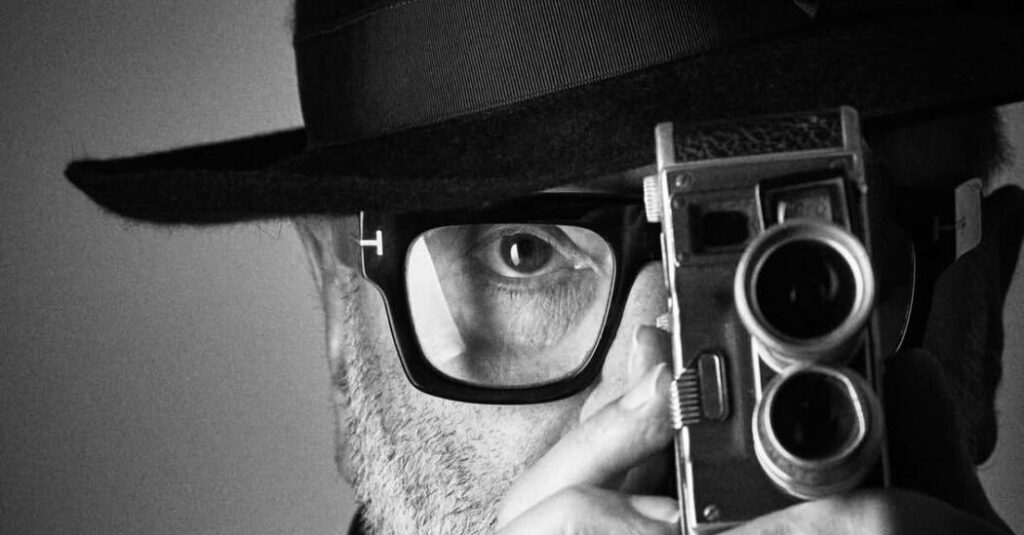
Amos Poe, the godfather of New York’s No Wave cinema, the scrappy, experimental, do-it-yourself movement that mirrored the music scene from which it took its name, died on Dec. 25 at his home in Manhattan. He was 76.
The cause was colon cancer, his wife, Claudia Summers, said.
At 22, Mr. Poe was already an ardent cinephile, a devotee of the convention-breaking French New Wave and the films of Andy Warhol, when he dropped out of the State University of New York at Buffalo in 1972 and drove his pickup truck to New York City with Barbara Brooks, a philosophy major who was then his wife.
He had made several films already, including one in which he reshot Orson Welles’s 1941 classic “Citizen Kane” as it was projected on a screen, zooming way in on images like Mr. Welles’s mustache. “Amos Poe’s Citizen Kane,” he called it.
His first week in Manhattan — having secured an apartment on St. Marks Place for $71 a month and a job as an editor and cameraman at a porn studio on 18th Street — he made a few more films. One of them, “Banana on Asphalt,” involved lobbing a banana onto the street and filming as the traffic reduced it to a pulp.
The East Village in the 1970s was a small town of striving outsiders and contrarians making art, music and film, and Mr. Poe fell in with them. He befriended Richard Hell of the band Television, who introduced him to CBGB, the grotty incubator of punk and post-punk bands. No Wave was a catchall phrase that described the anti-commercialism that most of the cohort embraced. The term may have been coined by Lydia Lunch, of the band Teenage Jesus and the Jerks, or by an anonymous graffiti artist who spray-painted the phrase on the walls of the club. In any case, it stuck.
Mr. Poe began filming the young musicians playing downtown clubs — Patti Smith, Mr. Hell, the Ramones, Blondie, David Byrne and others — using a camera with no sound. With his friend Ivan Kral, who later played guitar with Ms. Smith’s band, he rented an editing room from the Maysles brothers, the documentarians who had made “Gimme Shelter” and “Grey Gardens.” There, they added music from the bands’s demo tapes, though not in sync with the performances, and put together a movie. He and Mr. Kral had only $100 between them, which paid for 24 hours in the editing room, so they took a lot of speed to get it done.
“The Blank Generation,” a title they chose from a song of Mr. Hell’s, is glitchy and rough, with sound untethered to the action. That was intentional, Mr. Poe always said. It’s a home movie of the scene in 1976 and a homage to a group of young musicians poised on the brink of fame. Shown at midnight screenings in art-house theaters around the country, it made Mr. Poe’s reputation as an underground auteur.
Mr. Poe also made semi-narrative features, including “Unmade Beds” (1976), a goofy nod to Jean-Luc Godard’s seminal 1960 New Wave film “Breathless,” starring locals like Debbie Harry, the filmmaker Eric Mitchell, the artist and dandy Duncan Hannah, and Patti Astor, who later made a name as a gallerist.
Only 12 people showed up for the first screening on 42nd Street, but the film was chosen for the Deauville American Film Festival in France in the fall of 1977, where it was screened along with “The Blank Generation.” After one of Mr. Poe’s heroes, the filmmaker Claude Lelouch, savaged both movies to the press, “Unmade Beds” became a minor hit and Mr. Poe and his entourage minor celebrities.
Ms. Harry and most of the “Unmade Beds” crew also appeared in “The Foreigner,” Mr. Poe’s next film, an endearingly moody tale of a French secret agent adrift in New York City on a mysterious mission and stalked by mysterious foes; it starred a gloomy Mr. Mitchell, who exudes existential ennui.
When the movie was shown at the Whitney Museum of American Art in 1978 as part of the New American Filmmakers Series, The New York Times panned it, calling it “the cinematic equivalent of kindergarten scribbles,” a descriptor that delighted Mr. Poe, who slapped it on subsequent movie posters.
“It was like punk rock,” Mr. Mitchell, who had begun making his own films by then, said in an interview. “You could be a punk rocker by knowing three notes. And you could be a filmmaker by shooting a 16-millimeter film any way you wanted it to be. Everything was done on a whim and a wing. Sometimes it was good, sometimes it was embarrassing. That was the beauty.”
The slapdash nature of the work was the point, and Mr. Poe’s celebration of amateurism — and his hat tips to the canon of earlier avant-garde and experimental cinema — made him a mentor and a hero to up-and-coming filmmakers like Jim Jarmusch, who recalled following him and Mr. Mitchell around like a dog, Mr. Jarmusch said in an interview.
“It was all pretty casual,” Ms. Harry said in an interview. “We were just all so high on the spirit of the times, and Amos was going to be Godard, and we were going to be whoever we were.”
Mr. Poe, a charismatic figure who favored vintage suits and homburgs, was devoted to his own methods and rebel ethos, but he hankered for more mainstream success, or at least a distributor.
He had a near miss with “Rocket Gibraltar” (1988), a dark comedy starring Burt Lancaster. Mr. Poe had written the story of a patriarch reuniting with his large family as he nears death “as a sort of ‘Alice in Wonderland’” for his daughter Emily, who appeared in the film, he told The Times. It was wanly reviewed in the paper by Janet Maslin, who liked the cast but not the script. Mr. Poe was supposed to direct the movie but was fired halfway through the production, apparently for budgetary reasons.
“Triple Bogey on a Par 5 Hole” (1991), which Mr. Poe wrote, directed and produced, fared better critically but failed to find a distributor. A charmingly oddball film, it’s a dark comedy involving the children of two crooks (killed during a holdup on a golf course) who live on a yacht floating around Manhattan.
“‘Triple Bogey’ is not your ordinary run-of-the-mill independently made movie,” Vincent Canby wrote in his review for The Times. “It’s a sweetly demented original, a shaggy-dog story told with utmost gravity.”
Amos Porges was born on Sept. 30, 1949, in Tel Aviv. His mother, Inge (Winterfeldt) Porges, had emigrated from Berlin; his father, Stephen Porges, had emigrated from Prague and worked as a power company executive.
When Amos was 8, the family moved to East Meadow, N.Y., on Long Island, where his father owned a string of small businesses, and his mother worked as a seamstress and Hebrew teacher. By the time Amos dropped out of SUNY Buffalo, where he met Ms. Brooks, he had changed his surname to Poe. (He thought it sounded cool.) The couple married in 1972.
Indie filmmaking is not the most lucrative profession and, although Mr. Poe worked consistently on films and music videos, he was also consistently broke, he told The Times in 2020, and “hitting bottom on behaviors I wasn’t very proud of.”
Around 2011, Mr. Kral, his partner on “The Blank Generation,” sued him for not sharing the profits, such as they were. The judge ruled in Mr. Kral’s favor — Mr. Poe was teaching in Italy at the time and skipped their court date — granting him more than $100,000 for legal fees, profits and other costs, as well as the rights to four of Mr. Poe’s films, including “The Foreigner” and “Unmade Beds,” his only real assets, at $10 a film. In 2018, Mr. Poe filed for bankruptcy.
In 2021, Rolling Stone magazine declared “The Blank Generation” one of the 25 “greatest punk rock movies of all time.”
Mr. Poe’s marriages to Ms. Brooks and Sarah Charlesworth, an artist he married in the early 1980s, ended in divorce.
In addition to Ms. Summers, whom he married in 2019, he is survived by a daughter, Emily Poe, from his marriage to Ms. Brooks; two children, Nick Poe and Lucy Charlesworth Freeman, from his marriage to Ms. Charlesworth; two sisters, K. Shelly Porges and Alexandra Poe; and four grandchildren.
For more than two decades, Mr. Poe taught filmmaking at New York University’s Tisch School of the Arts and then the Feirstein Graduate School of Cinema at Brooklyn College. He was an unorthodox teacher, as the filmmaker Jaime Levinas, who studied directing with him at Feirstein, wrote recently in Filmmaker magazine. Prompts might include, “Why don’t you make one character really tall and the other one a midget?” or “What if he had an eye patch and talked through one of those throat speakers?”
If the color was off, Mr. Levinas recalled, Mr. Poe suggested making the film in black-and-white. And if a take was out of focus, he’d say, “Move on.”
As Mr. Poe explained to his students, “What’s more interesting is what’s not in focus.”
“What I really wanted to do,” Mr. Poe told an interviewer in 2021, “was start another Nouvelle Vague, our own New Wave. So my emphasis wasn’t so much on a particular film, because I knew it would get lost. The culture is so big in America, nobody would see a little 16-millimeter film that purports to be ‘Breathless.’”
He added: “But I thought that if I could make this film and finish it and get it out there, other people would start making films, too. And if five or 10 others were making these kinds of films in the same neighborhood, then the culture would have to pay attention, somehow.”
Penelope Green is a Times reporter on the Obituaries desk.
The post Amos Poe, New York’s No Wave Film Pioneer, Dies at 76 appeared first on New York Times.