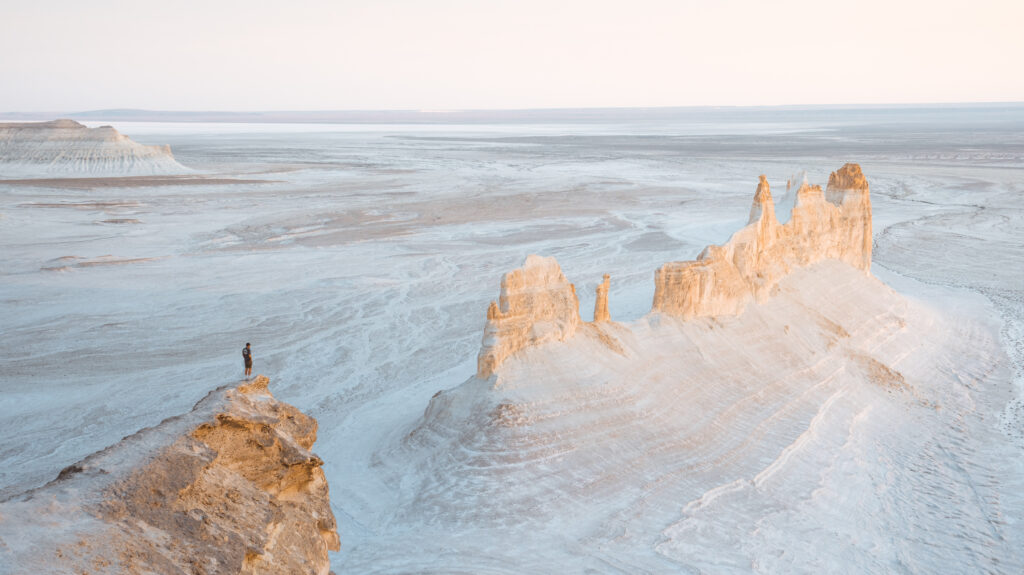
AKTAU, Kazakhstan — The Toyota 4×4 bounced across a roadless, barren plain. Behind, a cloud of pale dust shimmered in the sun. Ahead, a formation of bleached rocks shot skyward.
Our SUV was heading straight at it. And it was not slowing down.
Was our guide playing chicken … with a mountain?
“Anton,” I said as the white wall loomed closer.
“Anton.”
My hand braced against the dashboard.
“Anton.”
His eyes turned to me.
“Are we going … up?”
From behind the wheel, he gave me a look of quiet amusement: “Da.”
My seat tipped sharply back as the walkie-talkie erupted with shrieks and whoops from the Jeep behind us. It was like we had entered our own improbable car commercial, with the scenery to match.
Exiting our vehicles in the saddle between two limestone peaks, we gazed over a lunar landscape that more than rivals Monument Valley.
The valley we were looking across was once submerged under the prehistoric Tethys Ocean. Then, the land shifted. Pangaea broke up, the waters retreated and the elements worked for millennia to shape fossil and rock into massive geological formations. In every direction, great fins of rock, sprawling mesas, and crenulated domes thrust up from a bleached plain.
But what is perhaps most astounding is what we didn’t see: a single other person.
Welcome to the Mangystau region of western Kazakhstan, where the intrepid traveler can — literally — escape the beaten path for a few days.
This is a land that has stood arid and empty for so long that millions of years of history are still in evidence. Visitors don’t have to look too hard to find fossilized mollusks, shark teeth, and sea anemone scattered on the ground, mementos from when the Ustyurt Plateau lay deep underwater.
More recent history encompasses the ruins of a caravansary that sheltered traders on an offshoot of the Silk Road.
While that route faded to obscurity after Genghis Khan rolled in with his Horde, many of the region’s Sufi temples, necropolises and mosques — the earliest of which were carved into caves more than a thousand years ago — still show signs of being in use.
The geological features of the region tell stories of their own. In addition to the otherworldly spires of Bozzhira, where our Toyota demonstrated its vertical capabilities, intrepid visitors can brave the bare roads of Cape Zhigylgan, a miles-wide depression strewn with rocks the size of buildings. From a distance, it looks as if a giant once sat on the shore of the Caspian Sea and crushed the land beneath her.
That landscape could not be more different from the smooth, confectionary layers of a formation, aptly dubbed “Tiramisu,” that our group explores a few days later. Anton told us that local efforts to hide the location of this photogenic site were foiled by an enterprising tourist with GPS.
On the shores of the shimmering salt sea of Tuzbair, the serious photographers in our group capture undulating white cliffs and the water’s pastel hues, while the less-serious ones take advantage of the wide, flat beach to stage elaborate optical illusions.
Another opportunity for high and low art comes in Torysh, or the “Valley of the Balls,” where hundreds of spherical rocks ranging from pebbles to boulders dot the landscape. Scientists still don’t agree on exactly how they formed; I prefer the local theory that the valley was the playroom of the gods.
Perhaps the bigger mystery is how this region has flown under the radar for so long. Some visitors may be deterred by the desert conditions, remote locations or lack of infrastructure, though brief encounters with Russian, Chinese and Italian tourists suggest that Americans could just be late to the party.
If you decide to see for yourself, the gateway to Mangystau is Aktau, a city on the Caspian Sea that was dubbed the 2025 Culture Capital of the Turkic World.
As one of the hubs in Kazakhstan’s booming trade in oil, gas and minerals, Aktau is well-served by several airlines. International travelers can fly direct to and from Istanbul; Tbilisi, Georgia; or Baku, Azerbaijan, though it’s worth staying on in Kazakhstan to explore the current and former capitals of Astana and Almaty, both reachable by direct flights of roughly three hours — a reminder that this is the ninth-largest country in the world by area.
While still scruffy, Aktau does offer a long boardwalk to stroll, restaurants with a view, cafes with a modern vibe and several decent hotels.
We stayed in the Turan, a well-reviewed tourist-class option near the sea with a banya that can be booked in advance for some post-desert soaking. It is a bargain at roughly $25 a night, though there’s a case to be made for splashing out roughly three times that amount to stay on the sea in Aktau’s five-star Caspian Riviera Grand Palace Hotel.
Many of Mangystau’s sites can be reached by long day trips from Aktau, but given the distances involved and the poor condition of most roads (where they exist at all), the best way to immerse oneself in the region is through a multiday tour. We arranged everything through Nomadic Travel, a Kazakh company that worked with us to customize our five-day, six-night itinerary. Its manager, Olga Toporkova, connected us with Anton Dikin, our guide, driver and extremely capable cook.
The remoteness of the region means that many nights, camping is the only option. Luckily, most equipment was provided. We brought only our headlamps, toiletries and enough layers to navigate a desert climate where temperatures in late May range from the low 40s to upper 80s.
Our group did opt to spend one night at what can best be described as a yurt motel. We enjoyed a hearty dinner that featured classic Kazakh dishes like beshbarmak (beef and noodles), baursak (fried dough), plov (rice and meat) and kurt (fermented cheese balls), as well as access to a shower and WiFi, but we later agreed that we would have rather woken up in our own tents on the steppe.
Because while we may have been sleeping on mats on the ground, we were hardly roughing it. Anton’s setup included a domed tent large enough to seat us all for meals and secure enough to keep us snug when the winds howled outside. And there are few sensations like quietly cradling a hot drink as the morning sun begins to illuminate the rocks around you and feeling, for a few moments, that your little group has the world to itself.
Thanks to recent and planned infrastructure investments in Mangystau, it’s likely a matter of time before the camels and turtles that dot the landscape are supplanted by paved roads and guardrails.
According to Kazakhstan’s Bureau of National Statistics, the number of visitors at accommodations in Mangystau was nearly 409,000 last year, making up about 9 percent of all visits to resort areas. Most foreign travelers, it seems, come from nearby countries.
Our final night traveling together, we put the question directly to Anton, who has been leading tours in the region for more than a decade. How many other American groups has he worked with?
There’s that look again.
“None.”
Jennifer Mueller is a writer based in Washington, D.C.
The post A Silk Road moonscape, with no Americans in sight appeared first on Washington Post.