Over the past two weeks, Russian authorities tried hard to protect an oil tanker that the Americans wanted to seize. On Christmas Eve, Moscow permitted the ship to fly the Russian tricolor, a symbolic warning for U.S. forces to keep their distance. The Russian foreign ministry then issued a demand for the Americans to leave the ship alone, and the Russian navy provided an escort, which reportedly included a submarine. None of it did any good.
Yesterday, as President Vladimir Putin celebrated Orthodox Christmas on a military base near Moscow, U.S. troops descended from helicopters onto the deck of the tanker, dealing the Kremlin a humiliation such as it has seldom faced on the high seas. Some Russian commentators called the raid an act of war, though the official response from Moscow sounded a lot more cautious: The foreign ministry urged the United States to respect the rights of the Russian citizens on board and to “put no obstacles for their soonest return to the motherland.”
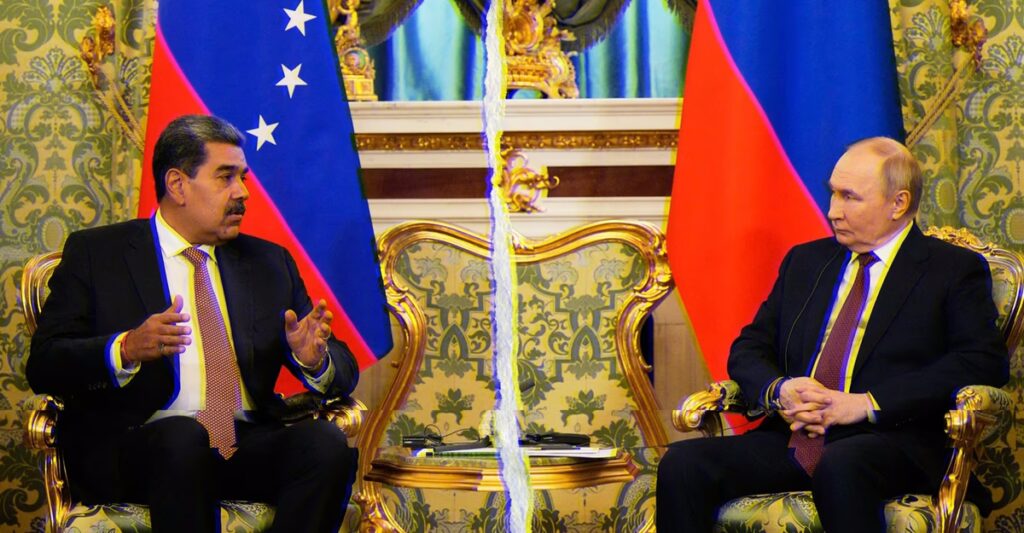
The standoff, reminiscent of the tensest moments of the Cold War, deepened the dilemma Putin faces. The Trump administration kicked off the year with a series of belligerent moves, first sending troops into Caracas to arrest Nicolás Maduro, the leader of Venezuela, then threatening a takeover of Greenland. Putin kept silent as the U.S. brought Maduro, his ally, to New York to face charges of trafficking drugs. While the Russian foreign ministry called on the U.S. to avoid “any further escalation,” some analysts speculated that the U.S. moves against Venezuela might offer benefits for Putin, heralding an era of great-power politics in which the U.S., Russia, and China carve up the world into their spheres of influence. But the American seizure of the tanker, known as the Marinera, was a reminder that between Moscow and Washington, a vast power differential remains.
The U.S. under Donald Trump has aggressively pushed Russia out of Latin America while giving no apparent ground in Europe. That dynamic could change if Trump makes good on his threats to take Greenland from Denmark, a NATO ally. Several European leaders, including Danish Prime Minister Mette Frederiksen, have warned that such a move could spell the end of NATO, granting Putin his long-held wish to dismantle the alliance. In a post on social media yesterday, Trump sought to give his European allies at least a modicum of reassurance. “We will always be there for NATO,” Trump said. The United States under his leadership, he added, is the “only Nation that China and Russia fear and respect.”
[Read: Trump seizing Greenland could set off a chain reaction]
Among Russian pundits and propaganda outlets, reactions to the Marinera’s fate reflected a mix of outrage and defeatism, as they realized that the U.S. has no intention of treating Moscow as an equal. “No one is carving up anything with us,” Dmitry Agranovsky, a Russian TV commentator, wrote on social media. “We are just the next in line.”
Some of the most influential military bloggers in Russia demanded an aggressive response from the Russian navy. “The Americans are not afraid of Russia,” wrote Alexei Dzermant, a political observer in neighboring Belarus, a Russian ally. “There obviously won’t be any trade of Venezuela for Ukraine.”
The idea for such a trade came up during the first Trump administration. Fiona Hill, who oversaw White House policy toward Moscow at the time, told Congress in 2019 that the Russians wanted to “make some very strange swap arrangement between Venezuela and Ukraine,” effectively suggesting that both of the nuclear superpowers should give each other free rein in their respective neighborhoods.
Hill recalled Russian diplomats and state media discussing the return of the Monroe Doctrine, a 19th-century policy in which the U.S. resisted European influence over the Western Hemisphere while staying out of Europe’s affairs. In the spring of 2019, Hill traveled to Moscow on behalf of the White House to reject the notion of swapping Ukraine for Venezuela.
The idea surfaced again this week, when Trump touted the U.S. raid against Maduro as part of a new Monroe Doctrine—or as he called it, the “Donroe Doctrine”—that would shape his approach to international affairs. “American dominance in the Western Hemisphere will never be questioned again,” Trump said in his announcement of Maduro’s arrest, on January 3.
Watching from Moscow, some members of the Russian political elite offered grudging praise for Trump while calling on the Kremlin to move with similar boldness. “Trump is showing us how we need to act,” the imperialist ideologue Aleksandr Dugin wrote on social media. “Right now, all of Russia is asking: Why do we not act this way toward our enemies?”
Dmitry Medvedev, the Putin acolyte and former president who now sits on the Kremlin’s security council, expressed much the same view in an interview with the state-run news agency Tass. He praised Trump and his team for “rigidly defending his country’s national interests, both political (with Latin America being the backyard of the United States) and economic (give us your oil and other natural resources).” In an apparent reference to the invasion of Ukraine, Medvedev added that the U.S. now has “nothing to reproach our country for.”
But the White House has shown none of the reciprocity Moscow seems to expect from what it sees as its fellow superpower. In the afterglow of the U.S. raid on Caracas, the Trump administration seems intent on asserting its claim to being the world’s preeminent decider, capable of imposing its will far beyond the Western Hemisphere. If the seizure of Russia’s ship in the North Atlantic did not make that clear enough, Pete Hegseth, the U.S. defense secretary, stated yesterday that the blockade of Venezuelan oil would be enforced “anywhere in the world.”
That kind of muscle flexing has long infuriated Putin. For nearly two decades, he has made it his mission to push back against what he describes as the hegemonic power of the United States. He first articulated this mission in a 2007 speech in Munich, when he declared that Russia would no longer tolerate the U.S. habit of using its military to get what it wanted. He has railed against American-led interventions in the Balkans, Iraq, and Afghanistan, calling them examples of an unbridled and intolerable “hyper-use of force.”
In 2011, when the U.S. and several of its European allies began a bombing campaign against the forces of Muammar Qaddafi in Libya, Putin lashed out. “What troubles me is not the fact of the military intervention itself,” he said. “I am concerned by the ease with which decisions to use force are taken in international affairs.” In his memoir, The Back Channel, the former diplomat and CIA director William Burns recalls how the death of Qaddafi affected Putin, who would replay footage of the Libyan dictator being dragged from a drainpipe and beaten by insurgents.
Afterward, the Russian president became far more aggressive in trying to counter U.S. military interventions. He sent warplanes in 2015 to defend his ally Bashar al-Assad in Syria from a coalition of insurgent groups and revolutionary forces, some of them backed by the United States. Putin’s defense minister at the time, Sergei Shoigu, later mused that the Russian intervention in Syria had dissuaded the U.S. from seeking to overthrow regimes it didn’t like, thus “breaking the chain of color revolutions,” such as the popular uprisings in Ukraine, Georgia, Kyrgyzstan, and elsewhere.
But the start of the Russian assault on Ukraine in 2022 forced Putin to scale back his global ambitions. He could not stop Islamist rebels from overthrowing Assad in 2024 and evicting Russia from its naval base in Syria. He offered little help to his allies in Iran last year when they came under attack from U.S. and Israeli warplanes. And he did nothing to save his ally in Caracas when Maduro’s turn came to face an American attack this weekend. The weapons that Venezuela had purchased from Russia over the years failed to shoot down a single American helicopter during the operation to detain the Venezuelan leader. “Seems those Russian air defenses didn’t quite work so well, did they?” Hegseth said in a taunting speech on Monday.
It remains to be seen how Russia might answer this latest round of American insults, but Putin’s options are severely limited by the demands of the war he started in Ukraine. The federal budget for the next three years envisions significant tax hikes to finance Russia’s enormous military spending (around 8 percent of GDP), and it will be sustainable only if the price of oil, Russia’s most important export, stays at an average of $70 a barrel.
Last month, the price of Russian crude sank to around half that level, and it could drop even lower if the U.S. manages to tap Venezuela’s oil reserves. One of Russia’s most influential billionaires, Oleg Deripaska, warned of the consequences after the U.S. swept into Caracas. “If our American ‘partners’ get the oil fields of Venezuela,” he wrote on social media, “they will control more than half of the world’s supplies of oil. And it looks like they plan to make sure that the price of our oil does not go higher than $50 per barrel.” At that level, Deripaska warned, it will be difficult for Putin’s version of state capitalism to make ends meet.
[Read: The ‘America First’ president takes on the world]
After the American move to seize Russian oil tankers, the Kremlin’s business model looks even shakier. Russia has relied on a “shadow fleet” of tankers to transport its oil to clients in China, India, and Turkey in circumvention of Western sanctions on its energy industry. The seizure of the Marinera suggests this loophole will continue to tighten, leaving Putin less room to maneuver on the global stage, or even to finance his nearly four-year-old war in Ukraine. Yesterday morning, the U.S. seized another oil tanker close to Venezuela, suggesting its campaign against the Russian shadow fleet is just beginning.
The post A High-Seas Gambit Humiliates Putin appeared first on The Atlantic.