The next new member of the D.C. Council won’t be elected by voters — but will instead be selected by the council itself as soon as this month, in a process that has already elicited frustration from some lawmakers.
Council member Kenyan R. McDuffie (I-At Large) resigned from the council effective Monday to set up a mayoral run. D.C. law says it is up to the council to select an interim replacement, but the law is vague on exactly how lawmakers should go about choosing their new colleague.
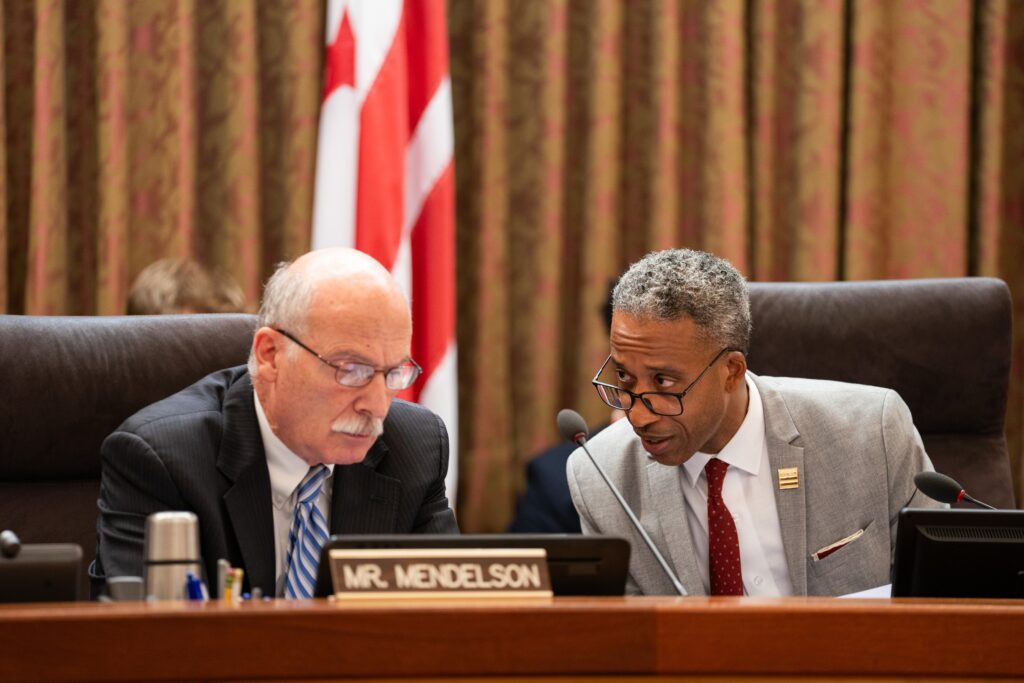
That has left council members to hash out a process among themselves — and opened the door to infighting. Council Chairman Phil Mendelson (D) has told lawmakers that dozens of potential candidates have been informally brought to him, and that he planned to fill the vacancy by talking to lawmakers, making a selection that he thought a majority would support, and putting that person to a vote by the full council later this month.
Not all on the council are on board with that plan.
“I feel like we owe it to residents and the process to be very clear on what we’re doing, and I don’t think that has happened yet,” said council member Christina Henderson (I-At Large).
D.C.’s Home Rule Act, which lays out the processes for filling council vacancies, says that when an at-large seat becomes vacant, the political party of the departing council member should choose an interim replacement to serve until a special election can be held. When the seat is held by an independent like McDuffie, however, the law says “the Council shall appoint a similarly non-affiliated person to fill such vacancy until such vacancy can be filled in a special election.”
The special election must be held between 70 and 174 days after the seat becomes vacant; a scheduled June primary falls within that window, and D.C. Board of Elections spokeswoman Sarah Graham said in an email that the board would meet next week to set the date. Then there will be a second election to permanently fill the seat in November, meaning the job could change hands multiple times this year.
But the interim council member selected this month could make consequential decisions — particularly because the vote on next year’s budget could fall during their tenure.
At-large vacancies have been filled in the past by the Democratic Party’s state committee. But this situation, where the council is asked to choose an interim lawmaker with no party affiliation, is unprecedented.
“I can’t say I wish [the decision] on anybody,” Mendelson said in an interview. “I mean, I think there’s some logic behind it, but it’s also fraught.”
Mendelson said Tuesday morning that at least 30 people had nominated themselves — or been suggested by someone else — for the role. By the afternoon, after a couple more emails hit his inbox, the list had grown to 32.
“If I don’t make the decision by tomorrow, it’ll probably be 34. Or by Friday, it’ll be 40,” Mendelson said.
The chairman declined to share who was on the list. Some people had been referred by someone else, perhaps without their knowledge, he said. Most of the candidates had nominated themselves. “Many” were former council members, he said.
At the council’s breakfast meeting Tuesday morning, it was clear that lawmakers were not in agreement about how to move forward with soliciting nominations and narrowing the list.
“I was hoping, maybe, we could do a more transparent, and fair, equitable process?” Janeese Lewis George (D-Ward 4) said after hearing Mendelson describe his plan.
Council member Zachary Parker (D-Ward 5) argued that Mendelson was exercising too much power.
“He will handpick who he thinks it should be and put it forth, probably after whipping votes with people,” Parker quipped. “That’s not a process. And I would just say, the [home rule] charter says ‘the council,’ not ‘the chairman,’ respectfully, so if members don’t agree with that process then we have within our means to come up with a process that we do agree with.”
Lewis George and others asked for the candidates’ names and resumes to be circulated for all lawmakers to see — but Mendelson said he preferred to discuss them individually with council members to prevent leaks to reporters. “It would be a mistake for me to circulate those names,” he said during the meeting. “That will be in the press immediately.”
He said later that he was thinking about whether and how to make a short list of candidates public.
Mendelson also said he was hesitant to lay out strict criteria. For example, he said, he could see arguments in favor of a fresh voice from outside the D.C. government — but also for someone with experience who would be ready to dig into the budget on day one. He could see the arguments both for and against someone who only wants the role on an interim basis — plus, he added, people could change their minds about whether to run in the special election.
Lawmakers who oppose Mendelson’s approach have started coming up with their own. Brianne K. Nadeau (D-Ward 1) and Lewis George started working on a list of questions to send each candidate. Robert C. White Jr. (D-At Large) said he thinks the council should come up with “objective criteria” that focus on policy ability, ability to represent diverse wards, and ethical standards, then stand up a vetting committee to hold public interviews with each candidate and make a recommendation to the full council.
Henderson said she believes that whoever emerges as the council’s pick should face some form of public scrutiny, but she cautioned against opening up the process too much. The law says it is the council’s job to decide; “it doesn’t say the mayor, it doesn’t say the business community, it doesn’t say advocates,” she said. Voters, she said, would have the opportunity to weigh in during the special election and again in November.
Henderson also stressed how important the decision was, given that the appointed council member could end up voting on the city budget. She said she was asking candidates tough questions about how they would approach city finances.
“It’s kind of like speed dating — but policy,” she said.
In a video posted on social media Tuesday, council member Charles Allen (D-Ward 6) said he would prefer that voters decide, but the law does not allow that. He acknowledged that if the person they pick runs in the special election, the council could be “putting their thumb on the scale” to that person’s advantage.
The debate over how to fill McDuffie’s seat comes ahead of a primary election that could significantly shake up D.C. politics — with the mayor’s office and multiple council seats up for grabs because the incumbents have chosen not to run. While McDuffie has not officially filed to run for mayor, Lewis George has, and White and council member Brooke Pinto (D-Ward 2) have both announced runs for Congress. To run as a Democrat rather than an independent, McDuffie would have to have vacated his council seat — a choice his colleagues did not have to make.
Mendelson, asked at a news conference Monday about how he would work to prevent the appearance of bias in the process to replace McDuffie, seemed resigned that he would be accused of tipping the scales.
“I’m thinking through it, but there’s not really much that I can do about it,” he said. “Whoever I select to nominate is going to be unwanted by some people, and they’re of course going to say that it was unfair.”
Mendelson also pushed back against some lawmakers’ suggestion that he was monopolizing the process.
“Given the fact that I have to pick somebody who has consensus from at least a majority of the council members, it is inaccurate to say that,” he said in an interview on the dais Tuesday after the council’s legislative business ended for the day.
It was early afternoon when Mendelson finished answering reporter questions. Then, he left the dais and returned to his growing email inbox.
The post Why D.C.’s next council member will be chosen by lawmakers, not voters appeared first on Washington Post.