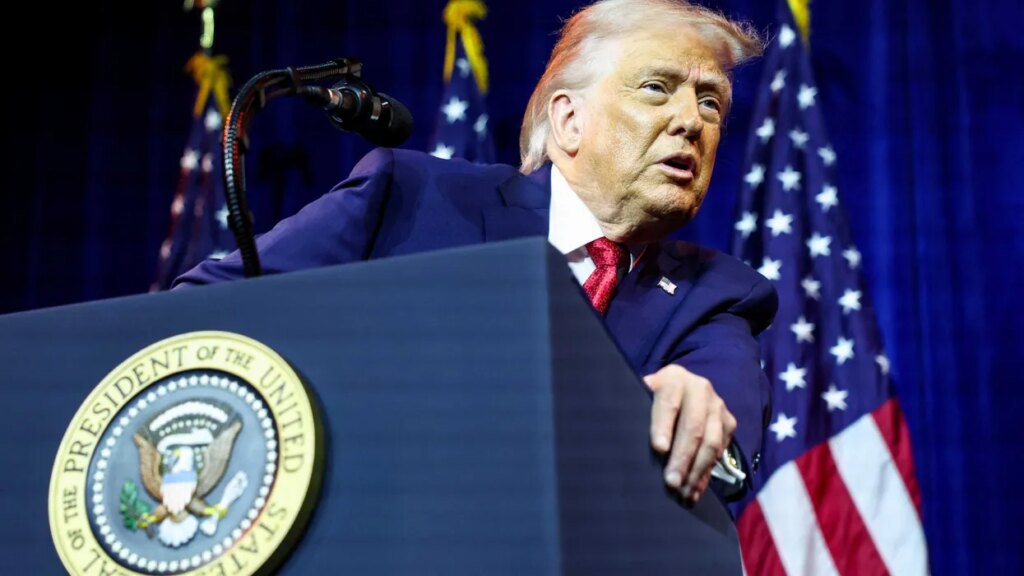
PORTLAND, Ore. — One year into President Donald Trump’s second term, Democratic attorneys general have filed 71 lawsuits against the administration.
There’s more to come in 2026. The lawsuits are part of a coordinated legal strategy by Democratic AGs in 22 states and the District of Columbia to resist the ever-widening power of the executive branch.
It’s not unusual for states to sue an administration; the party not in the White House has often turned to the courts. But it’s one of the few pathways for Democrats now, since Republicans hold the presidency, both chambers of Congress and have appointed a majority of the U.S. Supreme Court. And Trump in his second term has taken a much broader view of presidential power than previous administrations, asserting far more authority than his predecessors.
Democrats hope to retake at least one chamber of Congress in November’s midterm elections. But for most of the coming year, the party will be relying on AG court challenges as their main venue to take on Trump.
One of the most prolific AGs is Oregon Attorney General Dan Rayfield, who has led or joined 52 lawsuits against this Trump administration.
“It’s not a slogan or a political brand,” Rayfield said of the coalition in an email interview with Stateline. “It’s a working partnership. When we coordinate, we’re able to defend the constitutional balance, push back when a president overreaches, and make sure our residents aren’t left paying the price for unlawful decisions coming out of Washington.”
The state AGs have brought cases over Trump’s tariffs and National Guard deployments. They’ve also fought cuts to federal research, education programs, food assistance, disaster recovery, health care and housing. And they say it’s their job to maintain core civil rights protections as well as stick up for the people in their state who, they argue, are harmed by the whims of the president’s executive orders.
“None of the institutions in our government have been built to respond and react to the scale and speed of the destruction that’s being wrought by the Trump administration,” New Mexico Attorney General Raúl Torrez told Source New Mexico.
Since the beginning of 2025, the attorneys general have toured the country on multistate listening tours and have touted their accomplishments on progressive legal podcasts. They’ve won 40 of the 51 resolved cases, according to a tracker from the Progressive State Leaders Committee.
The AGs are not alone in taking legal action. Individuals, businesses, labor unions, associations, universities, local governments and other entities have filed 554 cases against the president’s expansion of executive branch powers, according to Just Security, a daily digital law policy journal with a litigation tracker that monitors challenges to Trump administration executive actions.
But the attorney general coalition serves as “a coordinated, quick-moving and high-capacity force protecting the rule of law, federal funding streams, and people’s rights,” said Jonathan Miller, chief program officer of the Public Rights Project, which helps state and local governments partner on litigation that protects and advances civil rights.
That’s the foundation for restoring faith in democratic institutions: making the legal system work the way it’s supposed to for the people it’s supposed to serve.
– Jonathan Miller, chief program officer of the Public Rights Project
The attorneys general have proven such a successful coalition that the Public Rights Project is adopting a similar approach that makes it easier for cities and counties to pool expertise, coordinate legal theories and act collectively, Miller said.
“The rule of law is ultimately about people,” Miller said. “When courts enforce the law, families stay housed, public health and emergency services stay open, and local leaders can govern without political coercion. That’s the foundation for restoring faith in democratic institutions: making the legal system work the way it’s supposed to for the people it’s supposed to serve.”
Immediate action
Democratic AGs began filing their multistate lawsuits the day after Trump took office, challenging the president’s executive order ending birthright citizenship. The immediate legal action was intended to send a clear message to the Trump administration that state attorneys general will “stand up for our residents and their basic constitutional rights,” New Jersey Attorney General Matthew Platkin said in a statement at the time. The U.S. Supreme Court is expected to hear arguments in the case this spring.
Rayfield said some days their work aims to build an emergency firewall to halt unlawful presidential actions — such as deploying the National Guard. Other days, it’s more targeted, fact-driven litigation designed to keep money, benefits and services flowing to states.
In December, Rayfield, New York Attorney General Letitia James and Washington Attorney General Nick Brown led a coalition of 19 attorneys general and the governor of Pennsylvania in challenging the U.S. Department of Health and Human Services for threatening to punish doctors, hospitals and clinics that provide gender-affirming care.
In early November, the U.S. Supreme Court heard arguments from Oregon’s then-solicitor general, Benjamin Gutman, who argued on behalf of a coalition of a dozen states that sued over Trump’s sweeping tariff policy on most goods entering the United States. Rayfield and Arizona Attorney General Kris Mayes began discussing a tariff lawsuit in April, before a joint appearance at a town hall in Oregon. Both had been considering it, but it was their in-person discussion that led to the collaboration, Mayes said during a panel discussion hosted by the “Legal AF” podcast on the MeidasTouch Network.
“This is not what I get up every day wanting to do,” Mayes told Cronkite News outside the Supreme Court, after Gutman argued the tariff case. “But if Donald Trump decides to violate the Constitution, violate statute, or harm the people of Arizona, I’m going to file that lawsuit.”
After Trump’s 2024 election, Democratic attorneys general began meeting almost daily over Zoom to prepare their legal approach for a second term. This time around, they had a better sense for what was coming because it was outlined in Project 2025, the conservative blueprint that has shaped much of the Trump administration’s agenda so far.
As they enter their second year of legal collaboration, the AGs continue to meet regularly, but because they’ve developed close working relationships, it’s at a “more sustainable cadence,” Rayfield said.
Republicans sue, too
Republican attorneys general say they, too, are taking action to protect state sovereignty. Alaska Attorney General Stephen Cox wrote in an op-ed in The Washington Post in November that lawsuits emerging from progressive states, particularly state- and municipal-driven cases in state courts over climate change, are “as much of a threat to state sovereignty as the federal government” as well as an attempt to “remake the nation in the image of progressive enclaves such as San Francisco and Portland, Oregon.”
“They reach into states like Alaska with their rules and regulations,” Cox wrote. “They push misguided legal theories targeting ordinary Americans. And they file lawsuits that would give state courts in ideologically aligned jurisdictions the chance to control the economies of states like mine.”
Republican attorneys general have been largely supportive of the president’s second-term agenda, including supporting the deployment of out-of-state National Guard troops to protect federal facilities. Led by Georgia Attorney General Chris Carr, Republican attorneys general in 26 states sent a letter in support of such a mobilization in June in Los Angeles, describing it as “the right response — and one we fully support.” And as recently as October, Republican attorneys general in 16 states wrote a letter supporting the Trump administration’s attacks on boats it says are smuggling drugs in the Caribbean Sea and eastern Pacific Ocean.
State attorneys general have long taken on the executive branch, no matter who was in power.
Democratic attorneys general filed 138 multistate lawsuits against federal agencies during Trump’s first administration, according to a 2020 assessment by Paul Nolette, a political scientist at Marquette University in Milwaukee.
And some Republican attorneys general were especially litigious during the Biden administration. Texas Attorney General Ken Paxton famously sued the Biden administration 106 times, including a suit challenging the administration’s offshore drilling policy in the final days of the presidency. Paxton followed in the footsteps of his Republican predecessor, now-Gov. Greg Abbott, who sued the Obama administration 31 times as a Republican attorney general: “I go to the office. I sue the federal government. Then I go home,” he told The Dallas Morning News in 2012.
Attorneys general in more progressive states say their actions during the current administration have kept their states from losing billions of dollars in federal funds that would have otherwise been blocked for schools, public health, domestic violence prevention and other services. In Oregon, it’s an estimated $4.5 billion, Rayfield said. Arizona estimates it has held on to $1.5 billion. In California, it’s $168 billion.
In Oregon, one of the lawsuit hearings this fall drew an audience so large that an overflow courtroom adjacent to a packed main federal courtroom was needed. A crowd quietly watched arguments on a video display as lawyers for the state of Oregon and the city of Portland argued that the Trump administration’s deployment of National Guard troops was not only a vast federal overreach, but also a threat to state sovereignty and public safety.
The administration said it deployed the Guard to protect federal agents, including those from U.S. Immigration and Customs Enforcement. But when an attorney for the U.S. Justice Department described protesters as “vicious and cruel radicals” for their demonstrations outside of an ICE facility in Portland, the phrase elicited muffled snickers from the otherwise decorous courtroom observers.
Among the protesters dominating news reports and social media feeds was a 20-something in a chicken costume. Other peaceful protesters spawned a new symbol of resistance: inflatable frog costumes. And naked bike riders rolled up en masse to the ICE facility, too, braving a cold, wet day and exposure on Comedy Central’s “The Daily Show.”
But the issue in front of U.S. District Judge Karin J. Immergut was no laughing matter.
Oregon’s lawsuit challenging Trump’s National Guard deployment was a critical public safety outcome for the state, Rayfield said. It prevented troops from mobilizing in Portland, forestalling what he described as “the kind of escalation that could have caused real harm.”
Attorneys general are prepared in 2026 to monitor and enforce their courtroom victories, Rayfield said. He and other state officials and local prosecutors have warned U.S. Department of Homeland Security Secretary Kristi Noem and U.S. Attorney General Pam Bondi that excessive force by DHS officers won’t be tolerated during immigration enforcement activities. If warranted, they’ll refer them for prosecution, he said.
“That isn’t just a legal win — it’s a safety win,” Rayfield said. “The president cannot use federalization as a shortcut to move troops into American cities without lawful cause. That matters for Portland, and it matters for every state watching what happened here.”
This story was originally produced by Stateline, which is part of States Newsroom, a nonprofit news network which includes Arizona Mirror, and is supported by grants and a coalition of donors as a 501c(3) public charity.
The post United front hits Trump with crippling resistance in 22 states appeared first on Raw Story.