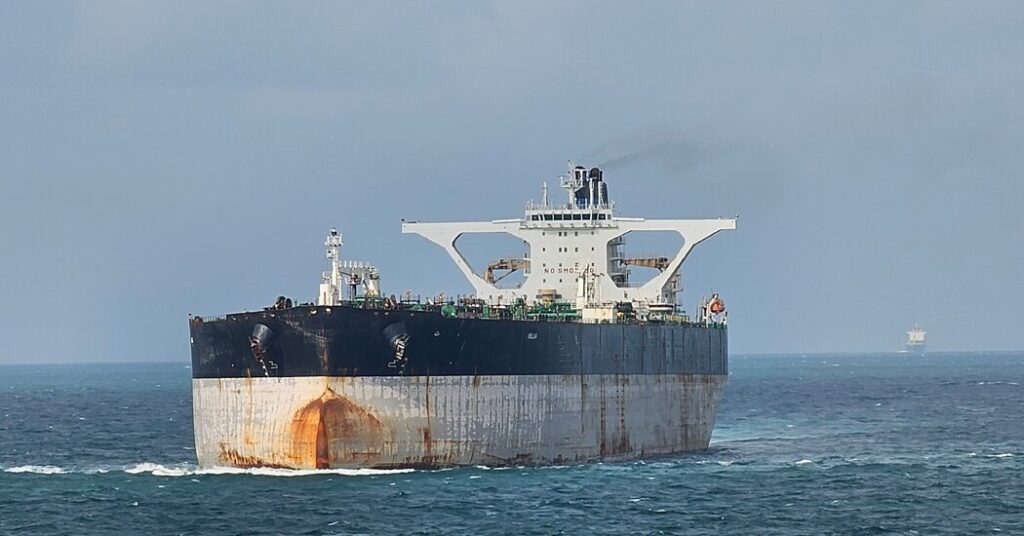
The United States on Wednesday seized an oil tanker in the North Atlantic that had evaded its effort to crack down on Venezuela’s energy exports, U.S. officials said, capping a pursuit that had lasted more than two weeks and raised tensions with Russia.
At about the same time, U.S. forces boarded another oil tanker in international waters near the Caribbean, a sign that President Trump planned to continue to enforce a partial blockade on Venezuelan oil as he pressured its new leader.
The first tanker, until recently known as the Bella 1, had been eluding the U.S. Coast Guard after being stopped in the Caribbean on its way to pick up oil in Venezuela. Its crew then began flying a Russian flag in a last-ditch effort to avoid seizure while Russia dispatched at least one naval vessel to meet and escort the ship.
But there were no Russian vessels in the area when the Coast Guard boarded the ship on Wednesday morning, averting the possibility of an armed standoff between the two countries, according to two U.S. officials briefed on the operation who spoke on the condition of anonymity to discuss a sensitive matter. The crew of the tanker did not resist the boarding attempt, one of the U.S. officials said.
Still, the military dispatched a large force to assist the Coast Guard, including a Navy P-8 submarine-hunting aircraft and AC-130 gunships. Several U.S. military aircraft left bases in Britain on Wednesday morning heading toward the tanker, according to flight-tracking sites. The ship had been sailing northeast in the Atlantic between Iceland and Britain, according to ship-tracking data from MarineTraffic.
Homeland Security Secretary Kristi Noem said in a statement on Wednesday that the Bella 1 had made “a desperate and failed attempt to escape justice” and commended the Coast Guard for pursuing it “across the high seas and through treacherous storms.”
The White House declined to comment.
The seizing of the tanker signals that the United States intends to maintain its partial blockade on Venezuelan oil after capturing the country’s leader, Nicolás Maduro, on Saturday in a stunning military operation in Caracas. Revenue from oil sales powers Venezuela’s economy, and squeezing it would put pressure on Mr. Maduro’s successor, Delcy Rodríguez.
President Trump has claimed that Venezuela will hand over tens of millions of barrels of oil to the United States. Energy Secretary Chris Wright said on Wednesday that the United States intended to oversee the sale of Venezuela’s oil production “indefinitely.”
In another sign of continuing pressure, the Coast Guard on Wednesday intercepted the second oil tanker. The ship, called the M Sophia, was not flying a valid national flag, making it liable to be boarded, according to a U.S. official.
The U.S. Southern Command said in a statement that the Coast Guard would escort the ship to the United States for “final disposition.” It also released a video showing U.S. forces descending onto the M Sophia’s deck from a helicopter. The Treasury Department had placed the ship under sanctions last January for its involvement in the Russian oil trade. But the U.S. authorities did not have a warrant to take possession of the vessel, according to a U.S. official.
That was in contrast to the Bella 1, which a federal magistrate judge had issued a seizure warrant for last month, based on the vessel’s history of transporting Iranian oil for groups linked to terrorism.
Both ships are part of a so-called shadow fleet that has transported oil for Russia, Iran and Venezuela in violation of sanctions imposed by the United States and other countries. The United States has cracked down on them since Mr. Trump last month ordered a “complete blockade” on oil tankers under sanctions going to and from Venezuela.
Russia’s Ministry of Transport said in a statement on Wednesday that it had lost contact with the Bella 1, which was recently re-registered with the Russian maritime authorities as the Marinera, and that U.S. forces had boarded it outside the territorial waters of any state.
In a statement issued on Tuesday to the state news agency Tass, Russia’s Foreign Ministry said the Bella 1 was operating in full compliance with international maritime law. It was receiving increased attention from the U.S. and NATO militaries that was “disproportionate to its peaceful status,” the statement said.
At least four other oil tankers that operated in Venezuelan waters in recent weeks have similarly switched to Russian flags, according to an official Russian vessel registry.
Reporting was contributed by Riley Mellen, Christiaan Triebert, Paul Sonne and Tyler Pager.
Nicholas Nehamas is a Washington correspondent for The Times, focusing on the Trump administration and its efforts to transform the federal government.
The post U.S. Seizes Oil Tanker, Raising Tensions With Russia appeared first on New York Times.