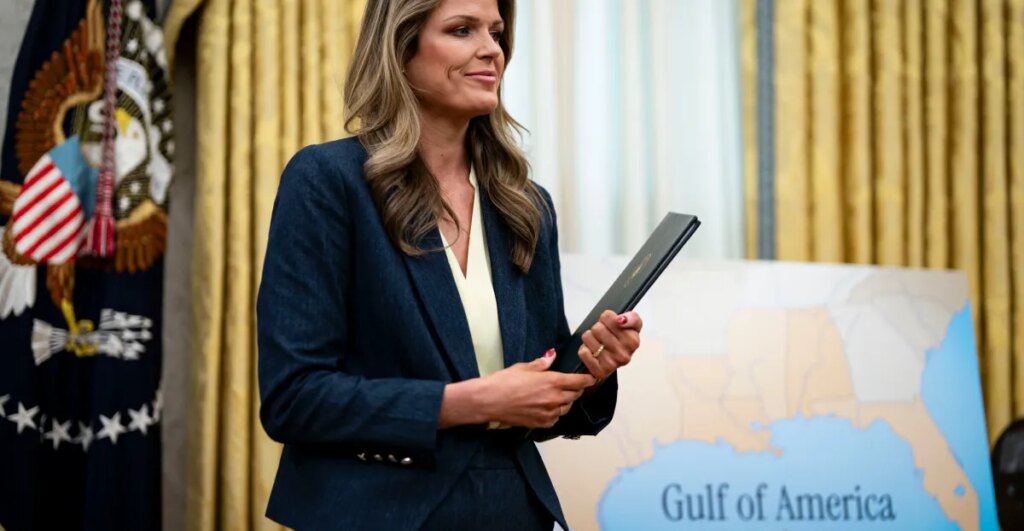
A Trump-appointed judge in Richmond, Virginia issued an unusual order on Tuesday that threatens one of President Donald Trump’s most high-profile Department of Justice appointees with disciplinary sanctions — or even with forbidding her from practicing in the federal courts in eastern Virginia.
The order, in a case known as United States v. Jefferson, is indirectly related to Trump’s attempt to get revenge against two of his perceived political enemies: former FBI Director James Comey and New York Attorney General Letitia James.
Last September, Trump ousted Erik Siebert, formerly the US attorney for the eastern half of Virginia, after demanding that the Justice Department bring charges against Comey, James, and Sen. Adam Schiff (D-CA). He then purported to install Lindsey Halligan, one of his former personal attorneys, as the top federal prosecutor in eastern Virginia.
Prior to this assignment, Halligan worked as an insurance lawyer and had not been a prosecutor.
Halligan swiftly complied with Trump’s demand and brought charges against Comey and James, but those charges were dismissed after federal Judge Cameron Currie determined that she was illegally appointed as US attorney.
The gist of Currie’s decision is that federal law permits the attorney general to temporarily fill vacant US attorney jobs for 120 days, but the Justice Department already used this authority to appoint Siebert at the beginning of Trump’s second term. That means that any new presidential appointment must be confirmed by the Senate, and Halligan was never confirmed.
And that brings us back to Judge David Novak’s Tuesday order in United States v. Jefferson. In it, Novak “observes that Ms. Halligan identified herself” in a recent court filing “as the United States Attorney for this District.” And he faults her for doing so despite Currie’s previous decision. Novak, who was appointed to the federal bench by Trump in 2019, orders Halligan to file a new document “explaining the basis for Ms. Halligan’s identification of herself as the United States Attorney, notwithstanding Judge Currie’s contrary ruling.”
More broadly, Novak’s order reflects a growing trend of federal judges doubting whether the Justice Department’s in-court statements can be trusted.
Nearly half of Novak’s roughly two-page order consists of a long citation quoting various ethical rules and standards of professional conduct that Halligan may have violated by continuing to represent herself as a US attorney. Among other things, Novak quotes a Virginia rule providing that lawyers may not knowingly “make a false statement of fact or law to a tribunal,” and another providing that it is “professional misconduct for a lawyer to” engage in dishonest conduct that “reflects adversely on the lawyer’s fitness to practice law.”
The most ominous quote in Novak’s list of disciplinary rules, at least for Halligan, is his citation to a judicial opinion holding that “Federal courts have the inherent power to control the admission of attorneys to their bars and to discipline attorneys who appear before them.” So Novak isn’t just threatening to discipline Halligan. He explicitly raised the possibility that she could be disbarred from practicing within the federal judiciary’s eastern Virginia district.
More broadly, Novak’s order reflects a growing trend of federal judges doubting whether the Department of Justice’s in-court statements can be trusted. If the judiciary comes to view DOJ as untrustworthy, that could seriously damage the federal government’s ability to enforce the law.
Why the fight over Halligan matters
Currie’s order holding that Halligan was never US attorney, and Novak’s subsequent threat to discipline Halligan, are among several high-profile embarrassments for Trump’s DOJ. Halligan isn’t even the only US attorney appointee who was removed by a federal court.
Last month, a federal appeals court affirmed a lower court decision holding that Alina Habba, another one of Trump’s personal lawyers that his administration tried to install as the top federal prosecutor in New Jersey, could not serve in that role past the 120-day deadline that federal law sets for temporary US attorneys. During her brief time in office, Habba began a failed prosecution against Newark’s Democratic Mayor Ras Baraka, dropped those charges after they were criticized by a federal magistrate judge, and then initiated a new prosecution against Democratic US Rep. LaMonica McIver for attempting to shield Baraka from arrest.
Meanwhile, Trump’s Justice Department has struggled to get many attempted prosecutions off the ground.
In the federal system, prosecutors typically must seek an indictment from a grand jury before they can bring felony charges. But there’s an old joke that it is so easy for prosecutors to obtain such an indictment that they could successfully bring charges against a ham sandwich if they wanted to. Grand juries typically hear one-sided cases because the prosecution may present its evidence, but defense counsel ordinarily does not get to make its case until their client is tried.
Under Trump, however, the Justice Department sometimes struggles to overcome what used to be a very low hurdle. Last September, for example, the New York Times reported that grand juries in Washington, DC, alone refused to allow seven criminal cases to move forward — including a case where the Justice Department was unable to secure an indictment three times against the same defendant.
By comparison, in 2016, the last year that the Justice Department published data on this matter, federal prosecutors investigated over 155,000 criminal matters. Only six of those cases ended after a grand jury refused to indict a suspect.
Nor is United States v. Jefferson the only case where a federal judge accused the Trump administration of making false statements in court. In a high-profile case challenging Trump’s attempt to use the National Guard to suppress a protest outside of Chicago, for example, a federal judge wrote that the Trump administration’s claim that the protesters presented a serious threat to public safety was “simply not credible.”
These embarrassments matter because they undercut one of the Justice Department’s most important assets: its credibility with federal courts. Historically, DOJ has tried very hard to cultivate a reputation for honesty with judges, even confessing error when it discovers that it has misrepresented a fact to a court. It does so because the Justice Department is a party to so many federal cases that it would find it very difficult to operate if judges started questioning whether DOJ lawyers are being honest.
Thus far, for what it is worth, the most important court in the country still gives an extraordinary amount of deference to the Trump administration. Last month, for example, the Supreme Court’s Republican majority reinstated the GOP’s Texas gerrymander after a lower court struck it down. The lower court’s order relied on a letter from Trump’s Justice Department that indicated that the gerrymander was enacted in order to change the racial makeup of several congressional districts, something the Constitution typically does not permit.
But, while the Supreme Court’s Republican majority may bail out Trump’s Justice Department in highly political cases such as the dispute over Texas’s gerrymander, the Supreme Court only hears a tiny percentage of federal court cases. The overwhelming majority of these cases involve apolitical prosecutions or civil matters that rarely make headlines — and that will never receive any attention from the justices.
And these ordinary matters are the ones where the Justice Department’s credibility matters the most. If judges can’t trust DOJ’s lawyers, then that most likely means that more people who actually committed federal crimes will dodge the charges against them. If nothing else, it means that Justice Department lawyers will have to spend countless hours shoring up factual claims that judges simply would have believed in the past. And that’s time that DOJ lawyers can’t spend bringing additional prosecutions or enforcing other federal laws.
Nor is it clear that DOJ will regain its reputation for truth-telling in a future administration. While Trump will no longer be in office in 2029 (barring an unconstitutional third term), many of the lawyers hired during his administration will still work at the DOJ after he leaves. And once a judge grows accustomed to viewing federal prosecutors as untrustworthy, they may not change that view just because there’s a new president.
Thus Trump, and the cronies he’s appointed to the Justice Department, may have done permanent damage to the federal government’s ability to enforce the law.
The post Trump’s revenge campaign is now putting the entire Justice Department at risk appeared first on Vox.