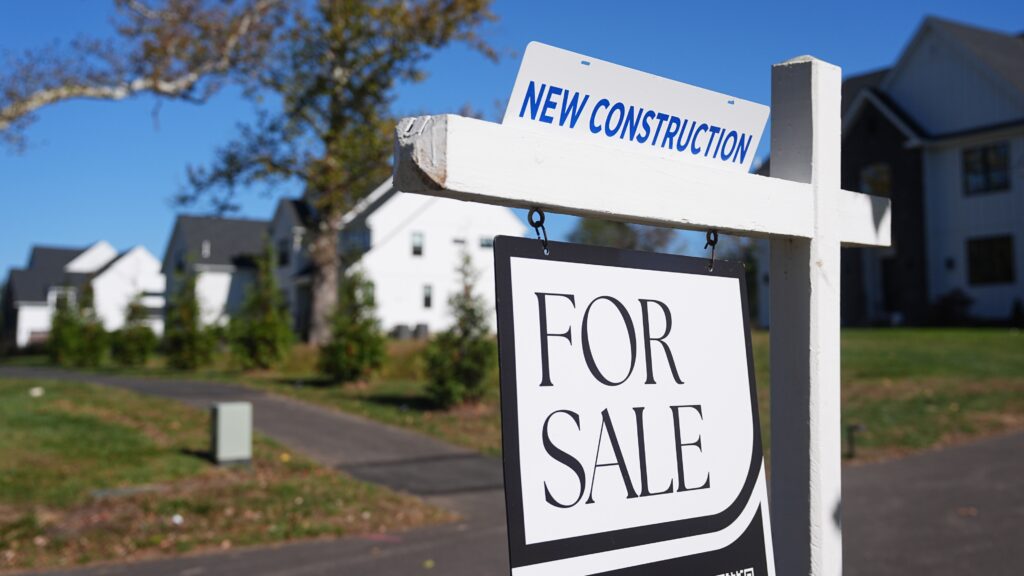
President Donald Trump said Wednesday that he would ban large institutional investors from buying single-family houses, marking a new push in the White House’s messages around housing supply and affordability.
Trump said he would call on Congress to “codify” the push, but he added no specifics. On Truth Social, he said “people live in homes, not corporations,” and that he would talk about the issue at the World Economic Forum in Davos, Switzerland, in a few weeks.
Republican lawmakers were quick to cheer the announcement, with Sen. Bernie Moreno (R-Ohio), who sits on the Senate Banking Committee, writing on X that he would introduce legislation “to codify this into law.” Democrats criticized the idea as something that they had been pushing for years, with Senate Minority Leader Charles E. Schumer (New York) writing on X that “Senate Democrats tried to do this last year. Republicans blocked it.”
In a statement, Sen. Elizabeth Warren (D-Massachusetts) said she had been “advocating for years to limit Wall Street from buying up America’s homes” and that Trump had not done anything to bring down housing costs.
“Enough talk — Trump should start with getting his own party in the House to support a bipartisan bill to bring down housing costs that passed the Senate unanimously,” said Warren, the top Democrat on the Senate Banking Committee. “And Congress should work on legislation to stop corporate investors from buying up homes.”
Many economists from the right and left alike say investors don’t have as large a grip on the housing market as politicians might suggest. An August 2025 paper from the conservative American Enterprise Institute found that the market share of institutional investors was less than 1 percent nationwide; less than 1 percent of counties had percentages between 5 and 10 percent.
While about 25 percent of homes purchased in the first three months of 2024 were bought by investors, only 1 percent were purchased by institutional investors, or those owning 100 or more properties, the paper said.
And a 2023 paper from the center-left Hamilton Project found that large institutional investors own just over 3 percent of single-family rental stock, though that might be higher in some markets. Larger investors are also more present in the multifamily rental market, like large apartment complexes, the paper noted.
The White House did not immediately respond to questions about the proposal, additional details on the policy or what such a ban would do for supply and affordability. Bill Pulte, who chairs the Federal Housing Finance Agency, also did not respond to a request for comment.
Markets reacted quickly to Trump’s post, even without specifics. Shares of Blackstone — an investment firm with a foothold in the rental business — dipped roughly 9 percent after Trump’s post, before regaining some losses.
In an analyst note, Jaret Seiberg, a housing finance expert at TD Cowen, said the announcement reflected “Trump trying to rally the populist wing of the MAGA coalition heading into the midterms given the importance of housing affordability.”
“We view this as a short-term housing boost though it will not address the supply shortage,” Seiberg wrote.
Institutional investors began entering the single-family rental market in the wake of the 2008 financial crisis. But since then, federal and state-level policymakers have made some effort to limit investors’ involvement in the housing market, often driven by Democrats looking to rein in large corporations. But more recently, the rhetoric has come from populist figures.
Jay Parsons, a housing economist and industry expert, said rental housing was among the most diversified industries in the country, and that no singular player had a lion’s share of the market. He said that even as a focus on institutional investors bubbled to the political surface, the problem persists that America doesn’t have enough homes to go around.
“There’s a problem, and people, naturally, want to find someone to blame,” he said.
The post Trump says he’ll ban large investors from buying homes, with few details appeared first on Washington Post.