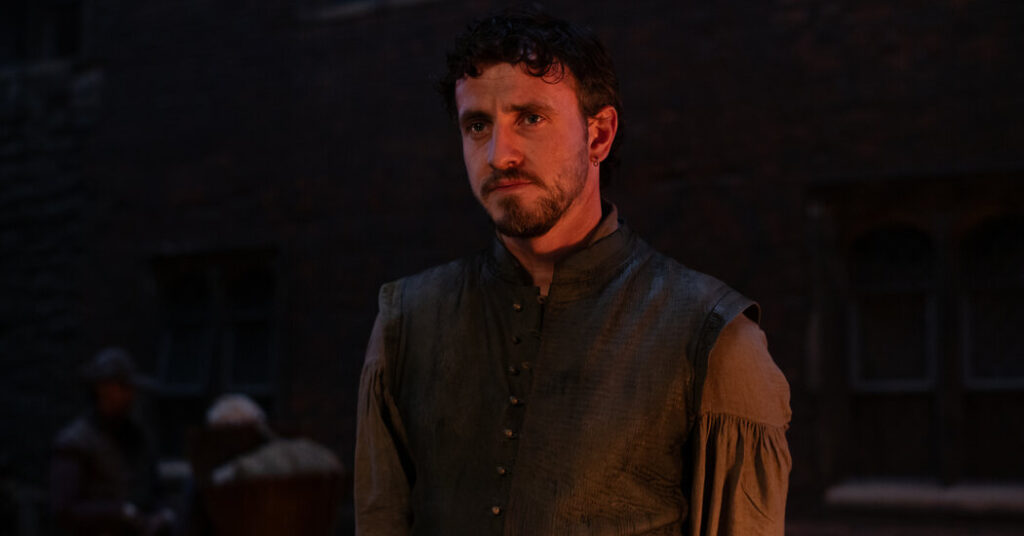
In Chloé Zhao’s drama “Hamnet,” an adaptation of Maggie O’Farrell’s 2020 novel, we encounter the most famous soliloquy in English literature twice. In the first instance, Paul Mescal, playing Shakespeare, stands on the edge of a wall at night, looking at water below in which, presumably, he might drown himself. He is bereft at the loss of his 11-year-old son, who drew his last breath before the father could arrive. Bleary with grief, the Bard gets the words out slowly, as if trying to find his way through fog: “To be … or not to be? That … is the question.” You aren’t quite sure if he’ll make it all the way through or heave himself into the sea.
Later, this contemplation reappears in a much different mouth: that of a young actor, played by Noah Jupe, who looks like a little golden god, all blond curls and clear-skinned smiles. He nears the edge of the Globe Theater stage; it is the first performance of Shakespeare’s masterwork. “To be, or not to be?” he puts to the crowd, as if it’s a bit of a philosophical question they might all ponder together.
He continues, inquisitively: “That is the question — whether ’tis nobler in the mind to suffer the slings and arrows of outrageous fortune, or to take arms against a sea of troubles, and by opposing end them.” His voice is light, his query unburdened by the great emotion that the writer of those words is feeling backstage, and that the playwright’s wife, Agnes, is experiencing as she watches the young man, who so closely resembles her lost son.
In both scenes, the lines seem emotionally authentic: This passage can be an inquiry as well as a lament, at once an existential interrogation and a guttural cry. Read Hamlet’s monologue when you are idly pondering the meaning of life, and it is a great thought experiment. Read it when your heart is breaking, and it is a wrecked soul’s whimper.
THIS SPEECH’S GREAT EMOTIONAL flexibility is among its wonders, and must have to do with its primal simplicity. The first and most famous phrase — to be, or not to be — is only six syllables long, only four unique words, each so short and easy that we learn them in the earliest weeks of literacy. The main building block of the phrase is an irregular verb, “to be,” that is both the most complicated of all verbs in English and the most common. It can be about existence, or occurrence, or the possession of a characteristic, all fundamental facts of living.
The phrases that follow are more complex, with words we barely use anymore — contumely, dispriz’d, quietus, fardels, bodkin — but the passage’s concept, once unpacked, is still elementary. Hamlet is thinking about something that any human with a shred of self-reflective impulse has considered, the question from which whole religions spring: What happens after we die? Well, none of us can answer that, can we? And that’s why most of us decide to stay on this side of the equation, no matter how bad things get. Better the hell you know, and so on.
Death is frightening. But it is also kind of absurd, sometimes even funny. We are thrown into this existence, and things happen to us that we cannot control: We are rejected, we fall in love, we are wounded. And in the midst of it all our hearts just keep on beating, we keep on breathing, we have little choice. What a farce. What a tragedy.
This is probably why the “To be or not to be” soliloquy has been so often performed, and with so many different shades of interpretation. I don’t just mean by actors playing Hamlet, though of course many — Kenneth Branagh, Richard Burton, Mel Gibson, Christopher Plummer — have taken him on. Some interpret the speech in unexpected ways: Ethan Hawke’s Hamlet, from the 2000 movie, is a film student wandering through Blockbuster, and Ben Whishaw’s version, from Trevor Nunn’s 2004 production at the Old Vic, delivers the soliloquy flanked by a knife and a bottle of prescription pills.
But phrases from the speech long ago escaped the play’s orbit and were launched into cultural space as entities unto themselves. In 1962, for instance, Kurt Vonnegut wrote a short story, “2 B R 0 2 B” — the 0 is pronounced “nought” — about a society in which aging has been cured, and thus strict and gruesome population control must be enacted. The 1991 “Star Trek VI: The Undiscovered Country” borrows on the speech for its title, though it’s referring to a future in which humans will dwell in peace with Klingons; the beginning of the monologue is also quoted, but in Klingon. (You can still tell.) In P.D. James’s 1992 sci-fi novel “The Children of Men,” elderly and sick citizens who can’t afford nursing homes are expected to die by taking part in the “quietus,” a government-sanctioned mass drowning; in the 2006 film adaptation, Quietus is the name of a self-administered suicide drug. And there’s the Canadian TV comedy “Slings & Arrows” (2003-6) set at a fictional Shakespearean festival.
The way the soliloquy has been used throughout film history — not just in “Hamlet” adaptations — shows just how much life it has even when lifted from its original setting. In Ernst Lubitsch’s gutsy 1942 film “To Be or Not to Be,” for instance, Carole Lombard and Jack Benny play married Polish actors performing “Hamlet” during the Nazi invasion of Warsaw. She is being courted on the sly by a young soldier, and tells him to come to her dressing room when her husband begins the soliloquy. The phrase becomes a bit of a code between them, but eventually the story grows bigger than their dalliance, as the actors find themselves performing for their very lives. “What he did to Shakespeare, we are doing now to Poland,” a Gestapo colonel says of the actor’s shaky staging, in one of the film’s most bleakly funny lines — especially given the timing of its release.
In “The King’s Speech” (2010), Colin Firth plays the future King George VI, who struggles to overcome a persistent stammer. His speech therapist, Lionel Logue (Geoffrey Rush), asks him to read Hamlet’s soliloquy into the newfangled phonograph. But the prince grows angry and tongue-tied just a few words in. So Logue instead blasts “The Marriage of Figaro” over the prince’s headphones as he reads, and behold: a nearly stutter-free “to be or not to be,” and the beginning of the prince’s own self-assertion.
In the 2024 drama “Sing Sing,” a group of incarcerated men prepare a production of a play in which the central character is Hamlet (the play, however, is not “Hamlet”), and so the aspiring lead, played by Colman Domingo, auditions with the soliloquy. Later, we hear another of the men, Clarence Maclin (playing himself), deliver the speech; after watching him struggle to find a reason to live, it takes on new shades of meaning.
Shot entirely inside the video game Grand Theft Auto, the 2024 documentary “Grand Theft Hamlet” follows a group of players and their often hilarious endeavor to put on a production of the play inside the game. Yet because the game is designed for killing, the “actors” keep getting gruesomely taken out by other players in the middle of monologues. It’s funny but becomes poignant because out in the real world, the Covid-19 pandemic is raging, and matters of mortality, fear and loneliness have taken on new meaning.
There’s plenty of comedy to be had in “to be or not to be,” facilitated by its familiarity. In one “Calvin and Hobbes” strip, Calvin’s disgusting green gloppy dinner declaims to him as he looks on, horrified. And the Royal Shakespeare Company pulled together a very funny sketch in 2016 to celebrate the 400th anniversary of the death of the Bard. At the start of the bit, Paapa Essiedu begins the famous lines, only to be interrupted by Tim Minchin, who says he ought to place the emphasis on “or.” “To be or not to be,” he instructs a skeptical Essiedu. One by one, a series of acclaimed actors stride onstage to offer their own suggestions: Benedict Cumberbatch, Harriet Walter, David Tennant, Rory Kinnear, Ian McKellen, Judi Dench — and, finally, Prince Charles (as he was known then), who does a surprisingly fine job of it, delighting the crowd.
ONE OF THE MOST COMICAL and significant instances of all comes in Tom Stoppard’s play “Rosencrantz and Guildenstern Are Dead.” The two main characters are supporting roles in “Hamlet.” But in this play, they’re trapped onstage while Hamlet’s story goes on in the background. They’re asking questions about free will and the meaning of existence. We, who have seen “Hamlet,” know how their story ends.
Just before Hamlet appears to deliver his monologue, Rosencrantz asks Guildenstern, “Do you ever think of yourself as actually dead, lying in a box with a lid on it?” When Guildenstern replies in the negative, Rosencrantz says he doesn’t either, but then continues because, clearly, he does: “Ask yourself, if I asked you straight off — I’m going to stuff you in the box now, would you rather be alive or dead? Naturally, you’d prefer to be alive. Life in a box is better than no life at all. I expect.”
Eventually Hamlet arrives to “weigh up the pros and cons of making his quietus,” as Stoppard’s stage directions have it. But ordinary, non-protagonist Rosencrantz has gotten to that contemplation first, and it’s funny and tragic and also ironic. Stoppard has given us an everyman, a guy like us, who feels like a player in someone else’s grander story, contemplating mortality and the undiscovered country in much more prosaic terms. What is death but another life in a box, when you think about it?
Were all of these shades of death’s meaning in Shakespeare’s mind when he penned the speech? Whether you take the motivation for writing them given in “Hamnet” to be true, it seems certain that he’d been thinking about every aspect of death for much of his own existence. Throughout his life, bubonic plague regularly wiped out large swaths of the population in horrifying ways. Quarantines and painful deaths were part of living, and there’s no doubt he’d thought about what happens next.
So perhaps he wept. Perhaps he raged. Perhaps he even laughed bitterly at times. And then he wrote down his words, and gave them to centuries more of us who needed to make them our own. To rage, and weep, and laugh along with him.
Alissa Wilkinson is a Times movie critic. She’s been writing about movies since 2005.
The post To Be or Not to Be: That Is the Question Filmmakers Can’t Resist appeared first on New York Times.