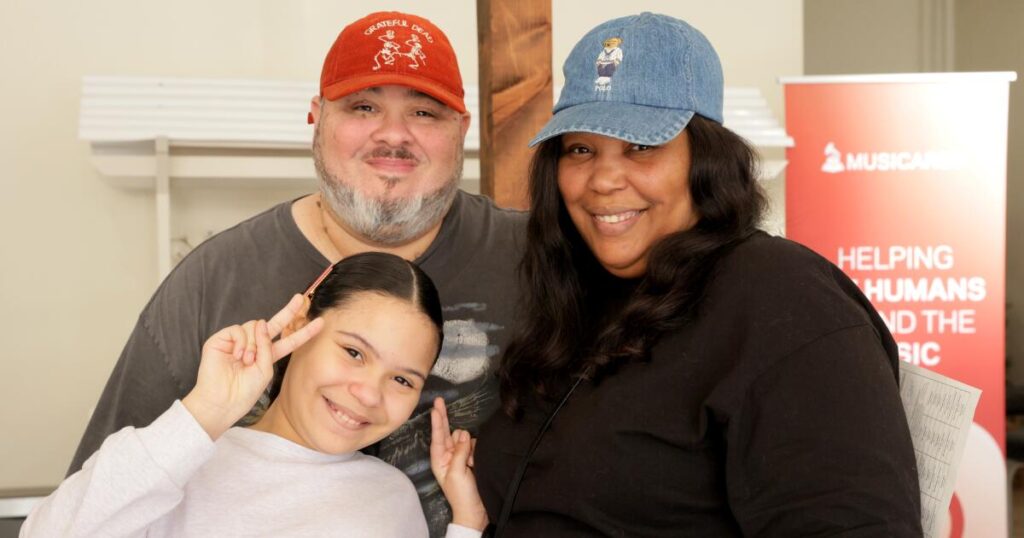
Singer-songwriters Lisa Simmons-Santa Cruz and her husband Francisco Carroll Santa Cruz were going through a challenging time last March when they worked on Snoop Dogg’s 2025 gospel album, “Altar Call.”
“We were actually writing all those songs in a hotel, displaced,” Carroll Santa Cruz said.
The couple, who have worked in the entertainment industry for more than 29 years writing and producing music for artists like Kelly Rowland and television shows such as “Desperate Housewives,” had lost their Altadena home in the Eaton fire a few months earlier.
Still, the platinum singer-songwriters didn’t want to pass up the opportunity, which came up during the final week of their hotel stay when Simmons-Santa Cruz and Carroll Santa Cruz were introduced to Snoop Dogg through artists Charlie Bereal and Point 5ve. Although Snoop Dogg had also set up a donation center for fire victims, the couple chose not to share their own displacement with him or anyone else in the music industry.
“We needed something the fire couldn’t burn and that was our music,” Simmons-Santa Cruz said. “At that time, we needed something separate from the fire — something that the fire couldn’t touch, it was too traumatic to keep revisiting what we’d lost, so our work became our peace and our escape.”
Despite the loss of their home studio and the limitations of working from a hotel room, they successfully completed the project in a short amount of time. Simmons-Santa Cruz later described the experience as “divine intervention in the midst of tragedy,” saying the music gave them space to heal through faith while doing what they loved most.
“It was comforting, we didn’t have to focus on the fire or what was lost, the music gave us a moment to reflect on life, and it became a saving grace,” she said.
The couple had originally resided in the Altadena home with Simmons-Santa Cruz’s 77-year-old mother, who first bought the house in 1974. In the aftermath of the fires, the couple was forced to figure out where they were going to live as they also grappled with the immense paperwork, bills and insurance claims that came with the loss of their home.
MusiCares, a health and welfare charity for musicians founded by the Recording Academy in 1989, offered them assistance.
“They were like, the FEMA of the music industry,” Simmons-Santa Cruz said.
According to Theresa Wolters, executive director of MusiCares, the organization supports the music community through direct financial assistance for basic living, medical, mental health and substance use needs, as well as free preventive healthcare. One year after the Los Angeles wildfires, MusiCares has directed more than $15 million toward relief and recovery, reaching over 3,200 music professionals affected by the disaster.
When MusiCares stepped in to provide emergency funds for Simmons-Santa Cruz and her husband, it also offered to replace an important instrument for her. Her father, who died seven years ago, helped her pick her first guitar, but the guitar was left behind when the fire broke out.
“That guitar was very sentimental for me,” she said.
Nothing can ever replace the personal memory tied to the guitar, but Simmons-Santa Cruz says that MusiCares offered her hope through this deed, and the new guitar represents that.
“I just broke down, I just started crying, because I’m like, who replaces a guitar? … The last thing that was on my mind was replacing our equipment because we’re still in survival mode,” she said.
The couple is living in a rental and continuing to deal with the fallout of the fires, still unable to rebuild their house because of the financial costs. Since the fires, many other music professionals have faced similar hardships, like music producer and drummer Darryl “JMD” Moore, who still has to pay the mortgage on the home he lost while rebuilding another one “like for like” as mandated by the mortgage bank.
“I wanted to build a home for my children, and my grandchildren, my descendants, that would serve them financially and in every other way it could, because I know this property is valuable, my house doubled in value, it was worth twice what I paid for,” Moore said. “But our insurance is not paying us enough money to build the same house, it’s like hundreds of thousands of dollars short, so everybody like us, we’re in a scramble to get the money to fill in the gaps.”
After years of renting in Altadena, Moore finally bought his first home there in 2011, a purchase made possible thanks to his success in the music industry. Moore is known in both the jazz and hip-hop music scenes, having produced acts like the Pharcyde and Freestyle Fellowship while also drumming for jazz greats like Horace Tapscott. Moore originally grew up in South L.A., where he started playing drums at 13, focusing on R&B and funk before eventually being mentored by the renowned jazz saxophonist and singer Elvira “Vi” Redd.
When the Eaton fire began to crawl toward Moore’s house, he said he quickly packed his most important possessions. He took an archival hard drive which contained his music from 2004 to the present, but everything else burned: his recording studio, archival tapes and reels, and his favorite drum set, a vintage 1965 Rogers Holiday kit he bought in the ‘80s.
“I played on albums and records with that Rogers kit, when I moved to New York in ’89, I took that Rogers kit with me, and I pushed that kit down the street every night from the East Village to the West Village to work,” Moore said. “I can get one that looks just like it if I was willing to spend the $4,000, but was it in the back of the subway, did I play it on Bleecker Street?” the jazz drummer said.
Immediately after the fire took his home, Moore needed to work, but he no longer possessed the peripherals and equipment he required to record. MusiCares donated thousands of dollars’ worth of equipment he needed, including a drum set, and it also provided grants to help him pay both his mortgage and the rent where he’s currently staying. Moore has a long way to go before he completely recovers financially, but he says the organization made a significant impact in his life this past year, and he’s grateful.
“My studio’s back online, I’m able to practice, I’m able to work and do some gigs … it gave me my voice back, really, that was the beginning of everything,” the hip-hop producer said.
For Gwendolyn Sanford and Brandon Jay, a married couple raising a 16-year-old and a 9-year-old, the emotional weight has been just as significant as the financial burden that followed. The couple said they’ve been proactive in prioritizing the mental well-being and happiness of their children since losing their Altadena home.
“It was harder for them early on, when we were moving so frequently, we didn’t have any control over it, we were just trying to get somewhere stable to be, and I think they were processing the loss when they were sad that we didn’t have our home,” Sanford said.
Sanford and her husband are singer-songwriters and have scored music for television shows like “Weeds” and “Orange Is the New Black.” The couple is also in a children’s music band called Gwendolyn and the Good Time Gang, and they recently composed music for the off-Broadway show “Romy and Michele the Musical.”
Like many others, the couple lost their personal recording studio, making work difficult. The stress has been immense for the couple, but they said MusiCares was able to ease some of the financial burden when the organization offered them grants to cover their mortgage, which they are still on the hook for.
“There’s all the red tape and hurdles and things we have to do just to rebuild our home, so that in itself is like a full-time job that we never wanted, on top of just our regular lives raising our kids and doing work,” Jay said. “So, to have the support of someone like that and have them say you don’t have to worry about this one aspect for a while, is invaluable.”
Recently, Sanford was asked to perform at a groundbreaking ceremony her former Altadena neighbor was having for a new house being built there. Sanford’s daughter had not wanted to go back to the neighborhood, but she decided to accompany her mother anyway. The return was cathartic.
“She was able to walk around our lot and have a private moment, and I asked her how she felt, and she said, ‘I feel safe here, this is my home,’” Sanford said.
At the event, Sanford sang a song she penned in 2011 called, “Acorn,” which was inspired by the grandeur of oak trees and what they symbolize in nature. The song has taken on a different meaning for her in the wake of the fires.
“The acorn is a metaphor, and I think that’s kind of where we all are right now, we have to start over, we have to start small, and eventually we’ll get back to where we were,” Sanford said.
The post These musicians struggled after the LA wildfires. MusiCares offered them a lifeline appeared first on Los Angeles Times.