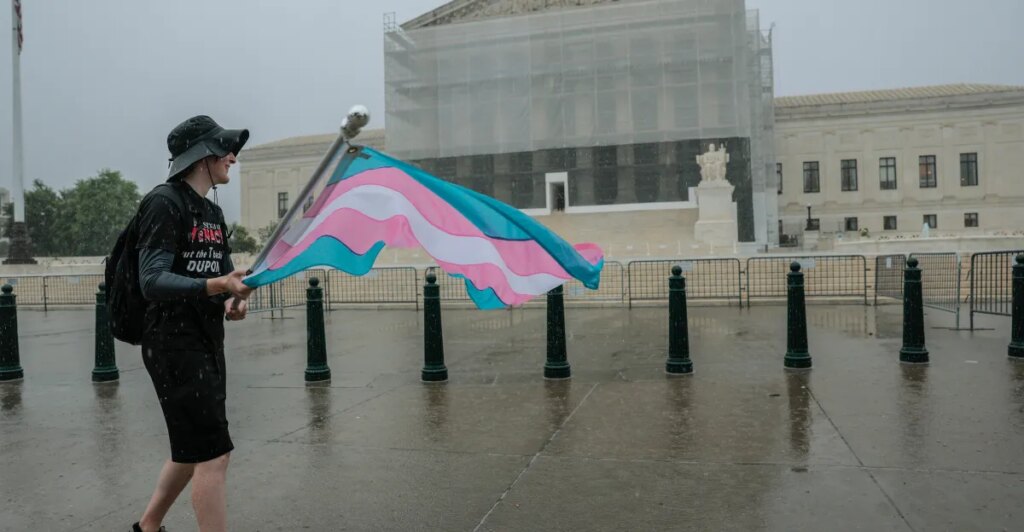
Let’s be honest. The question of whether transgender athletes have a right to play school-sponsored sports was always the toughest legal issue facing trans advocates.
The Supreme Court’s trans rights precedents are particularly ill-suited for plaintiffs challenging state laws prohibiting trans women from playing on women’s sports teams. The politics of this issue are absolutely awful for trans people. And the Court is dominated by Republicans who, just last June, voted that states could ban trans youth from receiving gender-affirming medical care.
So it is likely that most of the justices will rule, in either Little v. Hecox or West Virginia v. B.P.J., that states may prohibit trans women from playing women’s sports at the high school or college level. Both cases present this question to the justices — although there is a chance the Court will dismiss the Hecox case because the plaintiff in that case makes a strong argument that the case is now moot.
Key takeaways
- The question of whether trans women may play high school or college sports has always been the most difficult legal issue facing trans rights advocates.
- In Bostock v. Clayton County, the Supreme Court said a law banning “sex” discrimination in employment protects trans workers.
- But sex discrimination is allowed in sports — teams are typically gender-segregated — so Bostock doesn’t apply there.
To understand why trans advocates must climb such a steep hill to prevail in Hecox or B.P.J., it’s helpful to be familiar with Bostock v. Clayton County (2020), the one major victory the Court has given transgender Americans. Bostock held that a federal law which bars employment discrimination “on the basis of sex” prevents workplace discrimination targeting LGBTQ employees.
Although Bostock assumed that the word “sex” refers only to “biological distinctions between male and female” (that is, to sex assigned at birth), it concluded that “it is impossible to discriminate against a person for being homosexual or transgender without discriminating against that individual based on sex.”
The idea is that if Herman is allowed to date Janet, but Juanita is not, then Juanita is being treated differently because of her sex. Similarly, if a cisgender male worker is allowed to wear stereotypically male clothes, to use a male name, and to otherwise present as a man, then an “employee who was identified as female at birth” must also be allowed to do so, or they are also being discriminated against because of their sex.
But this rationale does not apply to sports, because the law permits sex-segregated sports teams. If a company attempted to divide its workers into male and female “teams,” that would be illegal. But schools may, and typically do, have separate sports teams for men and women.
To prevail in a case like Hecox or B.P.J., in other words, trans plaintiffs must show that they are protected from discrimination because they are transgender — and not just because they are men or women. And, while the Supreme Court held half-a-century ago that ordinary sex discrimination by the government is typically forbidden by the Constitution, it has never ruled that transgender Americans are protected because they are trans.
Meanwhile, several sitting justices appear to have already concluded that trans people do not enjoy constitutional protection. Justice Amy Coney Barrett wrote an entire concurring opinion in United States v. Skremetti (2025), the trans health care case, arguing that they do not. In an even more ominous sign for trans athletes, Justice Brett Kavanaugh worried during the Skremetti oral argument that, if trans women were given heightened constitutional protection, that could enable them “to play in women’s and girls’ sports … notwithstanding the competitive fairness and safety issues that have been vocally raised by some female athletes.”
Realistically, in other words, trans athletes should expect a rough ride in the Supreme Court.
So what exactly are Hecox and B.P.J. about?
The plaintiffs’ specific claims in Hecox and B.P.J. are fairly modest. They don’t claim that all trans athletes should be allowed to play women’s sports, but rather only a certain subset whom, they argue, do not have a competitive advantage.
The plaintiff in B.P.J., who is identified only by her initials because of her young age, is a high school track-and-field athlete. According to her brief, she “transitioned early in life” and “has received puberty-delaying medication and gender-affirming estrogen,” and thus has never gone through male puberty. The plaintiff in Hecox is Lindsay Hecox, a former college athlete who “is treated with both testosterone suppression and estrogen” and who says she “has circulating testosterone levels typical of cisgender women.” (Hecox is also a college senior who does not currently play on any team and who says that she does not intend to play college sports in the future, which is why she argues her case is moot.)
Neither plaintiff argues that all transgender women should be allowed to play high school or college sports. Instead, they seek a court order that applies to trans women with testosterone levels similar to cisgender women. Their lawyers argue that this subset of trans women enjoy “no athletic advantage” over cis women.
Meanwhile, the state of Idaho, the defendant in Hecox, spends a simply enormous amount of its brief doubting this factual claim. They rely largely on statements by Gregory Brown, a professor of exercise science whose professional webpage identifies him as “the faculty advisor for Turning Point USA” on his campus. The plaintiffs, meanwhile, rely largely on testimony by professor Joshua Safer, an endocrinologist who told the trial court that heard Hecox that “there is a medical consensus that the difference in testosterone is generally the primary known driver of differences in athletic performance between elite male athletes and elite female athletes.”
For what it is worth, one of the plaintiffs’ primary arguments before the Supreme Court is that the nation’s highest Court is the wrong forum to litigate this disagreement among professors. The trial courts in Hecox and B.P.J. deemed Safer’s testimony to be more credible than Brown’s. And appeals courts like the Supreme Court typically aren’t supposed to second-guess a trial court’s factual findings unless they are “clearly erroneous.”
This Supreme Court, however, is unlikely to defer to the lower courts just because the rules of civil procedure instruct them to do so. In Kennedy v. Bremerton School District(2022), a case about a public school football coach who incorporated prayer and other Christian activity into his coaching, the Court’s Republican majority made up a fake set of facts to justify ruling in favor of that coach — and even adhered to these fake facts after Justice Sonia Sotomayor produced photographic evidence that her Republican justices weren’t telling the truth. In cases involving disagreements about medicine, Republican justices often argue that state legislatures have broad leeway to do what they want so long as “medical uncertainty” exists.
And, even if the Supreme Court does credit the lower court’s finding that Safer has a more accurate understanding of how testosterone impacts athletic performance than Brown, the outcome of this battle of the professors only matters if the plaintiffs’ lawyers can convince a majority of the justices that trans people enjoy heightened protection under the Constitution.
Heightened scrutiny, briefly explained
As a general rule, the government is allowed to discriminate. It can discriminate against unqualified applicants and in favor of highly qualified ones when deciding whom to hire. It can discriminate against rich people and in favor of poor people when deciding who receives welfare benefits. And it can discriminate against criminals and in favor of law-abiding people when deciding whom to incarcerate.
Virtually all laws draw some kind of distinction between people they do apply to and people who are unaffected. And the Constitution typically permits this kind of discrimination, even when there is scientific evidence that a particular law discriminates for unsound reasons.
Meanwhile, there are some forms of discrimination that are ordinarily not allowed. Laws that discriminate on the basis of race, sex, or religion, for example, are subject to “heightened” scrutiny under the Constitution. The details of how this scrutiny works often depend on the type of discrimination — the Constitution treats race discrimination with more skepticism than sex discrimination, for example — but most laws that are subject to heightened scrutiny fail.
The Supreme Court held in United States v. Virginia (1996), for example, that “a party seeking to uphold government action based on sex must establish an ‘exceedingly persuasive justification’ for the classification.”
So how does the Court determine which forms of discrimination are allowed, and which ones are constitutionally suspect? Under the Court’s past decisions, the most important question is whether a particular group has historically been subject to discrimination that “bears no relation to ability to perform or contribute to society.”
The Court also sometimes looks at other factors, such as whether a group exhibits “obvious, immutable, or distinguishing characteristics that define them as a discrete group” or whether the group is relatively politically powerless. But these factors are less important. Religious discrimination is constitutionally suspect, for example, even though people can change their religion. And women and people of color have not lost their constitutional protection even as they’ve gained political power relative to women and racial minorities in the past.
The lawyers representing the plaintiffs in Hecox and B.P.J. make a strong argument that discrimination on the basis of gender identity should be subject to heightened scrutiny. In their brief, they list several historical laws that targeted trans people. Over two dozen US cities, including major metropolises like Chicago, used to ban “cross dressing,” for example. Others targeted bars that served “female impersonators.” At one point, the lawyers argue, the United States effectively barred openly trans people from immigrating.
Meanwhile, someone’s gender identity bears little relationship to their ability to contribute to society. As the plaintiffs’ lawyers write, “being transgender does not make someone less capable of being a lawyer, engineer, farmer, or doctor.” And openly trans people have historically held little political power. In all of American history, there’s been exactly one openly trans member of Congress — and she hasn’t even completed a single term in office.
Will that be enough for this Supreme Court? Probably not. As Barrett noted in her Skrmetti concurrence, the Court “has not recognized any new constitutionally protected classes in over four decades.” The Court’s gay rights cases, for example, seemed to actively avoid the question of whether discrimination on the basis of sexual orientation is suspect — even when those decisions found other reasons to rule in favor of gay plaintiffs. So a decision adding trans people to the pantheon of protected groups would be a highly unusual move by the Supreme Court.
And, even if the Court does conclude that trans people enjoy this protection, the plaintiffs in Hecox and B.P.J. must still overcome an additional hurdle.
Courts sometimes uphold laws that are subject to heightened scrutiny
Let’s say that the lawyers representing Hecox and B.P.J. somehow convince a majority of these justices that discrimination against trans people is just as odious as discrimination against women, and thus that laws that discriminate on the basis of gender identity should be subject to heightened scrutiny. Most laws subject to this scrutiny fail, but not all laws do.
As the Court held in Virginia, laws that discriminate on the basis of sex are permitted if they serve “important governmental objectives” and “the discriminatory means employed are substantially related to the achievement of those objectives.”
Indeed, one example of a law that discriminates on the basis of sex, but that courts have allowed to remain in place, is a law that segregates men and women onto different high school or college sports teams. Because highly athletic men typically outperform highly athletic women in sports, women-only sports teams are necessary to ensure that women have the opportunity to play. If women-only teams did not exist, nearly all women would be excluded from high school and college sports, because they would be unable to compete with their male classmates.
Or, to use the same language the Supreme Court used in Virginia, gender-segregated sports teams are allowed because they are substantially related to the important objective of allowing both men and women to play competitive sports.
Significantly, this rationale holds even though there are some women who can outperform nearly all men, and there are some men who underperform most women. A cisgender high school boy isn’t allowed to try out for the women’s field hockey team, even if he can demonstrate that he has unusually low testosterone levels.
The law, in other words, allows states to use the blunt instrument of declaring that all cisgender men must play on one team, and all cisgender women must play on another team, regardless of whether any particular man or woman’s athletic performance matches that of the other sex.
Thus, even if Hecox and B.P.J. can convince the Court that trans women with low testosterone levels do not enjoy a competitive advantage over cisgender women, and even if they convince the Court that laws that discriminate against trans people are subject to heightened scrutiny, there is still one more hurdle that they must overcome. The law typically permits schools to segregate sports teams based on students’ sex assigned at birth, so why should a trans athlete be treated differently than a cis athlete with similar athletic ability?
Hecox and B.P.J.’s lawyers, for what it is worth, have a pretty good answer to this question. They argue that “courts have recognized that sex separation in sports can pass constitutional muster where men and women still have equal opportunities to compete.” Thus, the hypothetical cisgender boy with low testosterone does not face discrimination because he can still try out for the men’s team. But transgender women who experience gender dysphoria, a psychological condition where the inability to express their gender identity causes great distress, cannot try out for the men’s team without triggering that distress.
That argument persuaded lower courts. As Hecox’s lawyers note in their brief, one court concluded that claiming that trans women can simply play men’s sports “is analogous to claiming [gay people] are not prevented from marrying under statutes preventing same-sex marriage because lesbians and gays could marry someone of a different sex” — an argument the Supreme Court rejected in its marriage equality decision in Obergefell v. Hodges (2015).
But even if this argument persuaded lower courts, it’s far from clear that it will persuade the Supreme Court. Three current justices dissented in Obergefell. And two other current justices, Kavanaugh and Barrett, have signalled pretty clearly that they are unsympathetic to trans women who wish to play school sports. That’s five votes — a majority in the Supreme Court.
All of which is a long way of saying that proponents of trans inclusion in school sports face a very difficult climb in the Supreme Court. Many of the Court’s current members have already indicated that they reject the pro-trans arguments in Hecox and B.P.J. And even if these plaintiffs faced a less hostile panel of justices, current legal doctrine is not very favorable to trans people, at least in areas where the Constitution typically permits the government to treat men differently than women.
The post The Supreme Court confronts the trans rights movement’s toughest legal battle appeared first on Vox.