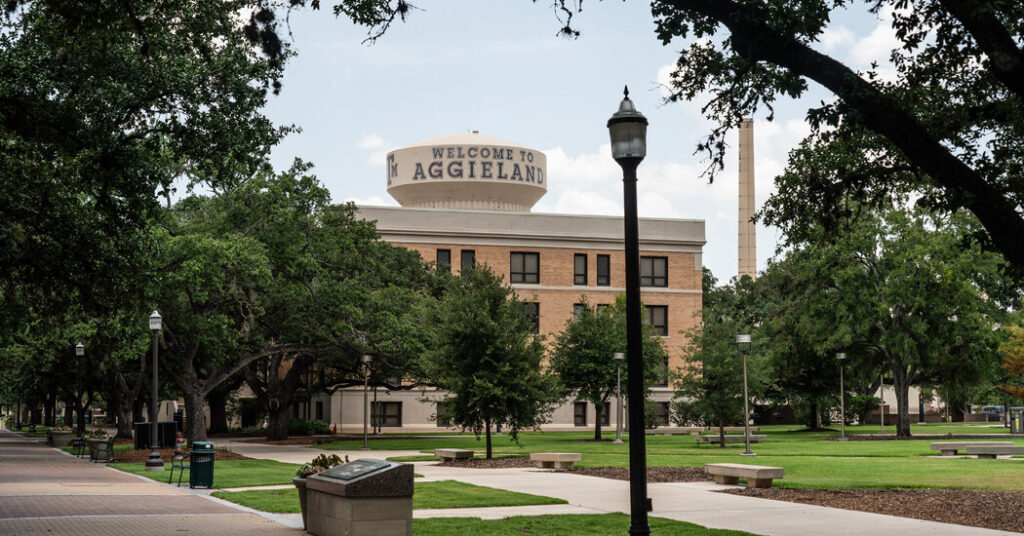
Martin Peterson, a philosophy professor at Texas A&M University, was thunderstruck when he was told on Tuesday that he needed to excise some teachings of Plato from his syllabus. It was one way, his department head wrote in an email, that Dr. Peterson’s philosophy class could comply with new policies limiting discussion of race and gender.
Days before the start of the spring semester, one of the nation’s largest public universities is racing to interpret and enforce the A&M system’s rules. Some professors are reconsidering syllabuses at the direction of administrators, or are unsure whether they will be able to lead certain classes. Course sections are being canceled or potentially reclassified, threatening students’ schedules.
And professors are worried that they are losing the academic freedom they prize.
“A philosophy professor who is not allowed to teach Plato?” Dr. Peterson said in an interview on Wednesday. “What kind of university is that? Is that really what they want?”
“How,” he added, “can we possibly teach philosophy without being allowed to discuss Plato, even if some of Plato’s ideas are a little bit controversial?”
Texas A&M, which is in College Station, did not immediately comment on Wednesday.
In recent months, bowing to conservative critics in the State Capitol, the university system’s regents have eagerly endorsed new limits on academic instruction.
Under policies approved late last year, courses may not “advocate race or gender ideology, or topics related to sexual orientation or gender identity.” In select instances, after “demonstration of a necessary educational purpose,” some graduate and “noncore” undergraduate courses may teach on those topics.
Universities across the country routinely say that classes cannot be used for political purposes. But the push by the A&M regents reflects a noisy debate in Texas, the nation’s most populous conservative state, over its public universities. Republican elected officials — often echoing the Trump administration’s grievances about American higher education — have argued that universities were too often veering away from academic instruction and into liberal proselytizing around, for example, diversity, equity and inclusion.
Brian Harrison, a Republican state representative and Texas A&M alumnus who has championed the pressure campaign in Austin, said it was “misleading and false” for professors to suggest that Plato had been banned. He added that critics’ objections were “dishonest, disingenuous and cynical” efforts to “hype up any actual or perceived issues.”
But, he said, “What we’re seeing here is just actually further evidence that inmates have been running the asylums in Texas public universities for far too long.”
Since November 2024, Texas A&M has shut down its minor in L.G.B.T.Q. studies and seen its then-president’s job threatened by the governor over a D.E.I. conference. Last September, a lecturer was fired after a contentious lesson in a children’s literature class — the university president stepped down afterward — and now, professors in an array of academic disciplines are trying to decipher what they will be allowed to teach when classes resume next week.
It was not clear how many professors, courses or students could be affected. Classes at large universities like Texas A&M often enroll dozens or hundreds of students.
The course Dr. Peterson was planning to teach — Philosophy 111, or Contemporary Moral Issues — would examine “representative ethical positions and their application to contemporary social problems,” according to the university’s academic catalog. Students can use the course to fulfill one of their core curriculum requirements.
Dr. Peterson’s original syllabus called for modules focused on debates around abortion, capital punishment, economic justice, and race and gender ideology, among other topics. When Dr. Peterson, who has been at Texas A&M since 2014, submitted his syllabus for review last month, he told his department head that his “course does not ‘advocate’ any ideology.” Instead, he wrote in an email he shared with The New York Times, “I teach students how to structure and evaluate arguments commonly raised in discussions of contemporary moral issues.”
On Tuesday, Dr. Peterson got a response from Kristi Sweet, the philosophy program’s head. University officials had discussed his syllabus, she wrote, and the new A&M policies. Dr. Sweet gave the professor two choices.
Either Dr. Peterson could “mitigate” his course’s “content to remove the modules on race ideology and gender ideology, and the Plato readings that may include these,” Dr. Sweet wrote, or Dr. Peterson could be reassigned to an ethics and engineering course.
According to the syllabus, Dr. Peterson’s planned Plato readings included passages about Diotima’s Ladder of Love and Aristophanes’ myth involving split humans.
Many conservatives have pressed for universities to devote more attention to classical education and the foundations of Western thought. But the dust-up at Texas A&M suggests that even ancient texts are not immune to modern flare-ups.
Dr. Sweet said on Wednesday that she had no comment on the exchanges with Dr. Peterson. In an interview, Dr. Peterson said he would reluctantly alter the course and replace the disputed modules with “lectures on free speech and academic freedom.”
But he was angry, he said, as well as bothered by the sense that students would receive a less rigorous, challenging education in his classroom. He insisted that he wasn’t “trying deliberately to be provocative” when he included the Plato texts.
“I’m aware that many members of the Board of Regents probably disagree with Plato,” Dr. Peterson said. “They may not be aware of that, because they haven’t read Plato — who knows? — but it’s still a valuable alternative perspective.”
Dr. Peterson, who chairs the university’s Academic Freedom Council, added, “We cannot have just one perspective in the classroom. Then there’s nothing to discuss. There’s nothing to learn. It’s indoctrination. It’s Soviet-style education.”
Two other faculty members at Texas A&M, who spoke on the condition of anonymity because they feared retaliation, said they had no plans to change their syllabuses and that they were not sure whether they would be permitted to teach.
In one email sent this week, A&M officials wrote that they were canceling a sociology course because they had “concluded that we cannot teach this course in its present form and comply” with system policies.
Those system policies took shape last year. At a November meeting, Sam Torn, the regent who chairs the Committee on Academic and Student Affairs, argued that it had “become clear” that some Texas A&M courses had strayed from the curriculum that system leaders imagined.
Although frustrations had been bubbling for months, the debate over A&M classes exploded in September, after a lecturer teaching a children’s literature course displayed a “gender unicorn,” which educators often use to explain the differences between gender expression and gender identity. In a widely circulated video — promoted by Mr. Harrison and other Republicans in Texas — a student addressed the lecturer and said, “I’m not entirely sure this is legal to be teaching because, according to our president, there’s only two genders.”
The instructor, Melissa McCoul, eventually replied, “You are under a misconception that what I’m saying is illegal.” The university quickly fired Dr. McCoul.
A faculty appeals panel ruled unanimously in November that A&M was “not justified” when it dismissed Dr. McCoul, but a university system official refused last month to reinstate her. Dr. McCoul’s lawyer has signaled plans to bring a legal challenge.
As that episode drew public attention last year, regents moved to tighten the system’s rules around what could be taught throughout the A&M system, which has about 165,000 students at a dozen campuses and a health sciences center.
On Wednesday, as word of disputes like Dr. Peterson’s spread, critics of the Texas A&M policies said free-speech clashes became inevitable after the board’s moves. The College Station campus’s chapter of the American Association of University Professors said the move against Dr. Peterson “raises serious legal concerns.”
The group said its misgivings went beyond the Constitution.
“Silencing 2,500-year-old ideas from one of the world’s most influential thinkers betrays the mission of higher education and denies students the opportunity to engage critically with the foundations of Western thought,” the group said. “A research university that censors Plato abandons its obligation to truth, inquiry, and the public trust — and should not be regarded as a serious institution of higher learning.”
Alan Blinder is a national correspondent for The Times, covering education.
The post Texas A&M, Under New Curriculum Limits, Warns Professor Not to Teach Plato appeared first on New York Times.