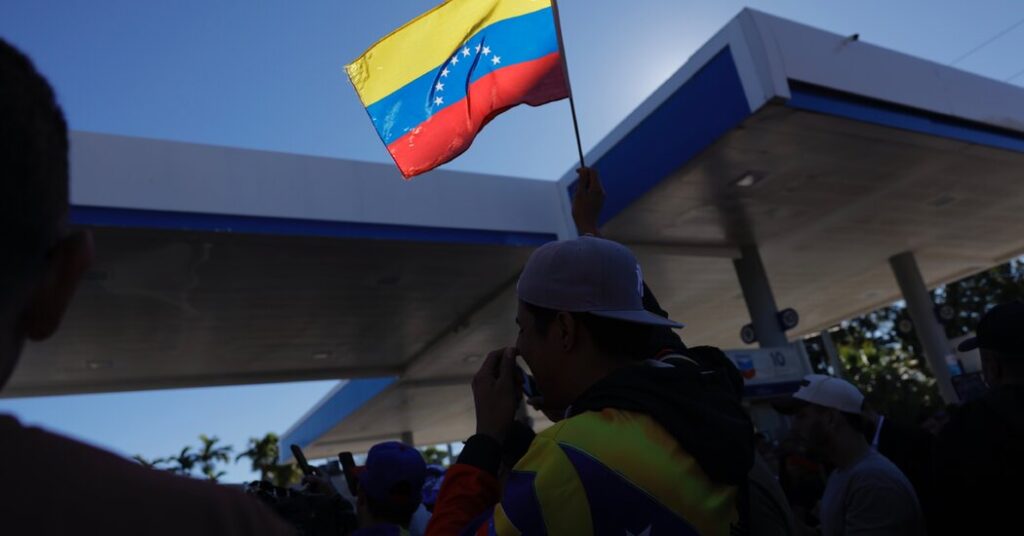
South Florida is suddenly just where its Republican politicians have always wanted it to be: at the center of the political solar system.
President Trump spent the holidays at his Mar-a-Lago estate in Palm Beach, where he gave the order for the extraordinary capture of the Venezuelan leader Nicolás Maduro. At a golf course near Fort Lauderdale over Thanksgiving, his special envoy to the Middle East, the real estate developer Steve Witkoff, held talks with Russian and Ukrainian officials. Earlier in the fall, Mr. Witkoff and Mr. Trump’s son-in-law Jared Kushner helped broker a Gaza peace deal from their mansions in exclusive areas near Miami.
Greater Miami has long lobbied presidents on issues involving Latin America and the Caribbean, especially Cuba. The first year of Mr. Trump’s second presidency has cemented the region’s identity as a global player.
Mr. Trump packed his second administration with Florida Republicans, starting with Secretary of State Marco Rubio, a Miami native who is also Mr. Trump’s national security adviser. The president nominated a number of Florida political donors and loyalists to plum ambassadorships, with Cuban Americans getting posts in Spain, Argentina and Panama. Later this year, the Group of 20 summit will take place at his golf resort outside Miami.
Nowhere has South Florida’s outsized influence been more evident than in Mr. Maduro’s removal. The military action was the culmination of years of behind-the-scenes work by Mr. Rubio and other Cuban Americans, who persuaded the president to take the sort of aggressive stance toward Venezuela that they have long hoped to see toward Cuba.
“The only reason it happened is because so many people in Miami give a damn,” Senator Rick Scott of Florida said to cheers from elected officials and other Republicans at a news conference inside a Cuban restaurant in Doral on Monday. The room was brimming with swagger.
Mr. Maduro’s capture prompted spontaneous celebrations in Doral, a city west of Miami that is full of Venezuelans, and at Versailles, the famous Cuban restaurant in Miami’s Little Havana neighborhood. Cubans said they were optimistic that change in Venezuela could lead to change in Cuba, but were trying not to get their hopes up too high.
The Doral celebrations included chants that Venezuelans first used to protest Mr. Maduro’s predecessor, Hugo Chávez, around 2002, nearly a generation ago.
With no Venezuelan Americans in the high echelons of American power, the key figure who was pushing for Mr. Maduro’s removal was Mr. Rubio. “Does this happen if Marco Rubio is not secretary of state?” said Carlos Curbelo, a Cuban American and former Republican congressman from Miami. “Probably not.”
Other players included Miami’s three Cuban American members of the House of Representatives and Mr. Scott, who is not Hispanic but learned when he was the state’s governor that foreign policy is hyperlocal in Miami.
A pivotal moment that revealed South Florida’s influence on Venezuela policy took place last year, when a U.S. special envoy was negotiating with Mr. Maduro’s envoys. Those talks drew strong opposition from Mr. Rubio and the Cuban American House members, Mario Diaz-Balart, Carlos A. Giménez and María Elvira Salazar.
At the time, Mr. Trump was working to rally congressional votes for his sweeping domestic policy bill. Mr. Rubio argued in internal government discussions that a rapprochement with Venezuela would cause the Cuban American representatives to withhold support for the measure.
In separate interviews this week, Mr. Diaz-Balart and Ms. Salazar said they had expressed their dismay about the negotiations to the president, and had suggested that taking a diplomatic approach to Mr. Maduro was a departure from Mr. Trump’s publicly stated views.
“We reminded the White House what was the campaign promise that the president had made,” Ms. Salazar said, adding that Mr. Trump had promised to reverse oil and other concessions that mad been made by the Biden administration.
“You cannot pressure this president,” Mr. Diaz-Balart said, adding that what lawmakers did was to argue that the special envoy had veered from Mr. Trump’s hard line on Venezuela.
Mr. Trump put a potential deal with Venezuela on hold to reduce the risk of the bill’s defeat, according to multiple people familiar with the talks. The bill passed the House on July 3 by four votes.
Afterward, Mr. Rubio embarked on an aggressive new strategy, announcing a series of measures that led to the labeling of Mr. Maduro’s government as a drug cartel and its designation as a terrorist threat to the United States.
It was a foreign policy shift far more important to South Florida than to any other constituency, except perhaps the American oil industry. The Trump administration’s Venezuela rhetoric echoed years of South Florida politicians’ Cuba rhetoric, fueled by what Cuban Americans describe as intergenerational trauma over their forced exile.
“This is all years and years in the making,” said Carlos Trujillo, a Cuban American and former state legislator from Miami who served as United States ambassador to the Organization of American States during the first Trump administration. “The only diaspora that has a similar amount of credibility and force is the Jewish diaspora.”
Cubans who fled to Miami after the 1959 revolution began to organize politically in the early 1980s. Jorge Mas Canosa founded the Cuban American National Foundation, modeled in part after the pro-Israel group AIPAC. The foundation became one of the most effective lobbying groups in Washington for a time, operating under the belief that the Cuban cause mattered more than partisan politics.
But Cuban Americans’ influence extended far beyond the foundation, which splintered after Mr. Mas Canosa died in 1997. Cuban Americans continued to recruit candidates for office, dominated Spanish-language media and developed successful entrepreneurs into major political donors.
“It penetrated on all levels,” said Joe Garcia, a Cuban American and former Democratic congressman from Miami who was once the foundation’s executive director. “In Miami, even the tax collector wants to engage in foreign policy.”
Cuban Americans helped Mr. Trump win Florida in 2016. Mr. Rubio, then a United States senator, and other Cuban American Republican lawmakers pushed for the hiring of fellow Cuba hard-liners — those in favor of the U.S. trade embargo and against having diplomatic relations with the island’s communist regime — to serve in key administration posts. Venezuelan Americans then helped Mr. Trump recapture the White House in 2024.
Though many Venezuelan Americans were initially elated at the news of Mr. Maduro’s removal, much uncertainty still surrounds Venezuela’s future and the United States’ role in it. Mr. Trump has focused on obtaining Venezuelan oil rather than on restoring democracy, freeing political prisoners or supporting María Corina Machado, the Venezuelan opposition leader and Nobel Peace Prize winner.
The president’s posture has put Mr. Rubio and the Miami lawmakers in the awkward position of having to explain or try to justify Mr. Trump to their constituents, after having spent years, for example, supporting Ms. Machado. Two of the lawmakers, Ms. Salazar and Mr. Giménez, traveled to Oslo last month for Ms. Machado’s Nobel ceremony. All three lawmakers have said recently that they remained committed to seeing her run in free elections in Venezuela, which they felt certain she would win.
“The road ahead is not clear,” Mr. Giménez conceded in the Doral news conference on Monday.
Mr. Curbelo, the former congressman, said the moment of exultation for South Florida also brought “a great potential for disappointment.”
“A lot of people are now starting to wonder how exactly this is going to play out,” he said on Monday. If the mission is ultimately to advance American commercial interests and limit the influence of U.S. adversaries in the region, he added, “it would fall way short of the dreams and aspirations of the exile and diaspora communities.”
Anatoly Kurmanaev contributed reporting from Venezuela.
Patricia Mazzei is the lead reporter for The Times in Miami, covering Florida and Puerto Rico.
The post South Florida Takes Center Stage in U.S. Politics After Maduro’s Capture appeared first on New York Times.