Today it seems obvious: Dip a sharp object in a poisonous substance, and then use that weapon to take down your prey. But when did human beings figure out this deadly strategy?
It remains as mysterious as the dawn of setting fires, building wheels and painting on caves. But a new study pushes back the timeline of this innovative hunting technique by tens of thousands of years.
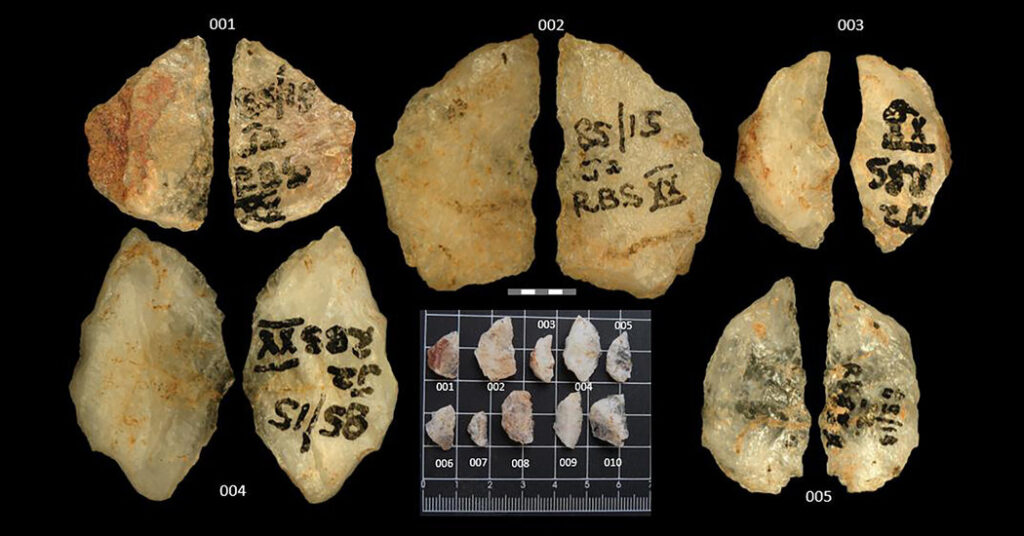
Researchers led by Sven Isaksson, a professor of archaeological science at Stockholm University, have discovered poison residues on 60,000-year-old arrow tips unearthed in South Africa. With the next-oldest trace of poison use dated to 35,000 years ago, these tips preserve the earliest evidence of poisoned weapons by a wide margin.
“It’s a big leap,” Dr. Isaksson said of the discovery, which was published on Wednesday in the journal Science Advances.
“It might be an even earlier practice,” he added. “This is just the earliest evidence so far.”
The finding reinforces existing evidence that early Homo sapiens had cognitive abilities nearing the sophistication of our own. That’s because in order to tip an arrow with poison, hunters needed knowledge of local plants and their effects, as well as the ability to craft special weapons with the right dosages.
“It takes a developed working memory to be able to predict that if I put this arrowhead into that plant, it will shorten the delay before I get my hands on this meat,” Dr. Isaksson said.
Dr. Isaksson and colleagues examined specimens that were originally discovered in 1985 at the Umhlatuzana Rock Shelter in eastern South Africa. The shelter contains layers of archaeological remains that were left tens of thousands of years ago. The researchers were inspired to look more closely at a handful of quartz arrow tips lodged in sediments estimated to be 60,000 years old.
The arrow points are unusually small, which suggests that they might have been crafted to deliver poison efficiently into an impact wound, as opposed to inflicting a blunt-force injury.
The team performed chemical and molecular analyses of the artifacts. That revealed two toxic compounds, buphanidrine and epibuphanisine, that were most likely collected from Boophone disticha, a plant known as the Bushman’s poison bulb. It remains a frequent source of poison used by traditional hunters in the region, such as the San and Khoe peoples, to this day, helping them slow their prey rather than kill it with a knockout blow.
Felix Riede, a professor of archaeology at Aarhus University in Denmark, called the discovery a “spectacular finding” that appears to be “the earliest evidence of poison use globally so far.”
He added that the paper was a demonstration “that it is possible to extract poison signatures from even very ancient residues on stone tools.” Similar compounds should be sought elsewhere, he said.
Michelle C. Langley, an associate professor of archaeology at the Australian Research Centre for Human Evolution at Griffith University, likewise pointed to the possibility that new clues about this ancient tradition may be hidden at other fossil sites or in collections.
“It is always worth going back and taking another look,” Dr. Langley said. “Especially as our techniques get better and cheaper and faster, people can at least look for things in the tiny little crevices and cracks where maybe something has been kept all those years.”
She also noted that the identification of these poison-tipped weapons added to a growing body of evidence that our human ancestors 60,000 years ago — and even earlier — were cognitively on par with modern humans.
“I’m not surprised that they found this,” Dr. Langley said. “It’s just building on everything that’s come before it, and really substantiating that the people 60,000 years ago were as complex as we are today.”
The post Scientists Discover Oldest Poison, on 60,000-Year-Old Arrows appeared first on New York Times.