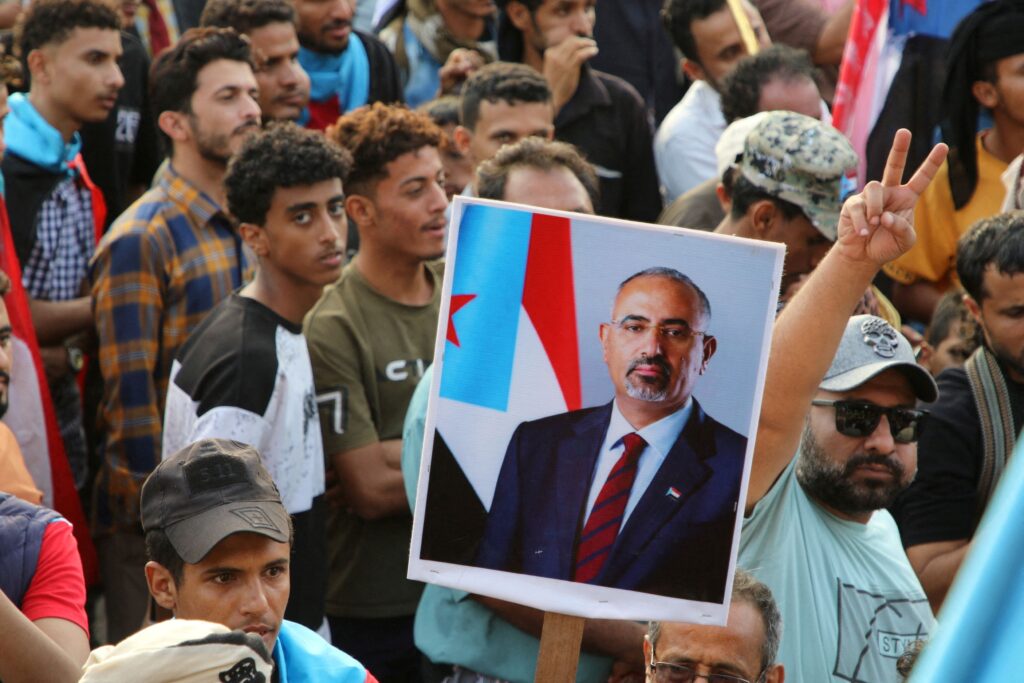
CAIRO — Saudi Arabia and its Yemeni allies escalated efforts Wednesday to wrest control of southern Yemen from separatists backed by the United Arab Emirates, expelling their leader from the internationally recognized government and launching airstrikes in his home region about 50 miles east of the city of Taiz.
The office of the Saudi-backed head of the Presidential Leadership Council announced that a majority of its members had decided at an emergency meeting to remove Aidarous al-Zubaidi, who leads the separatist Southern Transitional Council, from their ranks. The PLC, an uneasy alliance of power players opposed to the Houthi movement that controls the north, has served as the executive body for the internationally recognized government since 2022.
The moves to oust Zubaidi came after the separatist leader failed to board a plane to the Saudi capital, Riyadh, for planned talks intended to resolve the crisis. They are the latest salvos in a political and military counteroffensive by Saudi Arabia and its Yemeni allies to undo territorial gains made by the STC during a lightning offensive last month and to curb the secessionists’ — and their Emirati backers’ — power in Yemen.
Turki al-Maliki, a spokesman for the Saudi-led military coalition in Yemen, accused Zubaidi in a statement Wednesday of having “fled to an unknown location” after mobilizing a force in his home region of al-Dhale and distributing weapons to fighters in the port city of Aden, the seat of the internationally recognized government. In response, Maliki said, Saudi coalition forces tasked the STC’s vice president with securing Aden and carried out “preemptive strikes” early Wednesday targeting the fighters Zubaidi had allegedly massed in Dhale.
The STC disputed this account and said Zubaidi continued to oversee the work of state institutions from Aden.
“President al-Zubaidi has not left Aden. His people need him there,” Amr al-Bidh, a senior STC official, wrote on X. “While a senior STC delegation is in Saudi Arabia pursuing negotiations, the President remains in Aden to ensure security and stability. He will not abandon his people, and he will engage directly when conditions allow.”
In a news briefing later Wednesday, Bidh condemned the Saudi airstrikes on Dhale and said they had killed two and injured 14 civilians. He said Saudi officials had warned Zubaidi in recent days that they would take military action if he did not join the talks in Riyadh.
The STC still controls Aden and the surrounding provinces, Bidh said. Footage from Reuters showed vehicles carrying armed men and heavy guns passing through the group’s checkpoints in Aden on Wednesday.
The STC said in a statement it has not been able to reach its delegation to the Riyadh talks since they arrived in Saudi Arabia early Wednesday and demanded “urgent clarification” about their status and location.
The delegation consisted of more than 50 people, including most of the group’s senior leaders, Bidh said. One of them, Mohammed al-Ghaithi, posted on X. STC officials elsewhere have not been able to get in touch directly with any members of the group since they arrived, al-Bidh said.
“We call all the international community to put pressure to make sure that our delegation is safe,” he told reporters. He called on Saudi Arabia to de-escalate and said the STC is “still open” to dialogue, in particular on the demands of people from Yemen’s southern provinces who support secession. If dialogue doesn’t work, he added, the STC’s supporters “will resist on the ground.”
The STC advance on the strategic provinces of Hadramout and Mahra in early December stunned Saudi Arabia and briefly placed most of Yemen outside of Houthi-held areas under the control of Emirati-backed forces.
Diplomatic efforts to convince the STC forces to withdraw from the newly seized provinces failed, according to an analyst briefed on the talks and Sultan al-Aradah, a Saudi-aligned member of the PLC and governor of Marib province, in an interview Wednesday.
The STC has “crossed all lines,” he said, and Zubaidi appears unwilling to negotiate.
On Dec. 30, Saudi Arabia bombed a shipment of Emirati military vehicles at a southern Yemen port — a direct attack targeting the activities of a gulf power that is ostensibly an ally but has pursued an increasingly divergent foreign policy.
In the days since, Saudi-backed forces have swept through the provinces of Hadramout and Mahra, taking back areas lost to the STC last month and expanding their control over new areas. The fighters, under the cover of Saudi airstrikes, appeared to face little resistance from the STC, whose troops quickly stood down.
The infighting among anti-Houthi forces — and the tension on display between Saudi Arabia and the UAE in Yemen — has alarmed the Arab and Western countries who have supported the coalition to counter the Houthis in Yemen for years. The Arab League’s secretary general and the United Nations Security Council have urged the parties to de-escalate and reach a political solution that preserves the territorial integrity of Yemen, a rebuke of the STC’s separatist vision.
Secretary of State Marco Rubio spoke to his Emirati and Saudi counterparts last week about Yemen, the State Department said. But the United States has yet to take a clear position on either side of the gulf dispute there.
Massad Boulos, senior adviser for Arab and African affairs in the Trump administration, met Rashad al-Alimi, the Saudi-backed president of Yemen’s internationally recognized government, as well as with a slew of Saudi officials, on Tuesday. Saudi Foreign Minister Faisal bin Farhan al-Saud landed Wednesday in the United States to meet with Rubio, the ministry said in a post on X.
Heba Farouk Mahfouz, Mohamad El Chamaa in Beirut and Loveday Morris in Berlin contributed to this report.
The post Saudi Arabia’s allies in Yemen oust UAE-backed separatist from government appeared first on Washington Post.