Near-death experiencers are the best dancers. I could identify which attendees at the annual conference of the International Association for Near-Death Studies have been to the brink, because they moved their bodies with un-self-conscious abandon, ripping up the floor of a tent on the grounds of a suburban Chicago Hilton.
The dance party, which took place on the penultimate night of the conference, was dominated by longtime members of the organization. There were over 700 people at the conference and around 300 at this celebration. I recognized many of their faces from the jackets of the books sold at the conference’s bookstore and from the panels I attended.
You could walk up to any one of them, and they would matter-of-factly tell you about how they almost died. Evan Mecham, the president-elect of IANDS, had an archetypal near-death story, which he started telling me a few minutes after we met. He had been driving on an icy mountain road at night when a deer appeared. He swerved, saving the deer’s life but almost losing his own. He nearly bled out waiting for medical help after a semi truck hit his driver’s side.
“All the pain left me, and if death was a warm blanket, it drew itself up over me, and I crossed over. I let go. I had an incredible experience of talking with another dimension, and I died with gratitude and love for a creator and for my life and for family,” Mecham told me. It changed his life permanently. “I became kinder. I became a vegetarian.” He became a more mindful spouse and father.
You could tell who were survivors not just by their calm demeanor when describing the most traumatic day of their lives or because they danced with a notably blissed-out confidence. They also had bright green ribbons affixed to their conference badges that read, “Experiencer.”
I was halfway out of the tent, but I heard the first notes of the song “Stayin’ Alive” blaring from the amps, and it was too kismet to ignore. I returned to the dance floor and was rooted in the moment, smiling at their uncomplicated joy and the warm community they have created.
Any kind of meaningful coincidence like this is called, in the parlance of IANDS, a synchronicity. It’s a term coined by the Swiss psychiatrist Carl Jung, who was influenced by Albert Einstein’s theory of relativity. Jung believed that coincidences — whether they’re found in dreams, lurking in the subconscious or observed in waking life — could have cultural and personal significance.
I learned about IANDS through another synchronicity, an email from a reader, a missive I plucked out from the thousands of unsolicited emails I get a month. The reader told me that the organization had become a sacred center for her. Over time, the group had evolved to include other kinds of unusual experiences, and she had participated in local gatherings centered on spirituality.
I received her note around the time I was writing several essays about how millions of Americans had moved away from organized religion over the past 50 years. Among the reasons cited: Christianity had become too closely tied to conservative politics, their religious group had covered up a scandal, and they felt alienated by rigid doctrine.
What those who had drifted away from organized religion missed most was the feeling of the divine within a community. Without a religious superstructure, there was no one to bring a casserole or hold a baby at the big moments: marriages, births and deaths. Many still believed in God, yet there was no one to talk to about spiritual experiences that couldn’t be explained in the vernacular of secular life.
Facing death, whether your own or a loved one’s, is a core part of making meaning of one’s life. To struggle through this universal contemplation without a community can be brutal. The American religious landscape has become fragmented over the past few decades, and even observant people got out of the habit of going to services in person after 2020. So it makes sense that a group like IANDS could fill a much-needed gap for people who are unsatisfied by the strictures of mainstream observance and who aren’t fulfilled by the loose ties of a virtual and vague spirituality.
According to Pew’s huge Religious Landscape Study published last year, almost 80 percent of Americans surveyed said they believed “there is something spiritual beyond the natural world, even if we cannot see it.”
The religious scholar Ryan Burge’s analysis of General Social Survey data suggests that the proportion of Americans who believe in life after death has increased over the past 50 years.
Burge also points out that a majority of Nones — people who identify as atheists, agnostics or nothing in particular — believe in life after death. Pop culture has noticed this surge: There have been multiple documentaries and podcasts in the past few years exploring near-death experiences, like “Surviving Death” on Netflix and the latest season of “The Telepathy Tapes.”
I went to the conference to find out how this group could organize around such an individual experience. Was it possible to fulfill the spiritual and communal needs of the participants while having no real doctrine and no houses of worship? Many of the people I spoke to were distrustful of the religious traditions they were raised in: One person felt Christianity was “put down their throat”; another said that the New Testament was “geared to control a group of people.”
Ultimately, I was asking a very 2026 question: What is a spiritual organization made of people who are suspicious of such institutions?
IANDS as a group has been around in some form since 1978. In the past six years, its membership has almost doubled but is still small, around 2,000 people.
The annual conference has been held for over 30 years, and this year was its largest gathering yet. It feels as if the organization is at an inflection point, as it grows in visibility online; its website reaches 70,000 people on a good month.
The gender split among conference attendees appeared to be about 50/50, and the average age was graying. But since 2020, there has been more interest in IANDS from younger people, and I spoke to a handful of people in their 20s and 30s at the event.
The attendees fell into three distinct categories. First, there were the scientists, many of whom were longtime IANDS members in their 70s and 80s. They wore pressed shirts, sport coats and loafers, treating this like any other academic conference. That included Dr. Raymond Moody, a psychiatrist whose 1975 collection of near-death experiences, “Life After Life,” is a seminal text, and Dr. Bruce Greyson, a psychiatrist who developed the Near Death Experience scale, which is used to quantify near-death episodes.
Then you had the experiencers and their spiritual fellow travelers, who appeared to be middle-aged. Some of them looked like stereotypical New Agers, wearing flowing boho skirts and bright colors. One young man rolled up his pant leg to show me a tattoo that said, “Love.” But others looked aggressively normal. I saw a lot of people wearing graphic T-shirts, men in chinos attending light circles.
Finally, there were the grievers. The grievers I met seemed to be first-time conferencegoers who had no idea what to expect from the conference and no prior relationship to the scientific research or New Age groups. They had lost someone dear to them and had heard about IANDS from an online search or from listening to near-death experience podcasts. Many of them believed that a loved one had communicated with them from the beyond, and they felt a sense of peace and community at the conference that had eluded them.
“I feel like I found my tribe,” said Maria Small, a Navy veteran who lost her young daughter, Mia, in 2020 and had not been to an IANDS conference before. She was there with her husband, Derek, who is also a veteran; he paid for the trip as a present to Maria. Mia was born on Valentine’s Day, and Maria sees hearts everywhere. Once, visiting Mia’s grave on the first anniversary of her death, Derek and Maria saw her name written in melted snow.
Therese Rando, a psychologist and the clinical director of the Institute for the Study and Treatment of Loss, which provides specialized mental health treatment services, whom I consulted to understand the grievers better, has been working with the bereaved for decades. She wasn’t surprised to hear that so many grieving people were at the conference. She estimated that 80 to 90 percent of her patients have had what she terms “extraordinary experiences of the bereaved.” It might be noticing an animal, like a butterfly, that symbolizes the lost loved one, a symbol like Mia’s hearts or an olfactory sensation, like Proust’s madeleine.
Early in her career, Rando was more dismissive of these experiences. She was trained to believe they were wish fulfillment or even psychiatric symptoms. But after working with “hundreds and hundreds” of patients who have had these communications, she said, she thinks they matter. Going to a conference like the IANDS gathering could help give people “meaning and validation,” she said, and it gives them a sense of connectedness to their lost loved one.
Other attendees told me that they belonged to mainstream churches but that their pastors or priests were dismissive of their experiences, or even implied that after-death communications were somehow demonic. Maria Small said she defined herself as a Christian and spiritual but was not observant. She added that she has hesitated to tell stories about the signs she and her husband have received from Mia, because they didn’t want to be judged as crazy. “Here it just seems that people are very open and intrigued and welcoming,” she said.
The mixing of these three groups at the conference was sometimes harmonious and sometimes cacophonous; a sober medical lecture drowned out by the clang of a sound bath. This tension has been part of IANDS since the beginning.
The organization has its roots in academia. Bruce Greyson, who became the director of the division of perceptual studies at the University of Virginia, said that he and parapsychological researchers felt isolated and undervalued. The division, which is one of the few academic centers for the study of near-death experiences, reincarnation and after-death communication in the United States, is in the department of psychiatry and neurobehavioral sciences at the university’s school of medicine. He and his peers thought that by bonding together, they could share studies and give one another support. But the researchers quickly realized that the people they studied needed even more help.
The experiencers were often blackballed by their peers, and so they turned to local IANDS support groups that began forming across the country. These groups included not just experiencers but also people who believed in life after death or a consciousness beyond what science could explain.
The IANDS website became a source of information on near-death experiences and other extraordinary phenomena. The group has become “a way for people to seek spiritual communion with others without going to an organized religion, which has a lot of dogma attached to it,” Greyson told me.
That hasn’t always been easy. There have long been struggles with “individual people who set themselves up as gurus or shamans or just spiritual leaders who would want to come in and proselytize at the meetings and kind of take over,” Greyson said. The organization hired its first paid executive director, Janet Riley, last year. Riley, who has a background in corporate communications, was brought on to “try to give some structure to the organization,” she said, because it has been ad hoc and volunteer driven for decades.
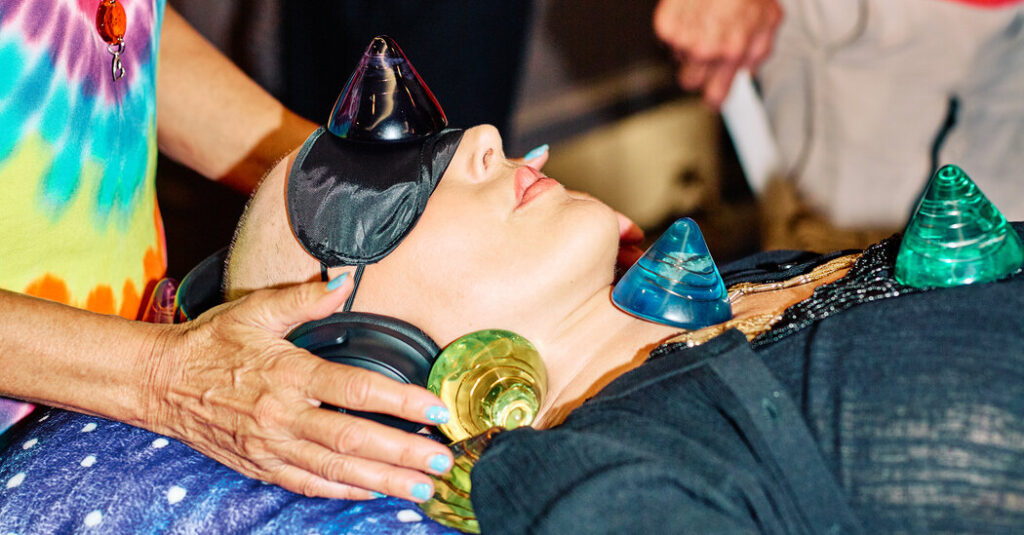
I felt that struggle acutely at the conference. I would go from PowerPoint presentations in frigid, darkened ballrooms that name-checked serious medical journals like The Lancet, to the exhibitor area, a glaringly bright, windowless space where a man in a beret tried to sell me on the healing power of a portable sauna, and I watched a light worker apply crystals to a supine woman.
This kind of tension isn’t new. Belief in an afterlife has existed for eons and in most major religions. A desire for scientific proof that there is consciousness after death has been part of the American mainstream since at least the 19th century, with interest in the topic cyclically rising and falling.
In the 1850s and ’60s there was one such explosion of interest in mystical experiences, like communication through mediums. Mary Todd Lincoln started holding seances at the White House after she was devastated by the deaths of two of her young children, and she believed that her sons visited her at night. During the Civil War, when many people lost loved ones they did not get to bury, spiritualism and communicating with the dead provided a way to grieve that traditional churches did not quite satisfy.
At the same time, empirical science was rising in influence, the historian R. Laurence Moore explained in his 1977 book, “In Search of White Crows: Spiritualism, Parapsychology and American Culture,” and perhaps paradoxically, so was spiritualism. Leading spiritualists “tried to emulate the scientific method; more important, they copied and helped popularize scientific language,” Moore wrote. They wanted to borrow the prestige and respectability of academia, and they wanted to “make religion rational.”
This desire for scientific proof of spiritual experiences only grew in the late 19th and early 20th centuries, as men affiliated with major universities like Harvard and Cambridge started doing what they called psychical studies, and leading figures in psychiatry like Sigmund Freud and Carl Jung took these phenomena seriously.
During the spiritual explosion of the 19th century, established churches formed organized opposition to seances and mediums. Catholics thought Satan was behind any extraordinary phenomena, and Protestants thought the rise in spiritualism would lead to a disruption of the social hierarchy; anybody could commune with a spirit, regardless of race or class.
Today some mainstream churches oppose the sharing of near-death experiences. After the success of 1990s movies like “Flatliners” and “Ghost,” which explored the porous boundary between the living and the dead, and the 2010s book and movie “Heaven Is for Real,” the Southern Baptist Convention passed a resolution in 2014 reaffirming Scripture as the only true source for information about heaven and hell.
More liberal denominations may have open-minded approaches. At the conference I talked to Vince Pizzuto, an Episcopal priest and college professor who told me he thought parishioners talking about their near-death experiences should be welcomed. He explained how successful churches are able to integrate this kind of spirituality with “an ancient tradition in a way that isn’t just rigid and stale.” Otherwise they risk continuing to lose young parishioners who still want to ask the big existential questions and who would still benefit from a community that cares.
At the conference I sat in on several panels that were research-based and led by academics from the University of Virginia’s division of perceptual studies, who talked about the qualitative studies they had performed. With PowerPoints and graphs, they covered near-death experiences in childbirth, apparent past-life memories in children and after-death communications. The 16 items described in Greyson’s near-death experience scale — including time speeding up; a life review; a sense of peace, harmony or light; separation from one’s body; and encountering a religious spirit, mystical being or dead relative — made frequent appearances.
I come in with an open mind, even as a person who doesn’t have a spiritual bone in my body, because I have had what the people at IANDS would call an after-death communication. I don’t know what else I would call it.
A friend of mine died in a plane crash in the summer of 1996, right after we graduated from middle school. I remember being numb at her funeral. It felt impossible to accept that she and her lovely parents had met with such a horrible and sudden end. She started appearing in my dreams when I was in college, and I still dream about her at an irregular cadence.
The dream has the same contours every time. She is flying, birdlike, in the clouds above me, and she is whatever age I am when the dream happens. She says something like: You’re sad because you think I didn’t get to grow up. You think I didn’t get to go to college or fall in love or have children. But I want you to know that I’m in another place and I’m getting to do those things.
My materialist explanation for these dreams is that I did not properly process my grief as a teenager and this is a way for my mind to work through the sadness of this loss.
The research that I have seen, both at the conference and in published papers, tended to be anecdotal and based on small sample sizes; it did not alter my initial gut feeling about my dreams. From everything I heard at the conference and have read, the uniformity of people’s descriptions of their near-death experiences most likely has some kind of neurological explanation, even if technology isn’t sophisticated enough to account for all the details.
Some survivors recounted details from events that happened when they were unresponsive, but Dr. Kevin Nelson, a physician who studies these experiences, told The Times this year that it’s possible for patients to hear and see during resuscitation efforts. Still, I appreciated the rigor that the researchers brought to parapsychology, and there is value in looking for explanations to unanswered questions.
I was more troubled by the spiritual side of the conference, like the mediums who seemed to be inventing their connections with the beyond. I worry about the downside of snake oil salesmen who might prey on the bereaved and about the well-documented spirituality-to-conspiracy-theory pipeline online.
Despite these real concerns, I came away from the conference much more convinced about the importance of sharing stories of extraordinary experiences than I was of the scientific proof for postdeath consciousness. And I realized that I felt the benefits of sharing, too.
I told a lot of people at the event about my friend who died in the crash and how often I dreamed about her. It felt good to bring up memories of our time together that I hadn’t thought about in years. Her talented mother sewed me a Halloween costume once, because my mom could not sew at all. I recalled sitting in her sunlit kitchen and gossiping while the bustle of her house went on around us.
Now that my older daughter is roughly the age I was when my friend died, the loss feels freshly shocking. We really were just babies. I still think those dreams are just my brain dealing with unexpressed grief. But wouldn’t it be more comforting if there was some other explanation?
It’s clear that IANDS can provide solace for many. But it’s an open question whether the organization can grow to serve as a substitute for a mainstream religious community for more than a select few. When you do not have the connective tissue of a church building or the Old Testament, it is that much harder to maintain an ongoing spiritual relationship. IANDS seems to be trying to build that connective tissue by professionalizing the organization and doing more social media outreach. The group is also trying to provide a firmer base for its members outside of its annual meeting with frequent online gatherings.
The Utah community group, one of the organization’s largest, has over 1,000 members, not all of whom are part of the national group, Riley told me. Its monthly meeting is attended by about 200 people.
That’s not nothing — many mainstream congregations are that small — but I don’t know if IANDS can replicate that elsewhere. In light of the age demographics I observed at the conference, I don’t know that the organization is able to provide the thicker, intergenerational bonds of a traditional religious community, especially for younger people who seek out in-person socializing. Loneliness, perhaps amplified by political and technological atomization, is hard to quell.
While I was at the conference, I stumbled on a different kind of barrier to expanding the group. Perhaps it was another synchronicity that brought me to the pediatrician Melvin Morse’s panel; it was the first discussion I attended on my first night. He talked about the near-death experiences he witnessed among his patients at Seattle Children’s Hospital. He showed us drawings from the children he treated, which followed the same out-of-body arc as the adult experiencers.
I was fascinated by the drawings, and when I looked into Morse, who is on the expert advisory board of IANDS, I discovered that in 2014 he was found guilty of reckless endangerment and assault in a case that involved his then-11-year-old stepdaughter. He was sent to prison.
This is information that readily appears when you search online for Morse, who is married to the sister of Raymond Moody, one of the organization’s most prominent researchers. I thought about the conferencegoers who were grieving their children or those who left traditional churches because of child abuse scandals. I wondered how people with these traumas might feel if they learned about Morse’s past.
When I asked Janet Riley about why Morse was included as a presenter at the conference, she said, “After a history of landmark contributions to the field of near-death studies, Dr. Morse was convicted, served his sentence, had his medical suspension lifted and has behaved as a constructive member of society. No additional issues have been reported since his release, and IANDS has observed firsthand, during the past three conferences, his valuable contributions to our field and to humanity.” She also said that “giving him that second chance probably reflects our culture of compassion.”
Maybe so. But there could be other ways to show compassion — by, say, allowing Morse to continue to be part of the group without putting him on the advisory board — that acknowledge the seriousness of his transgressions. The group’s decision to allow him to serve on the board suggests that IANDS has been operating in a bubble. If it wants to represent the future of spiritual community for people who are looking for a respite from the moral missteps and the kind of cronyism found in other institutions, that bubble needs to pop.
In the weeks since I returned from the conference, my mind has kept drifting back to a woman I spoke to, Hailey Georgia Harris, and her synchronicities. I chased her down after a panel in which she had asked a question, because she was so striking and so poised. She had a shaved head and a bright pink backpack. She told me she was diagnosed with breast cancer in 2019 and had been getting treatment ever since, though the disease has progressed from Stage 1 to Stage 4. She is 44 years old and has two sons.
As she began to process her mortality, Harris started listening to people recounting their near-death experiences. “I didn’t have the right words for it at the time, but I would find myself listening to them in the car, and then it became like a nighttime ritual, where I would put them on and I would go to sleep, and I didn’t really share that with anybody, but it just brought me profound peace,” she said.
She felt that after her diagnosis, she hit what she called an edge, “where you can’t go back, but people expect you to go back to your normal life within your circle, your tribe, but you also have one foot into the other side.” She found out about the IANDS conference two weeks before it started and decided to travel from Houston, based on her intuition about what she would find there. “I just showed up knowing that the universe will bring me into the right people and the right seminars. I’m just sort of walking from room to room and just accepting and receiving everything.”
Harris had that same looseness about her that the experiencers had on that dance floor. She was open to every connection, even if it was just a five-minute conversation. Harris told me she would absolutely return for next year’s gathering, though she was not sure she would maintain a regular connection with IANDS in the intervening months; she’s not a joiner. But in that moment, in that dusty hotel, I believed she was exactly where she needed to be.
Jessica Grose is an Opinion writer for The Times, covering family, religion, education, culture and the way we live now.
The Times is committed to publishing a diversity of letters to the editor. We’d like to hear what you think about this or any of our articles. Here are some tips. And here’s our email: [email protected].
Follow the New York Times Opinion section on Facebook, Instagram, TikTok, Bluesky, WhatsApp and Threads.
The post My Long Weekend With 700 People Touched by Death appeared first on New York Times.