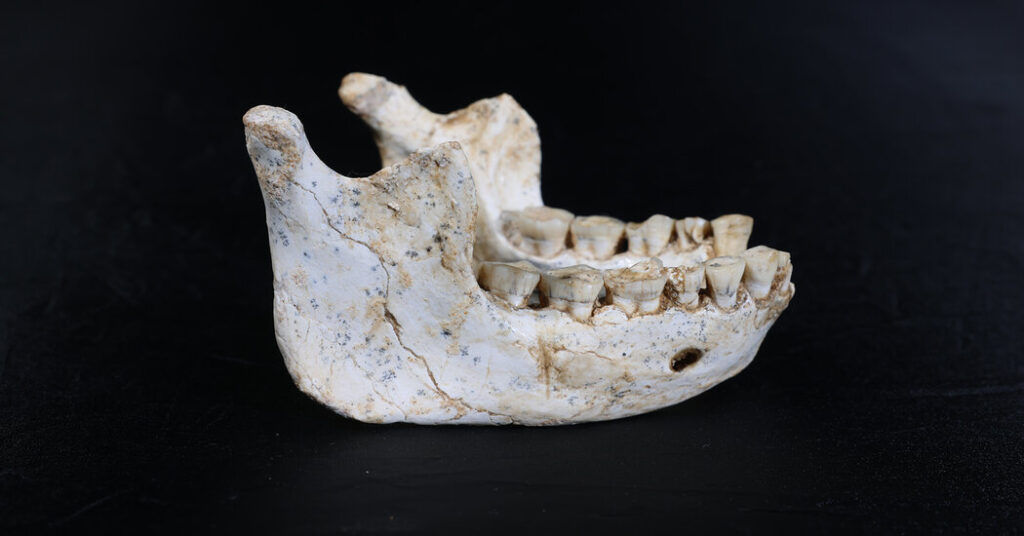
Researchers on Wednesday announced that fossils discovered in a Moroccan quarry are about 773,000 years old, filling a critical gap in the understanding how of human beings came to be. The find has the potential to revise theories on early human evolution.
The bones of hominins, primates leading up through the human lineage that branched off from chimpanzees and walked upright, are described in a study published in the journal Nature. The fossils come from Grotte à Hominidés, a cave site in Casablanca that may have been a den of prehistoric carnivores.
The site offers a window into a prehistoric coastal ecosystem, where the Atlantic meets a varied terrain of sand dunes, karsts and marine terraces. The region once was a vibrant habitat of wetlands and swamps that supported abundant wildlife, with panthers prowling the savannas and hippos, crocodiles, hyenas and jackals all sharing the muddy shores and surrounding areas.
The assemblage of hominin remains featured in the study includes a nearly complete adult jawbone, half an adult jawbone, the jawbone of a child, several vertebrae and isolated teeth. These remains are distinct from the fossils of the nearby Jebel Irhoud site, which at 300,000 years of age are currently the oldest known evidence of our species, Homo sapiens.
These rare, precisely dated bones are significant because they come from a period in the African fossil record from 600,000 to one million years ago from which similar specimens are yet to be found. This time frame is crucial, as it is when the African lineage leading to Homo sapiens is thought to have diverged from Eurasian hominins that produced Neanderthals and Denisovans.
The Grotte à Hominidés bones turn out to be strikingly similar to those of Homo antecessor, a species characterized by a mix of primitive and modern facial features and identified in the 1990s at a site in Gran Dolina, Spain. The Spanish fossils, which are of a comparable age, pushed back the known date for human presence in Western Europe by hundreds of thousands of years.
The Gran Dolina specimens challenged a theory that Homo sapiens originated in Africa and then replaced other hominins as they migrated to the rest of the world. Instead, they were offered as support for the idea that early hominins migrated out of Africa and evolved into distinct groups across Asia and Europe. In that evolutionary scheme, Homo antecessor was seen as a potential link between earlier African ancestors and the later European Homo sapiens and Neanderthals.
While distinct from the Spanish specimens, the Moroccan fossils also exhibit a mosaic of traits, indicating that the last common ancestor of these lineages existed on both sides of the Mediterranean and that the divergence between African and Eurasian hominin branches was already underway when the individuals lived. Jean-Jacques Hublin, an anthropologist at the Max Planck Institute for Evolutionary Anthropology in Germany and the lead author of the new paper, argued that this evidence supported a deep African origin for Homo sapiens and countered theories of a Eurasian origin for our species.
Scott A. Williams, a paleoanthropologist at New York University who was not involved in the project, said the research demonstrated that travel between northern Africa and southern Europe took place throughout the Middle Pleistocene epoch — an ice age period that lasted from roughly 774,000 to 129,000 years ago — and probably earlier.
Initial efforts to put an age to the Grotte à Hominidés specimens were inconsistent with surrounding geological and paleontological evidence. “Fortunately, the deposits at the site proved to be exceptionally well suited to recording past variations of the Earth’s magnetic field,” Dr. Hublin said.
The polarity of Earth’s magnetic field reverses periodically, leaving evidence of each flip in the geologic record. By using a technique called high-resolution magnetostratigraphy, the researchers were able to show that the specific sedimentary layer where the jawbones were found aligned with the most recent major flip. This provided one of the most accurate age estimates for an African hominin fossil collection from the Pleistocene epoch.
Could the Moroccan remains have belonged to members of the last common ancestor of Homo sapiens, Neanderthals and Denisovans? Although anthropologists estimate that the ancestor lived roughly 550,000 to 765,000 years ago, the limited fossil evidence fuels ongoing scholarly debate. Proposed candidates include Homo antecessor, Homo heidelbergensis or an unknown early hominin.
Uncertainty surrounds many aspects of the ancestor, including physical appearance, how populations changed over time and the timing and location of divergence. The species may not be fully represented in current records, even though DNA analysis confirms a complex ancestral history.
Dr. Hublin remained noncommittal on the identity of the Moroccan fossils.
“Human evolution is largely a history of extinctions,” he said. “It is difficult to say whether the small Grotte à Hominidés population left any descendants, but it provides a good picture of what the last common ancestor may have been like.”
He did point to evidence from Rhinos Cave, a neighboring site that is slightly younger than Grotte à Hominidés. It shows intense butchering activity, indicating that the Rhinos hominins were the apex predators of their era.
Still, he added with a touch of fatalism, “the occurrence at the Grotte à Hominidés of a hominin femur bearing gnawing marks from a large carnivore — probably a hyena, after death — demonstrates that hominins were also, at times, consumed as prey.”
The post Moroccan Cave Fossils Yield a Possible Missing Link in Human Evolution appeared first on New York Times.