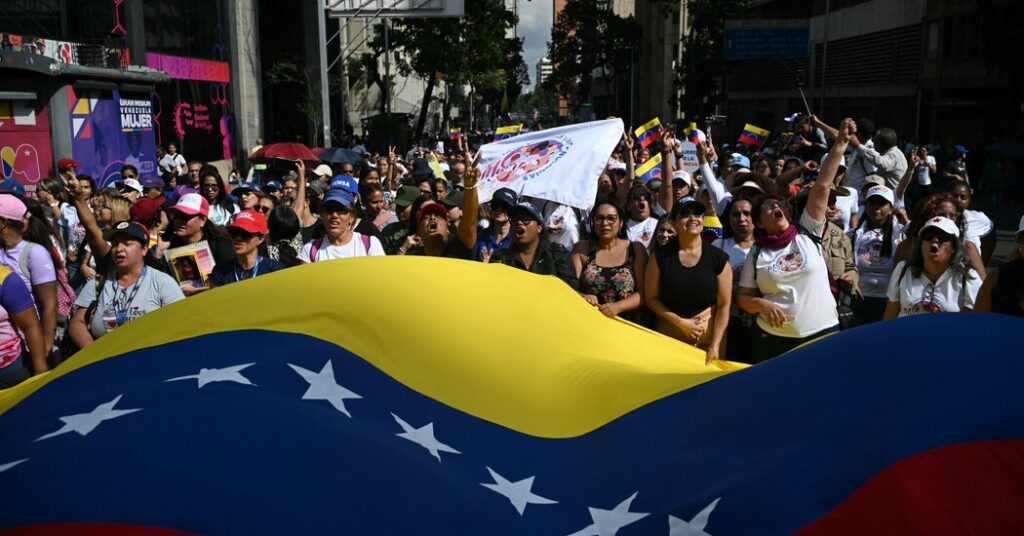
Government officials led a large crowd of Venezuelans through Caracas, the capital, on Tuesday, marching to demand the release of Nicolás Maduro, the nation’s ousted president.
At the same time, the government was on the hunt for anyone celebrating his capture by the United States.
Over the past several days, security forces have interrogated people at checkpoints, boarded public buses and searched passengers’ phones, looking for evidence that they approved of Mr. Maduro’s removal, according to Venezuelans in the country and human rights groups. At least 14 journalists and six citizens were detained; most have been released.
The split screen of the government leading a show of support for an unpopular authoritarian leader while cracking down on his critics was especially striking because the United States is now supporting that government.
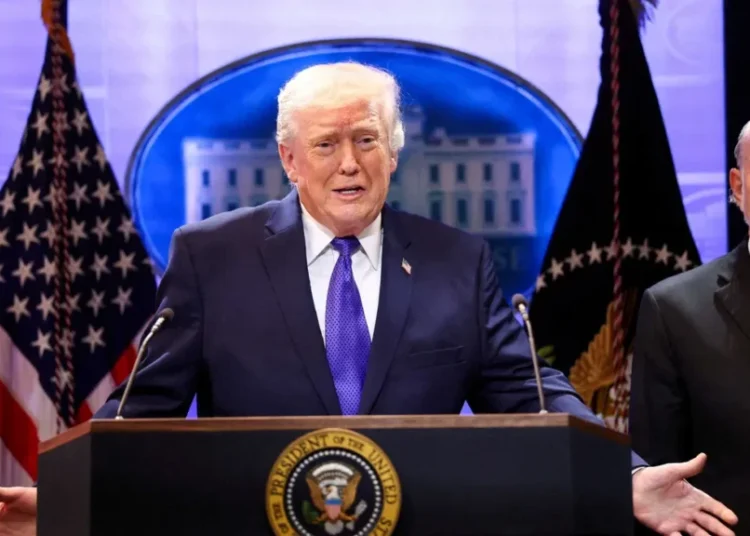
Four days after President Trump said the United States would “run” Venezuela, the sprawling political, security and intelligence apparatus that propped up Mr. Maduro’s strongman rule is in still place, and day-to-day life for many Venezuelans has worsened.
The interim leader, Delcy Rodríguez, who was Mr. Maduro’s vice president, has repeatedly demanded his release and condemned the Trump administration for the raid that captured him on Saturday.
“The government of Venezuela runs our country,” she said in a speech on Tuesday. “No one else.”
Despite Ms. Rodríguez’s public criticism, White House officials have expressed confidence that she will follow their orders, and there have been indications that they may be right. On Tuesday night, Mr. Trump announced that Venezuela had agreed to give the United States 30 million to 50 million barrels of oil. Venezuelan officials had no immediate response.
So far, it appears that Mr. Trump’s demands for the Venezuelan government, which he and other American presidents have denounced for its repression, have been relatively narrow.
In their public comments since Mr. Maduro’s capture, U.S. officials have focused largely on Venezuela’s oil and its connections to drug trafficking. Privately, they have also pressured Ms. Rodríguez’s government to expel spies and military personnel from China, Russia, Iran and Cuba.
Whether, or how, the Trump administration is prioritizing democracy and human rights in its talks with Venezuela is less clear.
Mr. Trump was asked by reporters on Sunday whether the two sides had discussed the release of political prisoners or the return of opposition politicians from exile. “We haven’t gotten to that yet,” he responded. “What we want to do now is fix up the oil.”
On Tuesday, Mr. Trump said that the Venezuelans “have a torture chamber in the middle of Caracas that they’re closing up.” He appeared to be referring to El Helicoide, a notorious prison where dissidents were held under Mr. Maduro’s rule. As of early Wednesday, it still seemed to be operating.
Ms. Rodríguez appears to have declared a 90-day state of emergency that gives the security forces broad power to “immediately search and capture” anyone who supports “the armed attack by the United States,” along with other measures that would further erode civil liberties in a nation long under authoritarian rule.
Since that decree, Venezuelans have reported an increase in the number of police and security forces on the streets, especially the so-called colectivos, militias of masked men carrying rifles.
The security forces have established numerous checkpoints around the country to stop vehicles, question passengers and search their phones for signs of opposition to the government, rights groups and Venezuelan citizens said.
“They went through people’s phones, opening their WhatsApp and typing in keywords like ‘invasion’ or ‘Maduro’ or ‘Trump’ in the chats to see if they were celebrating Maduro’s arrest,” said Gabriela Buada, director of Human Kaleidoscope, a Venezuelan organization that is tracking the crackdown.
Venezuelans interviewed for this article spoke on the condition of anonymity because they feared for their safety. One woman said that her husband, a 56-year-old produce vendor in the western state of Zulia, had shouted in celebration shortly after Mr. Maduro’s capture, saying that the autocrat who had once danced at rallies could now dance in prison.
Two days later, two national police officers were waiting for him at his produce stall, his wife said. He was arrested, and the police told the family to pay them $1,000 for his release, she said. They turned to relatives to raise the rest of the money and gave the police bags of fruit and vegetables, and he was released, his wife said.
On Monday, at Ms. Rodríguez’s swearing-in as acting president at the National Assembly in Caracas, the authorities detained 14 journalists, according to the local media union. Thirteen were later released and one was deported, the union said. Twenty-three other journalists who were detained under Mr. Maduro’s rule are still in custody.
On Monday and Tuesday, security forces detained at least six people at checkpoints, according to Human Kaleidoscope. In western Venezuela, police officials said they arrested two people in their 60s who had celebrated Mr. Maduro’s capture by firing guns into the air.
The current crackdown is not out of character for the Venezuelan government. For years, it has surveilled its citizens, imprisoned political opponents and restricted independent journalists.
What is striking is that the government seems to be ramping up such tactics just when it has the support of the Trump administration, which is also distancing itself from Venezuela’s main opposition, led by the Nobel laureate María Corina Machado.
Freddy Guevara, a Venezuelan ex-congressman and member of Ms. Machado’s coalition who is now in exile in New York, said he hoped the crackdown would spur the Trump administration to take more action against the government.
He argued that the state of emergency announced by Ms. Rodríguez had little practical importance because the government had long disregarded the law anyway. “But what really matters is what it shows,” he said. “It shows these people are believing that Trump is playing around and they can do whatever they want.”
Though a vast majority of Venezuelans opposed Mr. Maduro’s rule, there has been virtually no public celebration of his downfall, presumably because of the heavy security presence. State television has instead broadcast rallies across the country denouncing his capture, led by politicians and other loyalists.
The biggest yet was on Tuesday, when a crowd that appeared to be in the thousands marched through Caracas. At a rally at the end, the marquee speaker was Diosdado Cabello, the interior minister who oversaw Mr. Maduro’s repression of the population for years.
Days earlier, after Mr. Maduro’s capture, Mr. Cabello gathered a group of security forces and recorded a video of them chanting in armored vests and holding rifles.
“Always loyal! Never traitors!” they chanted. “Doubting is betrayal!”
Patricia Sulbarán contributed reporting from New York, and Emma Bubola from Buenos Aires.
Jack Nicas is The Times’s Mexico City bureau chief, leading coverage of Mexico, Central America and the Caribbean.
The post Maduro Is Gone, but Repression in Venezuela Has Intensified appeared first on New York Times.