Remember 2025, when President Trump dictated bracing new rules for the economy? Impose sweeping tariffs! Dismantle government agencies! Lower taxes! Cut spending! The Federal Reserve remained independent, but almost everyone else fell in line.
That may soon feel like ancient history, because in the first couple of months of this new year, the power shifts. The Supreme Court is expected to rule on both the Trump administration’s huge slew of tariffs and the president’s ability to control the Federal Reserve Board. In addition, a new nominee to lead the Fed will be handed over to the Senate for scrutiny. Meanwhile, Congress no longer seems to be listening to Mr. Trump on taxes and spending — and might even start enacting its own agenda.
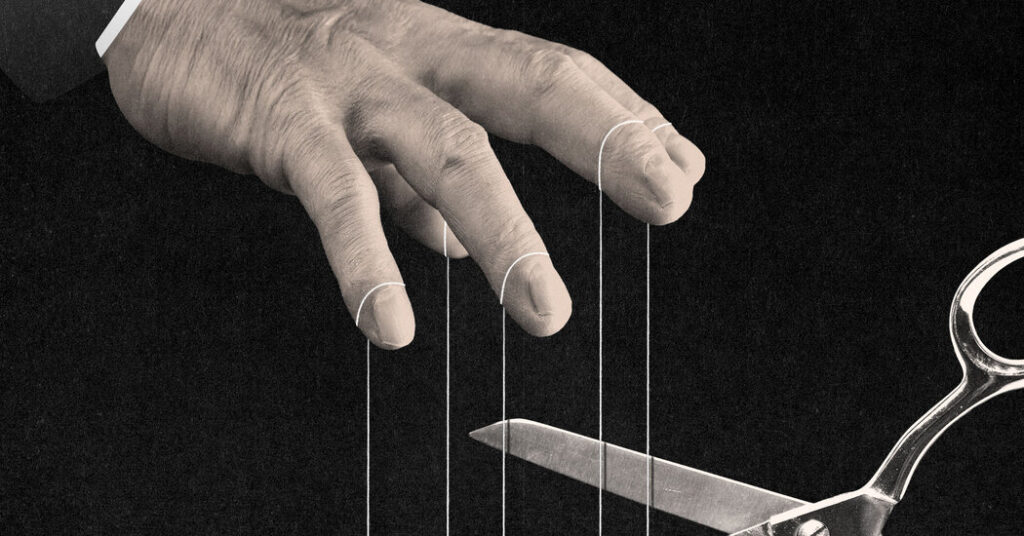
These developments, affecting cornerstones of Mr. Trump’s domestic agenda, will have a large impact on what our economy looks like and how it works. But in a sharp contrast to last year’s rule by fiat, none of the expected changes in these extremely consequential arenas is in the president’s control. At a minimum, these events may thwart his efforts to further impose his will. At a maximum, they will begin undoing the changes he’s made so far. Either way, we’re likely to end up well past peak Trump.
The tariff decision may be the first of these seismic events. In November, the Supreme Court heard arguments about the limits of the International Emergency Economic Powers Act, the basis of a majority of the tariffs introduced last year (including the so-called reciprocal tariffs of at least 10 percent imposed on almost all U.S. trading partners).
The court is expected to rule in coming days or weeks. A clean outcome — either fully endorsing or decisively rejecting the administration’s rationale — is possible but unlikely. More probable is a muddled decision that upholds some authorities while narrowing others. That ambiguity would ripple outward.
If some tariffs stay in place, businesses that have so far absorbed much of the costs may no longer be able to shield consumers from higher prices. Trading partners may reconsider their agreements — or retaliate against U.S. products. And if any tariffs are struck down, the administration will almost certainly try to reimpose them using alternative legal authorities, which will set off still more litigation.
The Supreme Court will be only getting started, however, because sometime soon thereafter it’s likely to issue a decision that will shape monetary policy more directly than the court has at any point in recent memory.
In August, President Trump claimed to have fired a Federal Reserve governor, Lisa Cook. Lower courts have blocked her removal pending Supreme Court review, with arguments scheduled to take place this month. (I joined every living former Federal Reserve chair, along with many former economic officials and economists, in an amicus brief supporting her.) The court’s ruling could reaffirm the independence of the Fed — or severely weaken it by effectively allowing the president to remove any central bankers who displease him.
Jerome Powell, the current Fed chair, particularly displeases him. Mr. Powell’s term as chair ends in May, so Mr. Trump is expected to choose a nominee to replace him sometime soon. Confirmation hearings will follow, to test not only the nominee’s qualifications, but also his or her willingness to operate independently of the White House.
Whoever takes the job will face real constraints. Financial markets will limit how far the chair can push policy. And within the Federal Reserve itself, the 11 other voting members of the Federal Open Market Committee have grown increasingly willing to dissent from the majority opinion. If the Supreme Court strengthens protections against removal, those dissents are likely to multiply — leaving the chair with less authority than at any point in decades.
Complicating matters further, there are signs that Congress, too, could reassert its powers.
In 2025, lawmakers largely did the president’s bidding on economic policy, passing tax cuts, spending cuts and stablecoin legislation with little effective resistance. But as midterm elections approach, the unified Republican front is starting to break, and Republican leaders could lose their very narrow control over the two chambers of Congress.
The overarching economic issue animating public debate is “affordability,” and its most immediate focal point is the expiration of expanded Affordable Care Act subsidies on Jan. 1. About 22 million people now face higher health insurance premiums. Democrats shut down the government last fall in an effort to extend the subsidies, framing them as central to a broader affordability agenda. In December, four House Republicans joined Democrats in a discharge petition to force a floor vote over leadership objections.
In an ideal world, Congress would use this moment to enact serious health care reform, lowering costs without increasing the deficit. With time already run out, that outcome seems unlikely. How lawmakers handle this issue may foreshadow whether they revisit the deep cuts to Medicaid and nutrition assistance enacted in the 2025 tax and spending bill.
These questions come at a moment when the state of the economy is already unusually uncertain. We’ve seen strong economic growth readings, falling inflation and the possibility that artificial intelligence will start to drive productivity growth. But the risk of recession remains elevated and lingering inflation complicates the possible responses. And today’s A.I. boom could yet turn into a bust.
I find myself wishing for something like Mr. Trump’s decisiveness from 2025 — but only if it could be paired with something it fundamentally lacked: wisdom. Instead, we may get a messy, fragmented system in which power is shared among nine Supreme Court justices, 12 Federal Reserve voters, 535 members of Congress, and millions of businesses and households making their own decisions.
I would settle for that. A stalemate, even an untidy one, is preferable to Mr. Trump wielding unilateral control over tariffs, other taxes, spending and monetary policy. If we are lucky, that stalemate will leave room for the enduring strength of the American economy: resilient workers, adaptable businesses and consumers who keep investing in the future.
Jason Furman, a contributing Opinion writer, was the chairman of the White House Council of Economic Advisers from 2013 to 2017.
Source photographs by Valiantsin Suprunovich and Irina Marwan/Getty Images
The Times is committed to publishing a diversity of letters to the editor. We’d like to hear what you think about this or any of our articles. Here are some tips. And here’s our email: [email protected].
Follow the New York Times Opinion section on Facebook, Instagram, TikTok, Bluesky, WhatsApp and Threads.
The post It’s Not Going to Be Trump’s Economy Anymore appeared first on New York Times.