I woke up on Dec. 13 in Belarus’s notorious Penal Colony No. 9, as I had every day for four and a half years, a political prisoner. But that Saturday was different. I was abruptly ordered to pack my belongings, blindfolded and driven away. I had no idea where I was being taken or why.
But when we crossed the border into Lithuania, I knew that I would be free. That day, I was one of 123 prisoners released in exchange for the lifting of U.S. sanctions on key Belarusian exports. I am grateful to President Trump for making this happen, but the job is not yet done.
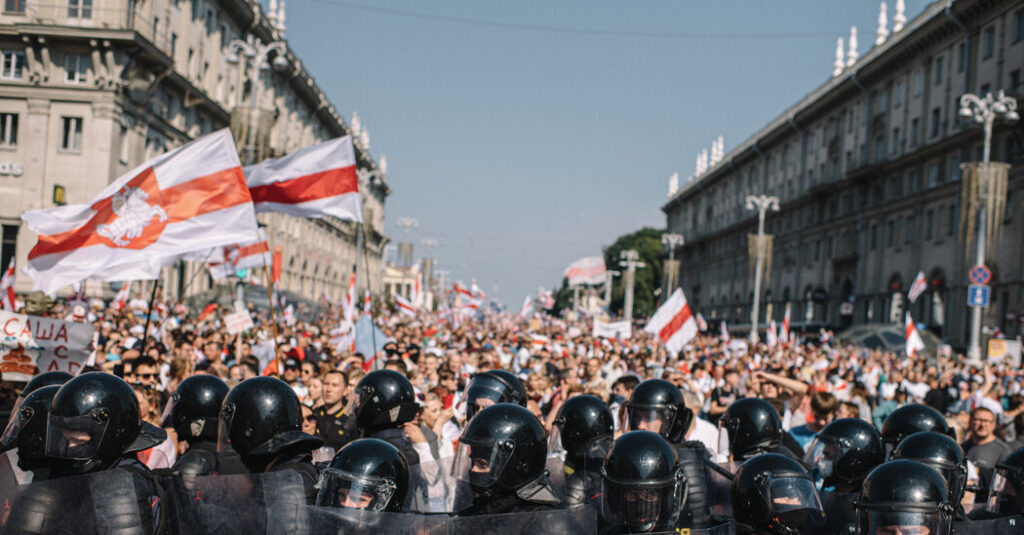
My story is part of a larger struggle for the freedom of the Belarusian people. I was detained in July 2021 during a brutal crackdown on political opponents ordered by the country’s leader, Aleksandr Lukashenko, in response to peaceful protests in 2020. As the leader of the Viasna Human Rights Center, I was charged with “smuggling” money and financing group actions that were “grossly violating public order.”
On March 3, 2023, after a show trial that was widely condemned as politically motivated, I was pronounced guilty and sentenced to 10 years in prison. A year later, the United Nations found that I was being arbitrarily detained in violation of international law and demanded my immediate and unconditional release. Yet, I remained detained in horrific conditions, placed in solitary confinement and denied access to necessary medication and regular contact with my family.
The human rights situation in Belarus worsened well before my detention, including through a severe crackdown on political participation and freedom of expression in the lead-up to the August 2020 presidential election. After Mr. Lukashenko’s so-called victory in that vote, which European officials denounced as neither free nor fair, the Belarusian people mobilized to demand respect for their democratic freedoms.
The electorate in 2020 was younger and more engaged on human rights than when Mr. Lukashenko came to power more than 30 years ago. As was clear from the widespread support for his opponent, Belarusians were ready for change. Instead, Mr. Lukashenko inflicted terror on his own people to maintain his grip on power: His henchmen carried out the violent repression of peaceful protests, arbitrarily imprisoning thousands of people and subjecting hundreds or more to torture.
Throughout my imprisonment, the human rights situation continued to deteriorate. Indeed, in 2023, the U.N. high commissioner for human rights, Volker Türk, found evidence of systematic, widespread and gross human rights violations and reported that some of the violations could amount to crimes against humanity. As of last month, there were reportedly still 1,100 political prisoners in Belarus, though the actual number is likely to be much higher, and freedom of speech and of the press have been largely eliminated.
Anyone who criticizes Mr. Lukashenko’s regime, human rights activist or not, is at risk of repression by the authorities. The people who were imprisoned alongside me were from all walks of life — students, factory workers and soldiers. They were simply people who dared to demand democracy.
What Mr. Lukashenko really fears is what will happen when the Belarusian people claim their freedom. He clearly wants to stay in power to enrich himself and his family. He wants to preserve and strengthen a regime that continues to serve the elites who carry out his wishes. Large segments of the Belarusian population unequivocally reject his dictatorship. Many of them will accept nothing less than his immediate departure and the opportunity to build a democratic society.
The international community has a critical role in supporting the Belarusian people. In addition to continued economic pressure on the regime, including sanctions on individuals and economic sectors, the most important steps it could take involve supporting pro-democracy organizations both inside and outside of Belarus.
For example, many pro-democracy activists work in exile. Democratic countries need to protect activists abroad who may be targeted by the Belarusian authorities, provide financial support for their organizations and foster the civic environment in Belarus necessary for the promotion of democracy and human rights and the ability to criticize the regime. Moreover, despite the danger, many courageous people inside Belarus continue to work for freedom, and they must not be forgotten. We must find new ways to build solidarity across borders because of the scale of the challenges facing the Belarusian people.
As the world considers how to improve the situation in Belarus, it is important to make two distinctions.
First, we must distinguish between Belarus and Russia. It is a mistake to assume that Belarus always sides with Russia. Notwithstanding Mr. Lukashenko’s alignment with President Vladimir Putin, some polls indicate that most Belarusians oppose sending troops to fight in Russia’s war on Ukraine. The world should not dismiss Belarus as lost to the Russian sphere of influence.
Second, we must always distinguish between the Belarusian people and the Belarusian regime in all areas. The population of Belarus is being held hostage by Mr. Lukashenko. The continued defiance of the Belarusian people in the face of harsh repression suggests that Mr. Lukashenko is running out of time. That is why we need to accelerate our efforts to bring democracy and human rights to our country.
In all my time in prison, I never gave up on the Belarusian people. The world must not either.
Ales Bialiatski is chairman and founder of the Viasna Human Rights Center, Belarus’s premier human rights organization, and a recipient of the Nobel Peace Prize.
The Times is committed to publishing a diversity of letters to the editor. We’d like to hear what you think about this or any of our articles. Here are some tips. And here’s our email: [email protected].
Follow the New York Times Opinion section on Facebook, Instagram, TikTok, Bluesky, WhatsApp and Threads.
The post I May Be Free, but the Belarusian People Are Not appeared first on New York Times.