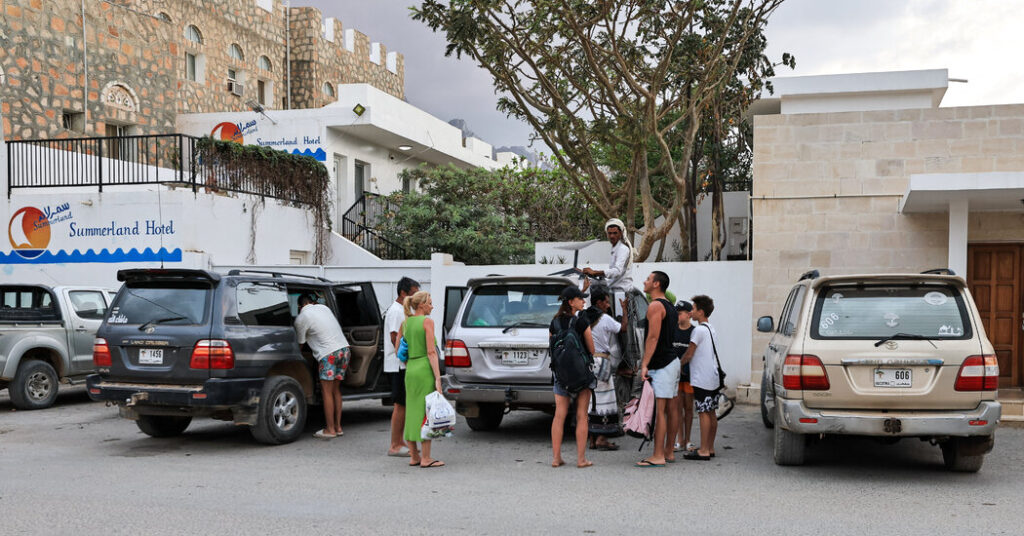
Hundreds of tourists have been left stranded on a remote island off southeast Yemen after flights were halted last week amid an escalating conflict on the mainland.
The cancellation of flights was triggered by tensions between the government of Yemen and a separatist faction that seized control of two key provinces in early December.
On Dec. 30, as the conflict intensified, the Yemeni government imposed an air, sea and land embargo on the country for 72 hours, including flights scheduled to and from the island of Socotra, which is part of the Socotra Archipelago, a UNESCO World Heritage site. Roughly 600 tourists — mostly Russians and Poles — have since been stuck in limbo on the island, according to Yahya Saleh Issa bin Afrar, a Yemeni government official in Socotra.
On Tuesday, the Russian and Polish governments said on social media that a new flight route operated by Yemen’s national carrier, Yemenia Airways, to Jeddah, Saudi Arabia, would begin regular service. The passengers had originally traveled to Socotra from Abu Dhabi in the United Arab Emirates on the Emirati-owned Air Arabia airlines.
Air Arabia’s press office did not respond to questions about the cancellation of its flights.
The stranded tourists have been caught in the middle of a fast-moving conflict in Yemen that has effectively become a proxy clash between two powerful Gulf allies.
While the internationally recognized government of Yemen is backed by Saudi Arabia, the separatist faction, which supports long-held ambitions by some Yemenis to form an independent state in southern Yemen, has received funding and support from the Emirates.
Saudi Arabia and the Emirates once partnered in a disastrous bombing campaign trying to oust the Houthis, an Iran-backed militia that took over the Yemeni capital more than a decade ago. But the two governments have been increasingly at odds in recent years, pursuing differing goals in Yemen, Sudan and beyond.
The Saudis and the Emiratis have feuded for weeks after the separatists gained control of parts of Yemen. That culminated on Dec. 30 in a Saudi-led airstrike on what the Saudis said was an arms shipment from the United Arab Emirates bound for the separatists.
In the aftermath, the Yemeni government imposed the air embargo. Days later, it sent the armed forces to recapture an oil-rich region from the separatists with Saudi support.
Socotra, though removed from the conflict on the mainland, sits in a strategic position in the Indian Ocean. In June 2020, the separatists staged a full-scale takeover of the island by ousting the government-appointed governor.
Since then, the Emirates has rebuilt Socotra’s only airport, upgraded the city’s commercial port and built a power plant on the island.
The island’s endemic species of flora and alien-like landscapes have remained a magnet for adventure tourists and social media influencers.
One American traveler said in an interview that he arrived at the airport in Socotra for a New Year’s Day departure only to find the terminal occupied not by airline staff, but by armed fighters from the separatist faction who said no flights would operate until further notice.
Saeed Al-Batati contributed reporting from Al Mukalla, Yemen
Ismaeel Naar is an international reporter for The Times, covering the Gulf states. He is based in Dubai, United Arab Emirates.
The post Hundreds of Tourists on Yemeni Island Caught Up in Saudi-U.A.E. Rift appeared first on New York Times.