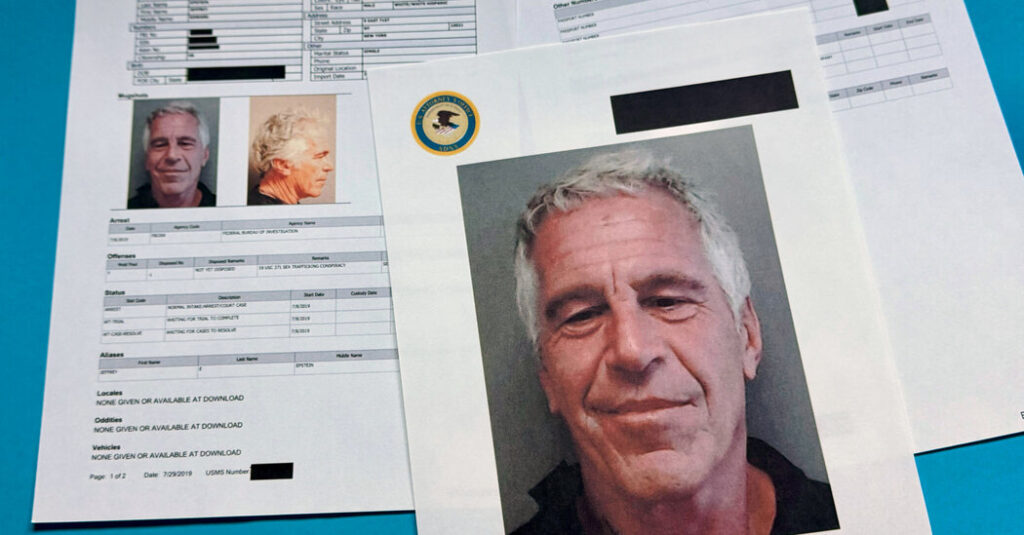
Nearly two-thirds of the lawyers in the U.S. attorney’s office in Manhattan are spending all or most of their work day reviewing many of the two million documents in the Jeffrey Epstein investigation that the Justice Department must still release.
The disclosure that 125 of the office’s roughly 200 assistant U.S. attorneys are participating came in a letter from Attorney General Pam Bondi and other officials filed in Manhattan federal court on Monday night.
The letter, which was also submitted by Ms. Bondi’s deputy, Todd Blanche, and the head of the Manhattan prosecutors’ office, Jay Clayton, said that the 125 lawyers were among more than 400 Justice Department lawyers who had been directed to review the Epstein materials to determine what must be redacted before they are released. The release was ordered by a new law, the Epstein Files Transparency Act.
The letter said that for at least the next few weeks the lawyers would be working to review and redact a huge trove of documents, photographs, video recordings, handwritten notes and other materials that are to be made public. That means that at least half of the office’s lawyers who normally handle criminal cases will be devoted to the review.
The law requires the government to redact names and other personal information that could identify victims of Mr. Epstein’s sex-trafficking scheme, in which large numbers of girls and women were sexually abused by him and his longtime companion, Ghislaine Maxwell.
The filing on Monday, addressed to Judge Paul A. Engelmayer, who oversees the Maxwell case, emphasized what the Justice Department called its commitment to protecting victim privacy under the new law, which had set a deadline of Dec. 19, 2025, for the materials to be released.
David Paul Horowitz, a private lawyer who teaches a workshop at Columbia Law School on electronic evidence and discovery, said that because of the heightened sensitivity of the Epstein case and Congress’s mandate that the department release the materials, “maybe throwing 400 lawyers at it as a show of good faith is not a bad idea.”
But, he added, having the Southern District divert more than half of its lawyers to work on the review, even for just weeks, “could pose a significant disruption to the office’s day-to-day work.”
“I’d like to know whose watching drug kingpins while they are looking at these documents,” Mr. Horowitz said.
The Southern District did not immediately respond to requests for comment on whether the Epstein review was diverting lawyers from other important matters. The department’s filing did not elaborate on how the review had been allocated among the office’s lawyers. Of the office’s roughly 200 assistant U.S. attorneys, 154 are assigned to criminal cases, 45 to civil matters and six are serving in executive roles, the Southern District has said.
The office has long handled some of America’s most complex prosecutions, including those involving terrorists, international drug traffickers, corrupt politicians and financial fraudsters. Its current docket includes defendants like Nicolás Maduro, the Venezuelan leader captured over the weekend in a U.S. military operation and charged with narco-terrorism conspiracy; and Luigi Mangione, who faces trial in the 2024 killing of UnitedHealthcare’s chief executive in Midtown Manhattan. Both men have pleaded not guilty.
Benjamin Weiser is a Times reporter covering the federal courts and U.S. attorney’s office in Manhattan, and the justice system more broadly.
The post Hundreds of Lawyers Are Spending Their Days Redacting the Epstein Files appeared first on New York Times.