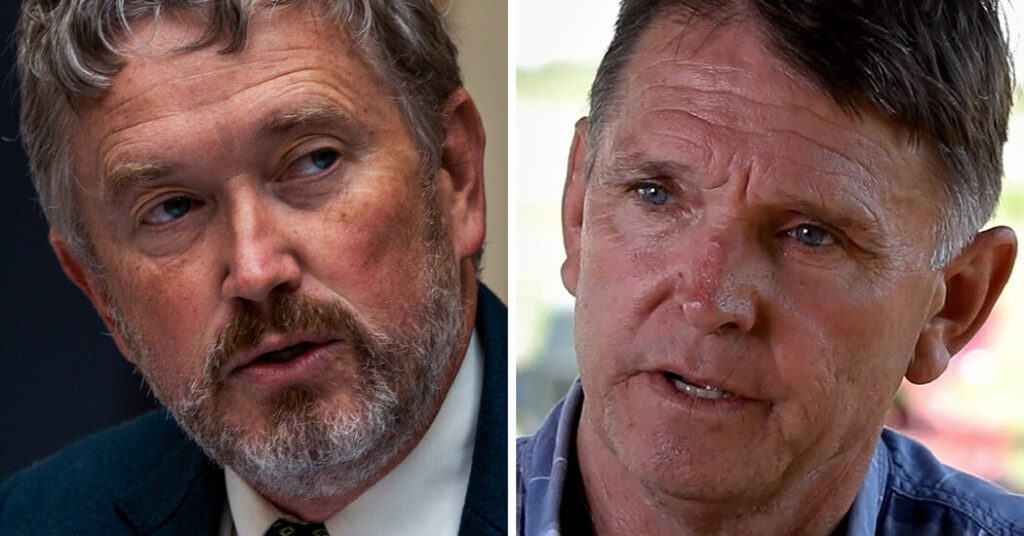
In the days since the United States captured the leader of Venezuela, Republican lawmakers have largely applauded the Trump administration’s initial actions. One vocal exception: an idiosyncratic Republican congressman running in one of the most interesting G.O.P. primaries on the map.
Today, I’m going to tell you a little about that congressman, his race and why it matters.
Representative Thomas Massie, a libertarian-leaning lawmaker from northern Kentucky who has long clashed with President Trump, was the rare Republican to bash the weekend intervention in Venezuela, suggesting it was a betrayal of the MAGA movement’s desire to stay out of foreign entanglements.
At the White House, that stance went over about as well as you’d expect.
“He only votes AGAINST the Republican Party, making life very easy for the Radical Left,” Trump complained on Truth Social this week.
Trump is backing the Massie challenger Ed Gallrein, a farmer who served as a Navy SEAL officer and is casting Massie as a roadblock to the president’s agenda. That’s a potentially potent argument in a district the president won overwhelmingly, and the May 19 primary contest is expected to be hard-fought. Gallrein, Trump noted approvingly in his post, “is a big fan of our recent attack on Nicolas Maduro, the Dictator of Venezuela.”
Massie, a seventh-term congressman who has survived political saber-rattling from Trump before, dismissed the comments with a meme.
Americans don’t usually vote on foreign policy. But if any Republican primary race in America is going to test G.O.P. voters’ appetites for intervention abroad and Trump dissent at home, it’s this one.
“The interesting question in that race is whether or not a more libertarian ideology, as it pertains to foreign policy and all kinds of different things, overcomes their all-out love for the president,” said Josh Holmes, who served as a top aide to Senator Mitch McConnell of Kentucky.
It’s a marked contrast with other primaries this year, where Republicans are racing to out-Trump one another. And it’s a departure from the Trump-related fault lines within the party that we saw during his first term.
Many of the old-guard, moderate Republicans who sometimes pushed back on Trump are out of office and in some cases have effectively become Democrats. Increasingly, the most vocal Republican dissent seems to be coming from the isolationist-leaning right, from figures like Massie and Marjorie Taylor Greene, who officially left Congress this week.
But there’s no question that Trump remains the dominant force in Republican politics, with many in the party supportive, at least so far, of his actions in Venezuela.
A national Reuters/Ipsos poll released this week found that 65 percent of Republicans approved of the U.S. military action to remove Maduro.
Jake Cox, who helped steer the 2022 campaign of Senator Rand Paul of Kentucky, said the question of foreign intervention “may play a larger outsize role as of this moment” in the Massie race.
But in a heavily pro-Trump state, perhaps the bigger challenge for Massie, he suggested, is that “the president and Congressman Massie have significant differences across the board.”
Just before we sent this newsletter, Massie called my colleague Jennifer Medina.
“Right now it is a politically perilous position for me to take,” he acknowledged, even as he said it should come as no surprise to his constituents. “But I think with age, it might start looking better.”
Massie told Jennifer that he thought the Venezuela action was “illegal and unconstitutional.” But asked if Trump should be impeached over it, he quickly replied, “That’s not something I would do.”
Why things just got dicier for House Republicans
The House Republican majority dwindled to the bare minimum of 218 votes this week, my colleague Annie Karni reported, after the death ofRepresentative Doug LaMalfa, a California Republican.
That razor-thin advantage will make it even harder for House Republicans to govern — and their grip on power is now all the more tenuous heading into a tough midterm campaign.
Got a tip? The Times offers several ways to send important information confidentially.
One Number
33 percent
That’s the share of all Americans who approve of the U.S. military action to remove the Venezuelan leader, according to the Reuters/Ipsos poll, a stark contrast with the 65 percent of Republicans who approved. Ruth Igielnik, The Times’s polling editor, explains.
It’s early days, but so far, Trump seems to have largely secured the support of his base over his actions in Venezuela. The rest of the country is less sold.
Thirty-four percent of Americans surveyed disapprove of the raid to remove Maduro, according to the poll, which was taken immediately afterward. Roughly one-third of Americans said they were unsure.
quote of the day
“I don’t understand what the president means when he says that we will, quote, run Venezuela.”
That’s RepublicanSenator Susan Collins of Maine, who is up for re-election in a closely watched race this year. “The Venezuelans ought to run Venezuela,” she said.
Take Our Quiz
This question comes from a recent article in The Times. Click an answer to see if you’re right. (The link will be free.)
Some wealthy Silicon Valley leaders are eyeing ways to support a long-shot primary challenge against Ro Khanna, a progressive congressman who represents a Bay Area district. Why are they mad at him?
-
He has defended a proposed one-time wealth tax in California
-
He was a vocal proponent of Gov. Gavin Newsom’s redistricting measure
-
He celebrated the inauguration of Mayor Zohran Mamdani of New York City
Jennifer Medina, Ruth Igielnik, Ama Sarpomaa and Taylor Robinson contributed reporting.
Katie Glueck is a Times national political reporter.
The post How Venezuela Is Already Rattling One Republican Primary appeared first on New York Times.