This year, North America will host the world’s largest sporting event: the 2026 FIFA World Cup, which will be played in 11 cities in the United States, three in Mexico, and two in Canada.
The World Cup is the most-watched sporting event on the planet, drawing more viewers than the Super Bowl and the World Series combined. This year marks the first time since 1994 that World Cup matches will be played in the United States.
This year’s edition has also gotten attention for political reasons. The US role in hosting the tournament has been years in the making, and it’s closely tied to President Donald Trump and his unusually warm relationship with FIFA President Gianni Infantino.
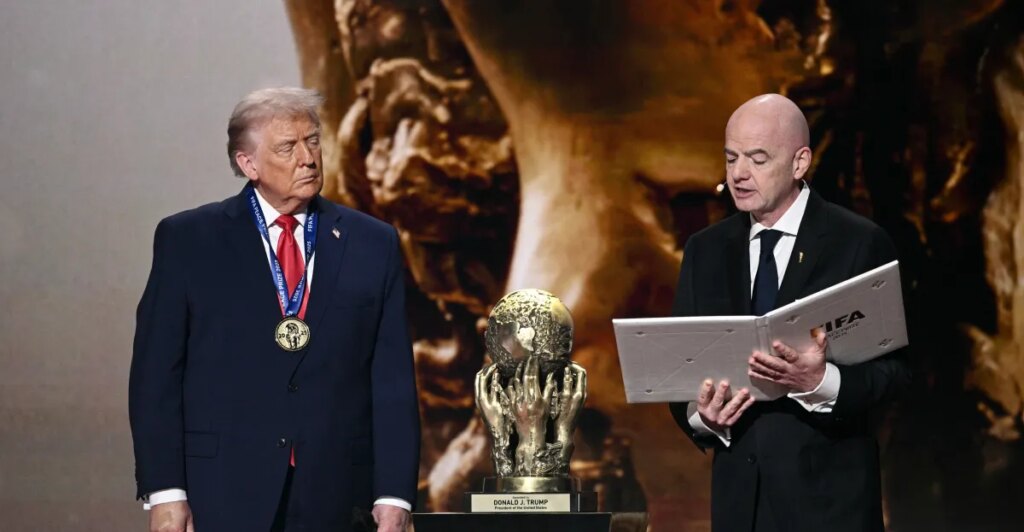
Infantino has praised Trump lavishly, presenting him with gifts — including FIFA’s Peace Prize, a wholly made-up award that the FIFA president gave to Trump last November — and has reportedly visited the White House more than any other world leader during Trump’s second term.
Today, Explained co-host Astead Herndon spoke with Adam Crafton, a senior reporter at t he Athletic, who has closely covered FIFA and the growing relationship between the two men.
Below is an excerpt of their conversation, edited for length and clarity. There’s much more in the full episode, so listen to Today, Explained wherever you get podcasts, including Apple Podcasts, Pandora, and Spotify.
How did the US, Canada, and Mexico even get these games in the first place?
The way it works is nations bid, and they bid quite a long way out. The process for this was around 2017. It was actually during Trump’s first presidency.
It’s interesting to look back on, because President Trump gets the opportunity to take credit for it. But actually, one of the motivating factors for [the US, Canada, and Mexico] joining forces was kind of this concern about whether America, the USA, could win a bid by itself, because this was coming off the back of, if you remember, the FBI’s criminal investigations into FIFA and the DOJs involvement. And there was this concern about whether FIFA membership would actually go for it, just an American bid. So [the US] joined forces with Canada and Mexico.
Also, just this feeling at the time of Trump saying some pretty disparaging things about other parts of the world. During the bidding process, I spoke to people part of that bid, and they would be going round saying to people things like, “Oh, you know, Trump doesn’t really mean what he’s saying,” or “Don’t worry, he won’t be the president by the time this comes around.” And yet, here we are. And Trump, I think Trump likes it, basically, because he can claim credit. He can say, “I was here when we won this. I brought this, and now I’m here to deliver this.”
We have our two main characters here: President Trump and Gianni Infantino, president of FIFA. Can you tell me about their relationship and how it’s shaping the World Cup?
Their relationship was born out of the bid. Infantino kind of got himself into the Oval Office a couple of times; that was how it started. But what actually happened was, whereas a lot of people obviously turned on Trump towards the end of his first presidency and certainly after January 6, Infantino didn’t. There was no point where Infantino publicly distanced himself from Trump. He stayed close. He went to Mar-a-Lago. He maintained that relationship. And I think Trump, whatever people think of him, he’s clearly someone who remembers those who are loyal to him.
When Trump was then out of office, FIFA found it really difficult to penetrate the White House. There was no picture with Joe Biden in the Oval Office. There was no visit to the Oval Office for Infantino during that time. Then, when Trump wins power in November 2024, Infantino is immediately on the front foot — I mean, on Instagram every other day, praising Trump. He went to his pre-inauguration rally. And Trump would keep name-checking him at these events. It was pretty odd for those of us who have followed Infantino as a job, kind of this soccer bureaucrat, to all of a sudden see him basically being on first name terms with the US president.
Infantino’s been in the Oval Office more than any foreign state leader, for example. That’s extraordinary.
Wait, say that again? He’s been in the Oval Office more than any other foreign state leader, any other kind of dignitary?
Yeah, I mean, if you think of, at least, in public appearances, where you see those kind of joint Oval Office affairs, like the one that, for example, Mamdani had with Trump in the Oval Office. There’s been several of those with Trump and Infantino.
Can you explain the FIFA Peace Prize?
So, at the FIFA World Cup draw, at the start of December, Donald Trump was presented with the inaugural FIFA Peace Prize.
FIFA has never had a Peace Prize. Nobody has ever asked FIFA to do a peace prize, as far as we know. And the background of this is earlier, in Autumn 2025, there was a kind of unofficial campaign coming out of the White House to suggest that President Trump should be winning the Nobel Peace Prize. And actually, the day before the Nobel Peace Prize was announced, Infantino goes out on Instagram and actually says President Trump deserves it.
I mean, there’s no reason for the president of FIFA to be making these declarations about who deserves the Nobel Peace Prize. Why is Infantino going out on a limb in this way?
There’s a few theories on this. The first is, just: Infantino loves it, right? He loves being around rich, powerful people — sees himself as this kind of head of state for soccer.
The second view is there is a pragmatic need for FIFA to go above and beyondd. And maybe they just think, “This is what we need to do to make sure we get what we need.” And there are things that FIFA needs. So, the host cities, the 11 host cities in the states, have needed $625 million worth of federal security funding for the tournament.
Recently, and amid all the immigration policies that have been going on, FIFA secured what has been called a “FIFA pass,” which means that, if you have bought a ticket for the World Cup, you will get an appointment wherever you are in the world through a visa interview in your country within six to eight weeks.
There are these concessions that FIFA have got, but at the same time, you now have four nations — Haiti, Iran, Senegal, Ivory Coast — whose countries have travel bans, which mean their fans can’t travel to the tournament.
So, there’s some wins and there’s some losses, but I think FIFA are wary [that], at some point, someone in the White House might turn around, look at FIFA and say, “Hang on. They are a kind of a global organization that get tax breaks from America, that get all this revenue from putting on a tournament on our soil, and we are not getting a cut of the ticket revenue, of the parking revenue, of the broadcast, the sponsorship. Why are we helping these guys so much?” Does a Peace Prize go some way to just making sure that’s always on [Trump’s] desk and reminding him FIFA’s great?
The post How Trump brought the World Cup to America appeared first on Vox.