The video was designed to grab attention.
Posted the day after Christmas, it shows right-wing YouTuber Nick Shirley exposing what he says are a series of fraudulent day care centers in Minnesota. He rings doorbells, pulls on doors, and sometimes claims to be a parent hoping to register his child, “Little Joey.” When he’s not admitted, he claims the centers are fake, with no children inside. All the while, a ticker at the bottom of the screen tallies up millions of dollars in alleged graft.
“When I look at the world as a whole, and I look at fraud, the Twin Cities is ground zero,” one of Shirley’s associates said at one point. “The fraud is worse here than anywhere else ever in history.”
The video does not actually provide direct evidence of fraud. State investigators visited the centers Shirley highlighted and found children at all but one, which was not yet open for families. But Shirley’s purported exposé, viewed over 3 million times, has started a wave of outrage among right-wing lawmakers already focused on allegations of social services fraud in Somali immigrant communities in Minnesota.
Now, the Trump administration has announced a freeze on federal child care funding to five blue states, including Minnesota, along with increased reporting requirements for all states. Providers around the country fear they may have to close their doors and lay off staff, and parents are worried about how their lives might be upended if they lose child care.
“Having disruptions like this is really counterproductive for children, for parents who are trying to go to work, and for the really underpaid, and stressed, and strained child care workforce,” said Amy Matsui, vice president of child care and income security at the National Women’s Law Center.
How did unsubstantiated claims of child care fraud go from a YouTube video to influencing federal policy in a matter of days? The answer lies at the intersection of actual pandemic-era fraud cases, a right-wing media ecosystem eager for anti-immigrant content, and a longstanding conservative antipathy toward subsidized day care. But the politics of early childhood in America are also changing, and the White House response to Shirley’s video could create blowback that the Trump administration didn’t anticipate.
Minnesota’s welfare fraud scandal, explained
The current controversy over child care centers in Minnesota has its roots in 2022, when federal prosecutors charged 47 people with fraudulently siphoning funds from a state program meant to feed hungry children during the pandemic. The scandal soon expanded to include providers charged with fraudulently billing the state for housing assistance and autism therapy services. Prosecutors say fraudsters may have stolen as much as $9 billion, and Minnesota Gov. Tim Walz dropped his reelection bid this week amid the scandal.
Most of those charged with fraud are part of Minnesota’s Somali community, the largest in the country. Most are also US citizens. The charges, filed during the Biden administration, have been re-amplified by conservative activist Chris Rufo and others in recent weeks and used to stoke racism and xenophobia toward all Somali immigrants. “I don’t want them in our country,” President Donald Trump said in December.
The recent federal fraud investigations that have garnered national attention did not have to do with child care centers. But now, thanks to Shirley’s video, the national spotlight is trained squarely on dayc ares.
In the video, Shirley and an associate identified only as David claimed that day care centers run by members of the Somali community have “stolen” millions of dollars from the state of Minnesota. State governments, supported in part by the federal Child Care and Development Block Grant program, subsidize providers for caring for children from low-income families. It is presumably these subsidies that Shirley believes are being stolen.
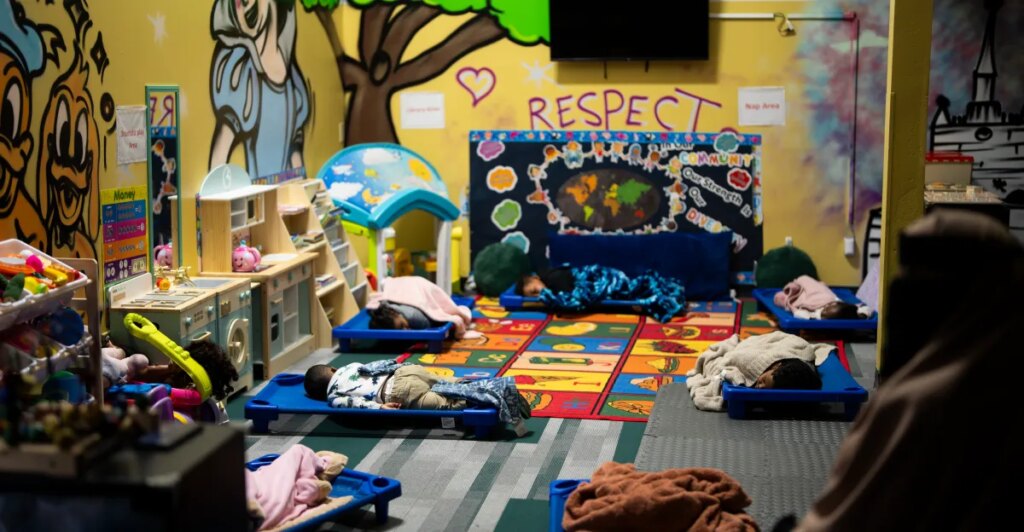
The video, however, does not provide any direct evidence of theft. Child care centers often keep doors locked, allowing only families and staff to enter, for safety reasons. “I have a very hard time imagining why or how child care staff would be willing to let a random stranger into a location,” Matsui said. “I would not want my child care provider to be letting random YouTubers into a space where my children were.”
None of the people identified in public documents as owning the centers have been charged with fraud, according to an investigation by the Minneapolis Star Tribune following up on Shirley’s video. While state investigations are ongoing, state officials who visited the centers after the video released said they were operating normally. Shirley has not responded to a request for comment from Vox.
There is no national database tracking child care fraud, but “as in any program, it’s not nonexistent,” said Daniel Hains, chief policy and professional advancement officer at the National Association for the Education of Young Children, a nonprofit that supports child care and early learning providers. Minnesota state auditors previously investigated claims of fraud in its child care programs and identified some potential vulnerabilities in 2019, leading to increased federal oversight and renewed focus from state lawmakers. Nationally, the federal government has also devoted attention to the topic. A 2020 report by the federal Government Accountability Office outlined nine recommendations for preventing fraud in the disbursement of child care subsidies, many of which states have followed, Hains said.
“There is huge public support for having greater public investment in child care. This is something that families want and need for their economic security.”
Amy Matsui, vice president of child care and income security at the National Women’s Law Center
But the Trump administration has responded to Shirley’s video with a series of blanket funding freezes. In a December 30 statement praising Shirley’s “excellent work,” Deputy Health and Human Services Secretary Jim O’Neill announced, “We have frozen all child care payments to the state of Minnesota.”
Then, on Monday, HHS officials told reporters that the agency would freeze $10 billion in child care and food assistance funds for five blue states: California, Colorado, Illinois, Minnesota, and New York. “Democrat-led states and governors have been complicit in allowing massive amounts of fraud to occur under their watch,” HHS spokesperson Andrew Nixon said in a statement, although there is no evidence of major fraud in the other four states beyond Minnesota. The agency also says that child care payments to all states will now be subject to additional scrutiny.
HHS describes the freeze as necessary in order to root out wrongdoing in the child care system. “These requirements help ensure the integrity of the program and protect both families and providers,” a spokesperson told me in an email.
Even for experts in the child care space, the rollout of overlapping freeze announcements has been confusing. It’s not clear exactly what information will be required to restart payments or how requirements will differ by state.
But states are likely to face delays in getting their federal funding, which could lead to delays in money paid to individual providers. Child care centers, which are often extremely small businesses, are ill-placed to weather such cash-flow disruptions. “Because providers are working on such small margins, it’s entirely possible that they might have to close, whether temporarily or permanently,” Matsui said.
Such closures put parents’ jobs at risk, Hains said. They also create risks for children if families have to turn to less-safe options, like leaving children home alone or with a sibling. Meanwhile, sudden disruptions in care can be harmful in themselves, Hains said. The relationship between children and their caregivers “is really formative and foundational, and it’s critical for young children’s healthy development to retain those sustained, nurturing relationships.”
Child care centers around the country are facing fallout even beyond the funding freezes. HHS is also rescinding a Biden-era rule that encouraged states to pay child care providers up front based on enrollment, rather than after the fact based on recorded attendance. Child care experts say a return to after-the-fact payments will make it harder for providers to plan and pay their bills.
Meanwhile, a Minnesota day care center not featured in the video experienced a break-in and theft of enrollment records and other documents, and other day cares run by Somali Americans in the area have reported threats and harassment. Copycat YouTubers have been recording their own videos at day cares in states like Washington and Ohio.
“It really is destabilizing and terrifying and not at all furthering the goal of enabling more families to have the child care they need,” Matsui said.
The politics of child care in 2026
The episode has provided an opening for conservative lawmakers and others to question the very premise of subsidized child care. “When did it become the federal government’s role to provide day care?” Rep. Thomas Massie (R-KY), known for his libertarian views, asked on X in December.
Efforts to expand public support for child care have also long run up against social conservatives’ concerns that more mothers should stay home with children, an ideal that’s been embraced implicitly and explicitly by members of the Trump administration and the larger MAGA coalition. The fact that a high percentage of child care workers are immigrants also makes the sector highly vulnerable to an administration that’s increasingly comfortable with sweepingly anti-immigrant rhetoric and policy. The administration this week announced a deployment of 2,000 federal agents to Minnesota in an immigration operation apparently aimed at the Somali community.
There’s nothing the Trump administration would like to talk about more than a crackdown on fraud tied to immigrant communities. But the pivot to disrupting child care on a potentially massive scale also comes at a time when there’s public momentum behind reducing costs for families with young children — a more politically sensitive topic for the White House.
Publicly funded child care is on an upswing in America, with New Mexico recently becoming the first state to offer universal child care. In New York City, universal child care was part of Mayor Zohran Mamdani’s affordability pitch to voters — one both parties are attempting to emulate. Polling also shows voters are interested in Washington doing more to help those efforts; one AP-NORC survey last year found 64 percent of US adults favored federal help for providing low-cost or free day care, including 51 percent of Republicans.
“There is huge public support for having greater public investment in child care,” Matsui said. “This is something that families want and need for their economic security.”
There was a time when freezing public funding for day care centers might have been an easy political win for Trump. But today, a move that drives up the cost of living for families around the country may be less popular than the administration imagines.
The post How the Minnesota fraud scandal could upend American child care appeared first on Vox.