The dark of night. A dog barks. In a small house on a dirt road, a woman screams as she gives birth. An elderly woman is tenderly undressed, washed and diapered by a young man, then painstakingly fed with a spoon. A song plays dimly, as if from a radio somewhere nearby.
These are the opening moments of Mario Banushi’s “Mami,” a wordless, dreamlike, poetic collage evoking mothers and children, adolescence and old age, the mutable exchange between the nurturer and the nurtured.
“Mami,” created by the Greek-Albanian Banushi in 2025, was one of the hits at the Avignon Festival in France last year, and this month it’s leading the Under the Radar festival, a celebration of experimental and international performance running Jan. 7-25 that will include 38 shows at 24 venues across New York City. “Mami” will run at N.Y.U. Skirball Jan. 7-10.
“Mario is a singular voice in world theater, and audiences here are getting a chance to experience it early in his career,” said Mark Russell, the founder and artistic director of Under the Radar, noting that he had first heard about Banushi’s work around 18 months ago “through my spies in Europe.”
Under the Radar, founded in 2005, lost its longtime home at the Public Theater in 2023, but has both survived and thrived, expanding into numerous partner venues and extending its footprint across the city.
Jay Wegman, the executive director of N.Y.U. Skirball, said he had seen an early performance of “Mami” in Athens last year and “was struck that no one in the U.S. is making work like this: no text, image-driven, mysterious.” Most drama in the United States, he added, is very text-based. “Mario’s way of having narrative unfold, of misdirecting the eye and suddenly revealing something new is a wonderful way of encountering new work.”
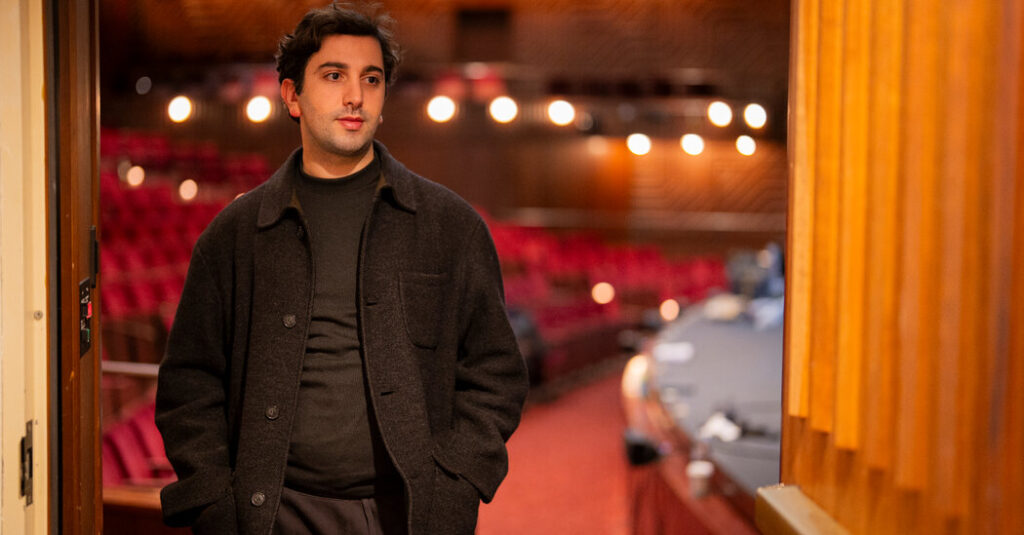
“Mami” is the 26-year-old Banushi’s fourth show, and his first to travel to North America. In a video interview, he said he had never traveled beyond Albania or Greece until 2023, when his second work, “Goodbye Lindita,” began to receive invitations from festivals and theaters abroad.
“All of this is still something new to me: festivals, curators, interviews,” he said. During an hourlong conversation, he spoke easily in English about his childhood in Albania and Greece, the start of his directing career and theater that is about feeling, not understanding. Here are edited excerpts from the conversation.
You were born in Greece, then lived in Albania until you were 6, before coming back to Athens. Do you feel both Greek and Albanian?
I feel more Greek. But Albania is very important to me, and a lot of the images in my work come from my childhood there, living in the countryside with my grandparents. The streets weren’t paved, my family were all nearby, and my grandmother was always cooking. Sometimes we would have no electricity and light candles — it was like living in a fairy tale. “Mami” was really inspired by this. It’s a world that’s nowhere: Dust, a light, a small house, a family, their stories.
The stories you tell are poetic and without speech or linear narrative. Did you know you wanted to work like this from the outset?
It really was more of an instinct than a decision at the start, and I began to understand that the only way I can work is by this kind of instinct, by talking to myself. No one in my family was connected to the arts; we never went to the theater or even the cinema. But I was a child who loved to draw and create things with my hands, and I am still that child who likes to take the materials and play with them. Words can limit things. For me, this way of working opens up more possibilities, more fantasy, more images, more ways to express feelings, more stories.
Did you know you wanted to work in theater?
Not at all. I wanted to go to the school of fine arts, but we didn’t have money for me to go to drawing lessons. When I was finishing high school, I bumped into a girl I knew, and she told me she was at drama school. I didn’t even know what that meant, but she explained it to me. I said, I want to do this. I learned a few monologues and went to audition at the Athens Conservatory. They accepted me into their four-year acting program.
You began to direct soon after the Covid pandemic began, creating a trilogy of works: “Ragada,” “Goodbye Lindita” and “Taverna Miresia,” all centered around family figures. What draws you to these very personal explorations?
It was very tough after I graduated, partly because of Covid, but eventually I had an opportunity to stage a short piece, which became “Ragada,” around my mother’s work as a midwife. Then I had an invitation from the National Theater of Greece to create something for its Experimental Stage, and I had to come up with a subject quickly. I was so stressed, then I thought “Ragada” worked because it was personal and mattered to me. What matters to me now? I was grieving the deaths of my stepmother and my father, so I decided, I will create these pieces and talk about grief.
For me, it’s a way to keep my memories and my roots alive, but it’s not only about that. Every artist is propelled by something, and for me, this is it. I might create a surreal world, but I want to start from real stories, to start from the personal and become universal.
You create dreamlike imagery that sometimes recalls works by Dimitris Papaioannou and Pina Bausch. What is your process of creation like?
I start with some visual ideas, drawings, images. I usually don’t know how many people will fit in this story, but I work a lot with the visual, so the shapes, the bodies, the ages all matter. I use a lot of music in rehearsals, and we improvise a lot on themes. I try to be their voice, to guide them. I often have something in mind, but I don’t tell them; I want them to be free and find it themselves.
The narrative elements of “Mami” were in my mind from before, but the way the action develops is very open. It’s like a cinema montage, like editing: If you change the order of the images, you will be telling a different story. That remains very open for me until the last moment.
We throw out 95 percent of what we create; it’s the most difficult thing as a director, but you have to do that.
I want to create theater that people feel, not theater people understand. I want you to imagine your own stories, see your own life, then live with this.
The post His Plays Are Silent for a Reason: ‘Words Can Limit Things’ appeared first on New York Times.