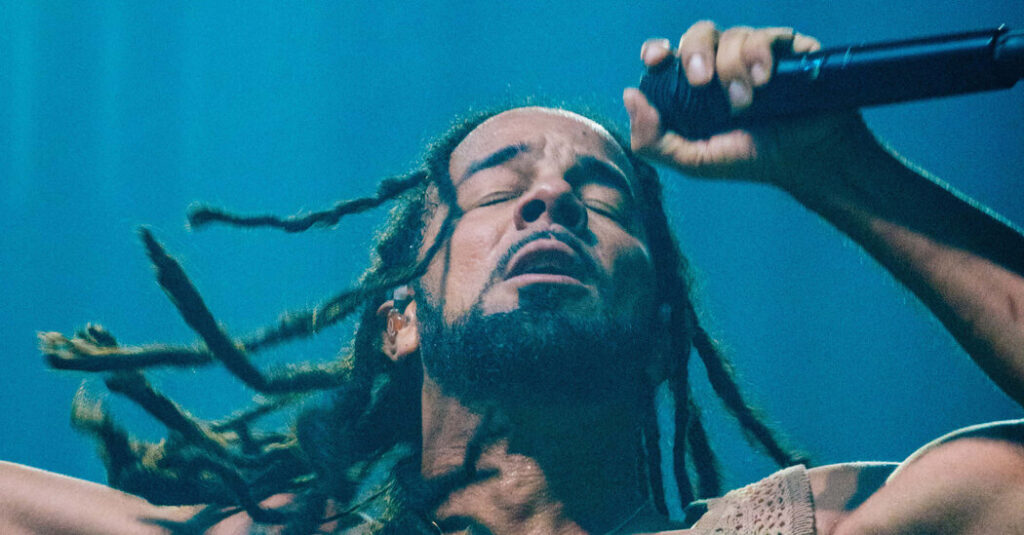
The high-energy soca group Kes the Band thrives on defying stereotypes. So if nobody expected the band from Trinidad and Tobago to headline Jazz at Lincoln Center’s Unity Jazz Festival this week, all the better.
“Our fans are no longer surprised when we come up with something really left field,” the group’s frontman, Kees Dieffenthaller (who goes by Kes), said in a recent video interview. “They actually expect us to and want us to push the envelope a bit.” Kes the Band, which began as a showcase for Kes and his brothers and a friend, has long incorporated R&B, EDM, dancehall, Afrobeat and jazz into its sound. It will perform on Thursday and Friday in Manhattan, leading the third edition of Jazz at Lincoln Center’s answer to Winter Jazzfest.
Soca, a blend of calypso’s vibrant lyricism with propulsive West African and Indian beats, originated with the musician Ras Shorty I in the mid-1970s after he became concerned about younger generations’ disinterest in their national music and the increasing demand for reggae, disco, soul and funk from abroad. In 1974, his song “Endless Vibrations” broke through outside of his homeland, bringing its bouncy groove punctuated by horns to audiences in the United States and beyond.
Over the years, soca has become closely associated with the dynamic celebrations of Trinidad’s annual Carnival. Kes, the lead singer, appreciates the music’s evolution — a few years ago, he took a class and dove deeper into understanding calypso and soca — and has been working to comprehend his place in its history. “I look at it as an arrow,” he explained. The arrowhead “cuts into new places.” The stem “keeps it solid.” And the tail “guides it in whatever direction it needs to go.”
“I think I’m at the head in the sense I cut through stuff, but I have to have a knowledge of my stem and my roots,” he said. “But my role is no more or less important than anyone else’s.”
Kes, 40, and his original bandmates, who included his older brother Hans on drums, another brother Jon on guitar, and their childhood friend and bassist Riad Boochoon, grew up enthralled and entrenched in Trinidad and Tobago’s tradition of polyrhythms and double entendres. But it was not their formative sound.
It started when his older brother Hans saw a Van Halen video on MTV at a friend’s house. Hans, who was 10, was inspired by Alex and Eddie’s family bond and ran home to tell his younger brothers, “‘Yo, we’re forming a band.’”
Kes said he was just 5, and the family didn’t own any musical instruments. “We didn’t have drum kits or guitars,” he recalled. “So he decided to start building a drum kit with buckets, a hi-hat out of a milk tin cover, and a spring”
The band soon dissolved, but Kes was hooked. He joined an R&B group called Klas in high school, covering songs by Boyz II Men and Blackstreet, and garnered attention for his soulful vocals. Kes was also gravitating toward the hybridity of Krosfyah, the trailblazing soca band from Barbados, and David Rudder, a Calypso legend celebrated as much for his musical variety and lyrical virtuosity as for his political engagement. Reforming his original band with his brothers and Boochoon in 2005, Kes spent the first decade of his career pulled between soca and everything else. Hans left in 2021 and was replaced by Dean James.
“I was recording all other genres of music in these spaces and doing really well with it, but there were no vehicles for me to really market what that was,” he said. “Nobody believed in it because of where I’m from.”
Just when he was going to give up, he recorded “Wotless,” an irresistible, freewheeling fete song that went viral during Trinidad’s 2011 Carnival. “‘Wotless’ started to teach me what a good soca song was, in the sense of its structure and melodies,” Kes said. He spent another seven years refining this sound, releasing “Hello” in 2018, which became the group’s most-streamed song to date. “It was the perfect bridge between what a soca song is and what a world song is,” he said. “The melodies are just very infectious. It’s a simple hook. Of course, everybody says hello, everybody. This is a greeting that is in any language.”
Still, soca hasn’t enjoyed the global market share genres like reggaeton, dancehall and Afrobeats have. “A lot of successful artists you see right now, they’re so depressing,” said Shaggy, the reggae star who collaborated with Kes on “Mood,” from his soca-inspired 2023 album. “So, it makes me wonder where happy music fits in? Where does that music that makes you feel, get up, and just helps your mental health come in?”
“That’s why it puzzles me why people can’t get soca,” Shaggy added. “It’s pure joy. It’s pure feel-good. I think Kes embodies that and brings that aura of a good time.”
It’s one thing to make feel-good music to match the bacchanal reverie of Carnival. But it is an entirely different feat to create exuberance during the most challenging periods of one’s life. “All of my hit songs came out of hard moments,” Kes said. “‘Wotless,’ I was going to give up soca. ‘Hello’ was in response to my divorce. ‘Savannah Grass’ was after my dad died.”
Now, as the band continues to tour in support of its 2024 album “Man With No Door,” its members are mourning another loss. Kes’s sister, Danielle Dieffenthaller, a prominent Trinidadian filmmaker and producer, died in November at 60 of renal failure. A few weeks later, Kes paid tribute to her with a gorgeous cover of Donny Hathaway’s “A Song for You.”
“There’s this saying that, ‘When joy is in your living room, sorrow is sleeping in your bed,’” he said about this simultaneous period of grief and gearing up for the intensity of the 2026 Carnival season. “It’s so crazy that when people pass, you don’t ever not miss them,” he added. “But when they pass, their light goes into you, and it completes a few circles within you. So her passing completed a few circles within myself that sparked new growth for something else, for other things.”
One of those things is bringing all those highs and lows, the festivity and fearlessness, to his first full concert at Jazz at Lincoln Center. Kes returns with the jazz trumpeter Etienne Charles, who invited Kes to perform at a private concert there in 2009. They first met as teenagers in Trinidad while performing in the musical “Treasure Island” in 1998. (In an interview, Charles fondly remembered that Kes’s group Limestone did a “rendition of ‘Bohemian Rhapsody’ that just used to level the place.”)
Having collaborated with Kes on two songs, “Magic” and “IzWE” in 2020, Charles is excited to see how the band will transform the Jazz at Lincoln Center space, as it has so many others. “You go to a soca fest, and what you see there you don’t really see anywhere else, hands in the air, butts on the ground,” he said. “I think it’s a new generation of curators and presenters that want to hear the music in this space, and if people come with open ears and a couple drinks in them, I think they’re going to be ready for a party.”
Charles and Kes are aware that these concerts in New York City come at a moment of global uncertainty: Trinidad’s northeastern coast is six miles from Venezuela, where Kes’s grandmother resides.
“Now is the time for soca to spread its message and its word. Now is not the time to be insular,” he said. “Now is to give people a sense of joy, remind them of their humanity.”
“I want you to feel like you’re somewhere else,” he added, “or in a parallel universe.”
Salamishah Tillet is a contributing critic at large for The Times and a professor at Rutgers University. She won the Pulitzer Prize for criticism in 2022, for columns examining race and Black perspectives as the arts and entertainment world responded to the Black Lives Matter moment with new works.
The post ‘Hands in the Air, Butts on the Ground’: Kes Heads to Lincoln Center appeared first on New York Times.