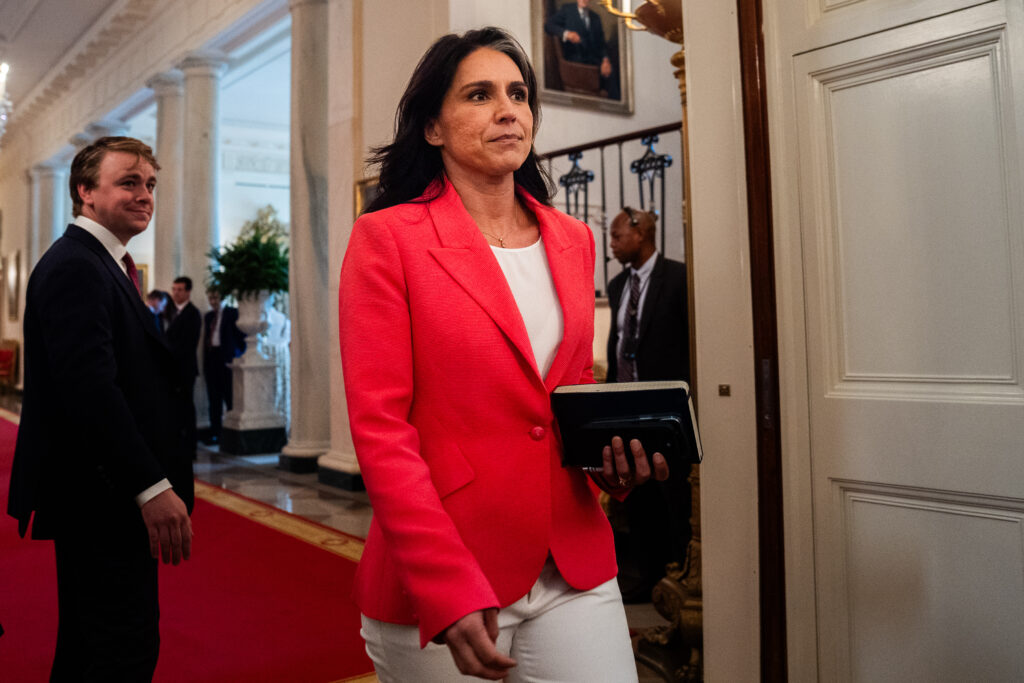
President Donald Trump’s top national security advisers in recent days have outdone one another, publicly extolling his bold decision to launch the risky military raid that captured Venezuelan President Nicolás Maduro. But one key figure has been largely absent from public view: Director of National Intelligence Tulsi Gabbard.
Gabbard, an Iraq War veteran who for years has spoken out against costly U.S. interventions abroad, waited more than three days before commenting publicly about Operation Absolute Resolve. Her usually busy feeds on X, where she maintains official and personal accounts, were abnormally quiet until she issued a terse statement Tuesday afternoon.
She has been missing in action from Fox News and other conservative broadcasts, where she’s been a frequent guest championing Trump’s priorities and excoriating his perceived enemies in a way previous intelligence chiefs avoided.
My heart is filled with gratitude, aloha and peace
#2026 pic.twitter.com/Du0iGV2sRb
— Tulsi Gabbard
(@TulsiGabbard) January 2, 2026
“President Trump promised the American people he would secure our borders, confront narcoterrorism, dangerous drug cartels, and drug traffickers,” she wrote Tuesday on her official X account. “Kudos to our servicemen and women and intelligence operators for their flawless execution of President Trump’s order to deliver on his promise thru Operation Absolute Resolve.”
Gabbard’s comments in support of the operation diverge sharply from the sentiments she expressed seven years ago, explicitly warning against a Venezuelan intervention. Her 2019 social media posts have recirculated endlessly in the last few days, often accompanied by snarky comments.
“The United States needs to stay out of Venezuela. Let the Venezuelan people determine their future. We don’t want other countries to choose our leaders–so we have to stop trying to choose theirs,” Gabbard, then a Democratic congresswoman from Hawaii, posted on X (then Twitter), in January 2019.
“It’s about the oil … again,” she posted a few days later in response to comments by then White House national security adviser John Bolton, making the case for Trump administration sanctions on Venezuela’s state-run oil company and pressure on Maduro to leave following tainted 2018 elections.
Gabbard played little role in the planning and execution of the complex raid Friday night and early Saturday into Caracas to seize Maduro and his wife, Cilia Flores, according to three current and former U.S. officials, who spoke on the condition of anonymity to provide details on sensitive operations. The mission was carried out by elite Delta Force commandos, supported by a covert CIA team on the ground, cyber operators and more than 150 aircraft.
The core team comprised Stephen Miller, the White House deputy chief of staff and homeland security adviser, Secretary of State Marco Rubio, Defense Secretary Pete Hegseth and CIA Director John Ratcliffe, who worked the issue for months, discussing plans for the operation in multiple confidential meetings that sometimes included Trump, a person familiar with the planning said.
That group was at Trump’s Mar-a-Lago estate in Florida as the operation got underway late Friday evening. Gabbard was not present, this person said, and was not among the senior officials who briefed lawmakers Monday evening.
A spokeswoman for Gabbard, responding to multiple emails requesting comment on her position on Trump’s Venezuelan intervention and her role in it, pointed to her X post on Tuesday.
“President Trump has full confidence in his entire exceptional national security team,” White House communications director Steven Cheung said in a statement. “Efforts by the legacy media to sow internal division are a distraction that will not work.”
On New Year’s Day, as U.S. military special operators were anxiously waiting for the weather to clear sufficiently for the mission to proceed, Gabbard posted on her personal X account pictures of herself doing yoga on a beach, apparently in her home state of Hawaii. “My heart is filled with gratitude, aloha and peace,” she wrote, adding a prayer-hands emoji.
Trump’s intervention in Venezuela, and threats to other countries — from Cuba to Iran, Greenland and Colombia — have exposed potential fractures within his political base and raised questions about how his “America First” promises align with what now appears to be a more muscular, interventionist foreign policy.
In late October, Gabbard addressed Middle Eastern and other leaders at an event in Manama, Bahrain, saying that the Trump administration marked a new day in U.S. foreign policy and an end to “toppling regimes [and] trying to impose our system of governance on others.”
“It seems pretty obvious that she was not part of this [Maduro mission] and has not been part of the inner circle for some time, if ever,” a former U.S. intelligence official said of Gabbard. “She is an isolationist, and Trump is some kind of weird imperialist,” said the official, who spoke on the condition of anonymity to discuss personal observations.
As director of national intelligence, coordinating the work of all U.S. intelligence agencies, Gabbard has focused on going after perceived political enemies that she and her allies allege are part of a “deep state” not sufficiently loyal to Trump.
In August, she publicly revoked the security clearances of 37 former and current U.S. officials, including one of the CIA’s senior-most Russia experts. That action inadvertently harmed the Trump administration’s attempts to prosecute former CIA director John Brennan for allegedly lying to Congress about a probe into Russia’s 2016 election interference, because several of the officials targeted were potential witnesses in the case, one current and one former official said.
In a separate move, Gabbard fired the top two officials of the prestigious National Intelligence Council in May, after that analytic group produced an assessment contradicting Trump’s assertion that Maduro’s government was directing the activities of the Venezuelan gang Tren de Aragua.
Gabbard has also driven the declassification of long-buried documents concerning the assassinations of President John F. Kennedy, Robert F. Kennedy and Martin Luther King Jr. The reams of documents provided new historical details, but no bombshells.
Gabbard interrupted her political career in 2003 to join the Hawaii National Guard and served in medical and military policy units in Iraq and Kuwait. As a veteran and politician, she has consistently argued against U.S. involvement in foreign wars and other nations’ affairs, frequently criticizing Trump during his first term.
As a congresswoman, she decried Trump’s decision to assassinate Qasem Soleimani, head of the Quds Force, the covert action arm of Iran’s powerful Islamic Revolutionary Guard Corps. Soleimani was killed in a U.S. drone strike in Baghdad in 2020. There was “no justification whatsoever for this illegal and unconstitutional act of war,” she said at the time.
Gabbard also criticized Trump’s 2018 Syria policy, in particular his threats to hit the Bashar al-Assad regime if its forces attacked an enclave held by anti-government rebels, including militants aligned with al-Qaeda. Speaking on the House floor, Gabbard called Trump’s policy a “betrayal of the American people” that would benefit terrorists.
She was broadly criticized for a 2017 visit to Syria in which she met with Assad, whose regime was accused of gross human rights atrocities that have been further confirmed since he was deposed by rebels led by Ahmed al- Sharaa in December 2024. Gabbard later declared that Assad is “not the enemy of the United States.”
Gabbard has had an up-and-down relationship with the Trump team. During the campaign and transition, she was seen by some as representing, along with Vice President JD Vance and others, a younger generation of Trump’s Make America Great Again movement. Gabbard was narrowly confirmed by the Senate Intelligence Committee and then the full Senate for the DNI post.
But White House officials were angered by what they saw as a series of missteps by Gabbard and her office.
On June 10, Gabbard posted a video on social media in which she described a recent visit to Hiroshima, Japan, the site of the U.S. nuclear bombing that helped bring about the end of World War II. “As we stand here today, closer to the brink of nuclear annihilation than ever before, political elite warmongers are carelessly fomenting fear and tensions between nuclear powers,” she said in the video.
Trump later confronted Gabbard at a White House meeting with others present, telling her, “I saw the video, and I didn’t like it,” a person aware of the exchange said.
Days later, Israel began attacking Iran’s key nuclear sites, military leaders and top nuclear scientists, a campaign that the United States joined on June 22, bombing nuclear enrichment and research sites at Fordow, Natanz and Isfahan.
In March, Gabbard had testified to Congress — reflecting the U.S. intelligence community’s assessment at the time — that Iran wasn’t building a nuclear weapon but the pressure on Supreme Leader Ali Khamenei to do so was growing.
Asked about that assertion in June, Trump said Gabbard was wrong. “I don’t care what she says,” he said.
The post Gabbard MIA on Venezuela operation amid tensions over Trump policy appeared first on Washington Post.