This story contains spoilers.
Masses of humans moving in total synchronization. Armies of drones working mindlessly toward the same singular purpose. Beings speaking in the same flat monotone. The hive mind doesn’t quite fit in the same category of horror as slashers or monsters, but it is its own impressive breed of terror. It’s been a feature of science fiction and horror for decades, from body snatchers to the Borg. More recently we’ve had several examples across TV and movies offer variations on the same theme: a collective consciousness that serves as the antagonizing force, or a means of control for a higher ranking villain.
The Joining
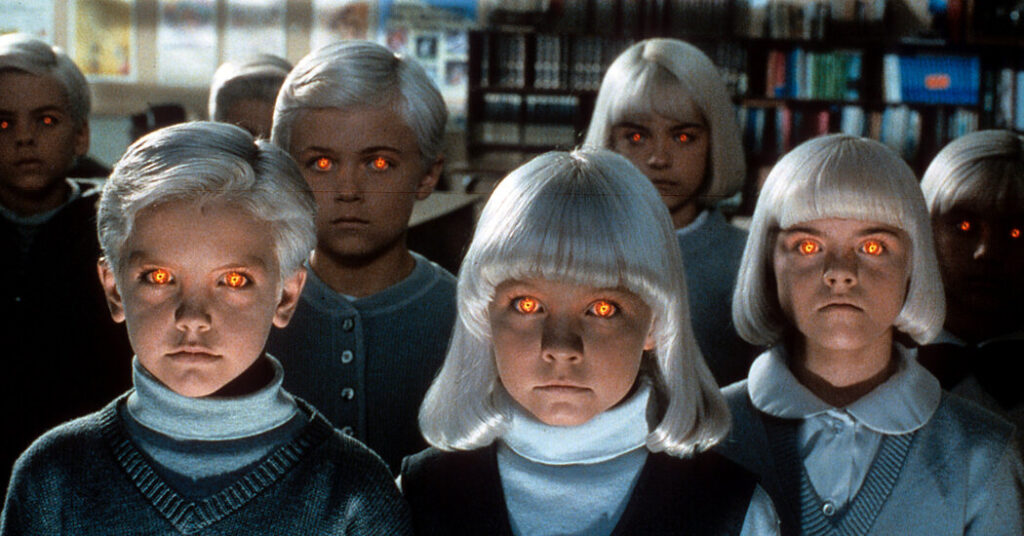
Joining a community or a club is usually an occasion for celebration, but not when it comes to a hive mind. An early example is the 1960 sci-fi film “Village of the Damned,” in which the members of a supernatural in-crowd of platinum blonde-haired, glowy-eyed children are miraculously conceived all at once, during a period of widespread unconsciousness in an English village. This is a rare case of seeing the origins of the hive mind. What we do often see is how the hive mind starts to spread. It’s never a pretty sight. (A 1995 “Village of the Damned” remake directed by John Carpenter swapped England for the San Francisco area and changed the body count at the end.)
In the Apple TV series “Pluribus,” the hive is biological, spreading through contact. In the first episode, a scientist becomes patient zero when she’s bitten by an infected rat, and she kisses her colleague, spreading the disease through her saliva. Just like the hive mind is a warped representation of our basic urge to gather in the interest of a greater good, the spread, too, is a perversion of one of our most intuitive ways of showing affection and care for one another.
The more intimate the means of conversion, then, the more grotesque the process seems. This is true for the intrusive method of assimilation in “Stranger Things.” Vecna, the big bad of the Upside Down, the show’s ghoulish nightmare world, gradually courts his victims, eventually encasing them in fleshly cocoons and covering their mouths with a tube. Vecna is effectively a monstrous Pied Piper, luring children away to satisfy his plan for more power, but his means of ensnaring the children of Hawkins, Ind., is more akin to that of a depraved maternal figure. He provides the illusion of safety and care, even “feeding” them his fantasy via a kind of umbilical cord. And when the children physically escape Vecna and his demons, the way Will Byers did early in the series, the psychic link remains intact.
The Attacks
A hive mind is a formidable antagonist in part because it can’t be fought like a singular villain. In fact, many hive minds depicted onscreen simply act out one imperative: spread, without any hierarchy or leader.
In other cases there is a queen bee, so to speak, and the collective is essentially a tool or weapon used to realize the head honcho’s plans. This is the case in one of the most famous science fiction hive minds, the Borg, which first appeared in “Star Trek: The Next Generation.” The Borg is made up of cyborg drones that are only “activated” to attack when commanded or provoked. Different iterations of “Star Trek” have depicted a Borg Queen in different ways, some granting her individual consciousness over the hive and others just using her as an avatar for the larger threat.
But either way, the Borg drones, with their mostly cybernetic biology and mechanized behavior, are meant to epitomize what happens when technology outpaces humanity. Even in the 1980s the Borg seemed like a dark portent of A.I., an ultraefficient machine army in the early days of personal computing.
One of the most resonant and unsettling images in entertainment last year was of the running children in “Weapons.” In this devilishly delightful horror movie, the students in a third-grade class, save one, inexplicably disappear one night, leaving home at exactly the same time to run into the night with airplane arms. The movie later reveals that the children have been weaponized and are being controlled as a unit, so when they’re discovered standing perfectly still in a basement awaiting instruction, they resemble a minute version of Borg drones, in kiddie pajamas.
Their controller is eventually revealed to be Gladys, the witchy “aunt” of the child left behind. Like Vecna, she manipulates her way into being a deviant version of a caretaker or guardian, using dark magic to steal children from their homes and control them for her evil machinations. By the end of the movie, however, her nephew uses her own magic against her, commanding the hive mind to fatally attack her before the children are freed from their shared trance.
The Ethics of It All
But … is a hive mind really all that bad? In Orson Scott Card’s Ender saga, humanity fights the threat of Buggers, a collective consciousness of alien ant-creatures. But the twist the genius hero, Ender, discovers at the end of the first novel is that the Buggers are actually innocent victims of humanity’s war against them.
More often than not, hive minds are depicted as dangerous threats, but in a few rare instances, they represent a more nuanced argument about the values of the collective versus the individual.
In the many film adaptations of Jack Finney’s 1954 novel “The Body Snatchers,” the so-called “pod people” of the hive mind aren’t depicted as sympathetic, but neither are they seen as nefarious in the traditional sense; they are just parasites fulfilling a biological imperative, trying to survive. But when taken in the context of the time, the body snatchers served as a reductive metaphor of the supposed Communist threat, the fictional stand-ins for a political ideology that espoused the collective over the individual — as in the bootstrapping American capitalist.
Leave it to the Adult Swim cartoon “Rick and Morty” to offer a perspective on the hive mind that’s as sharp as it is silly. In the Season 2 episode “Auto Erotic Assimilation,” Rick runs into Unity, an ex who is actually a collective consciousness spread by individuals’ vomiting into each other’s mouths. Rick enjoys the benefits of a collective, with wild group sex and partying; that is until his granddaughter, Summer, protests that Unity’s control is unethical. But when Unity partially loses control of the group, the free individuals immediately break out in a race war. Summer is forced to admit that she was wrong: “I didn’t know freedom meant people doing stuff that sucks. I was thinking more of a ‘choose your own cellphone carrier’ thing.” Apparently individuality is the cost of universal peace and harmony.
Unity appears again in a later season, when the president of the United States takes over the collective consciousness to ensure better voter ratings. Unity must serve as the hero to stop the president’s narcissistic campaign of domination. Again the hive mind isn’t depicted as an absolute evil but a representative of a common fear at the center of the American identity: the dissolution of the ego, a concept very much at odds with American individualism. Celebrity, novelty, genius — all become insignificant in a world ruled by a hive.
That’s what Carol Sturka fears in “Pluribus,” and the reason she sticks to her quest of returning the world to the way it was. But the members of the collective encourage her to join them, citing the peace, efficiency and happiness that they share. Individual memories and experiences haven’t been completely eradicated, just absorbed into the whole, so that in a sense the collective embodies all the realized potential of humankind.
The most visually compelling scenes in “Pluribus” are the ones that so clearly and succinctly convey Carol’s loneliness. Empty neighborhoods and stores. Lights of the city extinguished around her home. A long line of cars snaking out into the distance, abandoning her. It makes sense that after a while, even Carol, who distrusts the hive and plots for its destruction, begs for its return.
We’re social creatures, sure, but the hive mind captures one of the contradictions at the heart of humanity: we want so desperately to be part of a bigger picture or purpose, but we just as desperately hope to be one in a million.
Maya Phillips is an arts and culture critic for The Times.
The post From ‘Star Trek’ to ‘Stranger Things,’ What Hive Minds Tell Us About Ourselves appeared first on New York Times.