Ukraine’s allies agreed on Tuesday to provide key aspects of postwar security for the country in the event of a cease-fire with Russia, including a declaration by the leaders of France and Britain that they would commit troops to dissuade Russia from invading again.
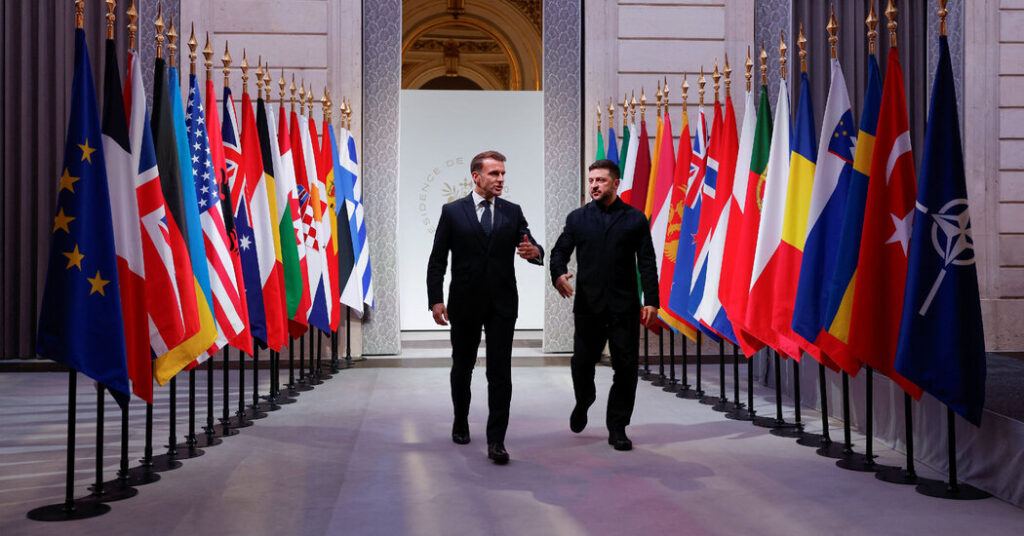
President Emmanuel Macron of France and Prime Minister Keir Starmer of Britain signed an agreement with President Volodymyr Zelensky of Ukraine at a meeting in Paris of more than 30 European leaders and other members of the so-called Coalition of the Willing. The countries in it have committed to strengthening Ukraine’s security.
In addition to the troop commitment, the agreement also said that the United States would lead an effort to monitor any eventual cease-fire, and that a special commission would be created to “address any breaches, attribute responsibility and determine remedies.” Britain and France agreed to establish military hubs across Ukraine after a cease-fire that would house protected facilities for weapons and other equipment to support Ukraine’s forces.
Mr. Zelensky, who had expressed more skepticism about the peace talks in recent days, said that the signed commitment was the first of many he anticipated and that the “architecture of security” for his country under a peace deal “now exists.”
“This is a huge step forward because one year ago, we couldn’t even think about it,” Mr. Zelensky said at a news conference after the meeting. “We are each day a little bit closer.”
Perhaps the most important sign of progress for Ukraine at the meeting — the 15th since the coalition was formed — was the sight of two of President Trump’s envoys onstage with Mr. Zelensky and other European leaders. Both negotiators, Steve Witkoff and Jared Kushner, offered strong signals of backing for Ukraine after a year of fluctuating support from the American president.
Mr. Trump “is strong for the country of Ukraine and for a peace deal,” Mr. Witkoff told reporters after the meeting. “And we will be there for the Ukrainians in helping them to get to that final peace. And we’re confident we will get there.”
Still, any cease-fire appears remote for now because Russia is not involved in the negotiations, and has said that it will not agree to any deal that includes NATO-country troops in Ukraine.
“Putin is not showing that he is ready for peace,” said Mr. Starmer, calling the Russian attack on Ukraine in recent weeks “horrific.”
That, he said, “only hardens our resolve.”
In their formal declaration, the leaders also vowed to support Ukrainian forces with money and weapons and promised “binding commitments” to the country in case of a future attack by Russia.
Yet they left many details unclear.
Mr. Starmer emphasized that the commitment only “paves the way for the legal framework” for British and French troops that would be stationed on Ukrainian soil. And Mr. Macron, mindful of his domestic audience, noted that the forces would be far from any front lines. In a brief interview with the public television channel France 2 on the sidelines of the meeting, he said “several thousand” French soldiers could be deployed to Ukraine to help maintain peace.
Other leaders have offered commitments of weapons and other military support, Mr. Zelensky said, but added that those proposals remained private for now and await ratification through their nations’ democratic processes.
“We are willing to commit, but the final question has to be answered in the cabinet and also in Parliament in the parliamentary process, and that’s going to be due on the moment that the peace deal is almost done,” Prime Minister Dick Schoof of the Netherlands said in an interview after the meeting.
The alignment between Europeans, Ukraine and United States would send a strong message to President Vladimir V. Putin of Russia, Mr. Schoof said. “I’m sure that President Trump will put everything in his power to get Russia to the table because we now all agree and have shown that we really want to have peace,” he said.
Tuesday’s meeting comes 11 months after Mr. Macron hastily organized European leaders in response to Mr. Trump’s signals that he could withdraw American support for Ukraine while engaging with Russia, leaving Europeans — who view the war on their continent as a fundamental threat — on the sidelines.
Since then, European leaders and their military chiefs have met many times, working toward a plan to help Ukraine secure a cease-fire. Mr. Zelensky and other European leaders have also worked feverishly to bring the American president on board.
Their efforts have been bumpy.
In November, the Americans backed a peace plan that seemed torn from the Russian wish list. It called on Ukraine to cede territory, restrict the size of its military and rule out NATO membership, while requiring few concessions from Russia.
After another flurry of meetings among the Coalition of the Willing members, a new 20-point plan emerged, more in line with Ukrainian and European demands. Mr. Zelensky presented the plan to Mr. Trump in December, and after two recent meetings at Mar-a-Lago, the Ukrainian leader declared that the plan was “nearly complete,” although some of the thorniest issues were unresolved.
Emerging from Tuesday’s meeting, Mr. Zelensky and the Europeans seemed to have pulled the Trump administration on board — at least for now.
“Ukraine gains what it has been lacking since 2022, which is credible, structured and multinational security guarantees without having to wait for NATO membership,” said Alexandra de Hoop Scheffer, president of the German Marshall Fund of the United States in Washington. “This declaration is locking in long-term support for Ukraine. It’s not ad hoc anymore.”
Firm commitments from allies would put Ukraine in a much more powerful position at any negotiation table facing Russia, she said.
As for Europe, the outcome of the meeting showed that it had “formalized and institutionalized U.S. long-term commitment and a U.S. backstop role,” she said.
“Russia is clearly the strategic loser here,” she said.
Lara Jakes contributed reporting from Rome and Ana Castelain from Paris.
Catherine Porter is an international reporter for The Times, covering France. She is based in Paris.
The post European Allies Agree to Key Security Provisions for Ukraine appeared first on New York Times.