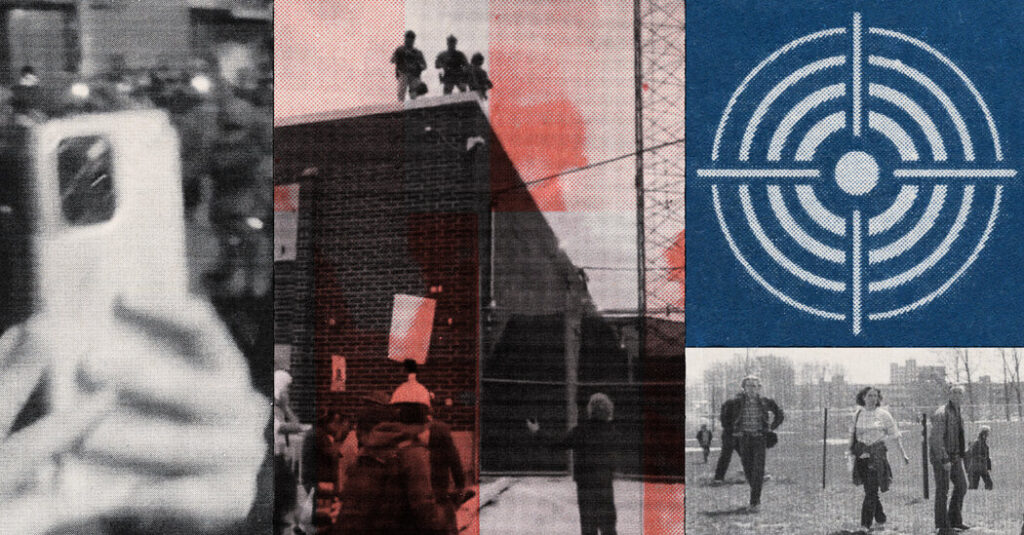
In October, a cellphone video from a protest at an ICE facility near Chicago began making the rounds on X. A Presbyterian minister named David Black is seen on a sidewalk in front of the building, his dress clearly clerical — black shirt, black pants and white collar — while other demonstrators mill around with signs. Three ICE agents stand on the roof: They wear tactical helmets and sunglasses, and neck gaiters hide their faces. Black’s arms are outstretched in prayer, reaching up toward the agents, who are backlit by a soft evening sky.
One of the agents tilts a slender weapon toward Black and, aiming from the hip, starts shooting. Pop, pop, pop. Smoke rises from the sidewalk near Black, who stands his ground as the projectiles strike his arms and torso. A shot then hits him directly in the head with a big puff of smoke, and he falls to his knees. Black later said he could hear laughter. In another video, a crowd of masked agents then pours out of a gate. One brandishes what looks like a grenade launcher. Another, kitted out in camo and a gas mask but wearing, jarringly, a pair of Vans, blasts pepper spray directly into Black’s face.
The weapon that Black was shot with was probably a Pepperball Custom Carbine S, which fires projectiles filled with chemical irritant at 300 feet per second. What looked like a grenade launcher was most likely a 40-millimeter tactical launcher, which can shoot beanbags, rubber bullets or foam rounds — all suitable means for administering “pain compliance,” according to one manufacturer.
Collectively, these are referred to as “less lethal” weapons, or L.L.W.s, a method of crowd control meant to reduce the possibility of death or permanent injury. Recently, their indiscriminate use has been captured vividly in cellphone videos from Chicago and other anti-ICE demonstrations. In Portland, Ore., protesters filmed agents shooting pepper balls into a crowd from a rooftop. In a video from Los Angeles, a woman cautiously approaches a phalanx of officers, one of whom then shoots her in the stomach with a rubber bullet.
These protest videos are, unsurprisingly, difficult to watch. The demonstrators pose no apparent threat. Some wear costumes. They defend themselves with umbrellas. In one video, a protester tugs off his shirt to reveal around 20 swollen pepper-ball welts on his back, as though he’d been lashed. Even the roiling jet of pepper spray directed at Black looks remarkably violent, like some kind of malevolent spirit.
What is surprising about these videos is the nonchalance with which the brutality is applied. This is in contrast to another type of cellphone clip, wherein police officers hold unarmed but “suspicious” men at gunpoint, which is characterized by high-voltage dread. When officers and agents wield their L.L.W.s, they often do so casually, as if they were playing a video game. They exude main-character energy and appear unfazed by their actions. While the Department of Homeland Security defends the use of L.L.W.s by officers to control “violent” protesters, these agents don’t seem to grasp that their weapons are, indeed, weapons.
Half a century ago, the civil rights and antiwar movements also generated striking images of official violence, and a direct consequence was the development of L.L.W.s, which were intended to deploy force in more humane ways. A series of iconic photographs captured the public’s attention, from snarling K-9s lunging at civilians to soldiers wielding bayonets. One such photo was taken on May 4, 1970, after nearly a thousand Ohio National Guard troops were sent to Kent State University to quell demonstrations over President Richard Nixon’s invasion of Cambodia. Guardsmen marched toward a crowd of protesters, who were throwing rocks, to disperse them. Then, without warning, 28 soldiers raised their weapons and began to shoot — some of them directly at the crowd. They fired more than 60 rounds, killing four students and wounding nine.
Several photographs captured the aftermath, but the most enduring was taken by John Filo, a journalism student, of a young woman kneeling over a student’s dead body, screaming. The image appeared on the front page of newspapers worldwide; it became known as the Kent State Pietà. A presidential commission concluded that sending soldiers “armed as if for war” had been a terrible mistake. “The need for something more effective than tear gas and less deadly than bullets is greater than ever before,” its authors wrote. “Effective nonlethal weapons,” as they called them, were urgently needed, and they implored the government to develop them.
Creating such weapons meant embracing a kind of violence that was, ironically, quite barbaric. Early experiments involved shooting chunks of wood at demonstrators. Rubber bullets and stun bags filled with birdshot followed. Proponents hailed “the revolutionary promise of new weapons technologies and their potential to promote the humane use of force,” as one scholar put it. But when the British deployed rubber and plastic bullets in Northern Ireland, grievous injuries began to occur almost immediately; by 1989, at least 16 people had been killed, including eight children.
The risks were known from the start. In 1972, a report commissioned by the U.S. National Science Foundation acknowledged that “nonlethal” weapons, “if used with any degree of regularity, would undoubtedly cause some deaths.” The prediction proved prescient. In 2004, a student in Boston died after she was shot through the eye with a pepper ball. A review of nearly 2,000 events worldwide involving these weapons identified 53 deaths and 300 cases of permanent disability, many due to vision loss. During the George Floyd protests, 89 people were injured by L.L.W.s and 16 suffered brain injuries in Minneapolis; nationally, over a hundred demonstrators were shot in the head or neck, and 24 people were partially blinded.
Over time, rather than re-evaluating the weapons’ use, law enforcement simply adopted new nomenclature: “nonlethal” became “less lethal.” Although they “theoretically offer an option for reduced force,” a global report from Physicians for Human Rights states, “in practice, and perhaps because of the assumption that they are always less lethal, the weapons are often used in an indiscriminate manner.” Maybe this is why those ICE agents look so relaxed as they administer “pain compliance” to demonstrators. A Harvard brief noted this problem way back in 2005. “The spread of these weapons may lead to more use of force overall,” the authors wrote, “not less.”
Powerful images, in part, led to the creation of L.L.W.s. Now we have a new generation of imagery cataloging the often inhumane ways in which they’ve come to be used. Could it catalyze a new backlash? “Get your cellphones out — record what you see,” J.B. Pritzker, the governor of Illinois, posted on X in September. “Put it on social media.” There is a risk that we become inundated by these videos; it’s hard not to worry that this could inure us to further violence — perpetrators included — and make galvanizing change more difficult. Overexposure might turn them into something like L.L.W.s themselves — initially presented as a means to justice, but ultimately compromised by their own ubiquity.
Still, the only solution to this particular strain of brutality may be through relentless documentation, with more videos and more protest. Doing so could open the door to change. In Chicago, a group of demonstrators, media organizations and clergy members, including Black, sued the D.H.S. for excessive use of force and other claims, in part using cellphone videos as evidence. Although the ruling has since been blocked on appeal, a federal judge in November issued an injunction strictly curtailing the use of L.L.W.s in her district. “The use of force,” she wrote, “shocks the conscience.”
Clayton Dalton is an emergency physician and a writer who has contributed to The New Yorker, Harper’s Magazine and other publications. He lives and works in New Mexico.
Source photographs for illustration above: John Filo/Getty Images; screenshots from X and YouTube.
The post Could Viral Protest Videos Create a Backlash Against ‘Less Lethal’ Weapons? appeared first on New York Times.