With tariffs rising around the world and President Trump vowing an end to decades of globalization, China’s leadership is trumpeting a tropical island as proof that it is moving in the opposite direction.
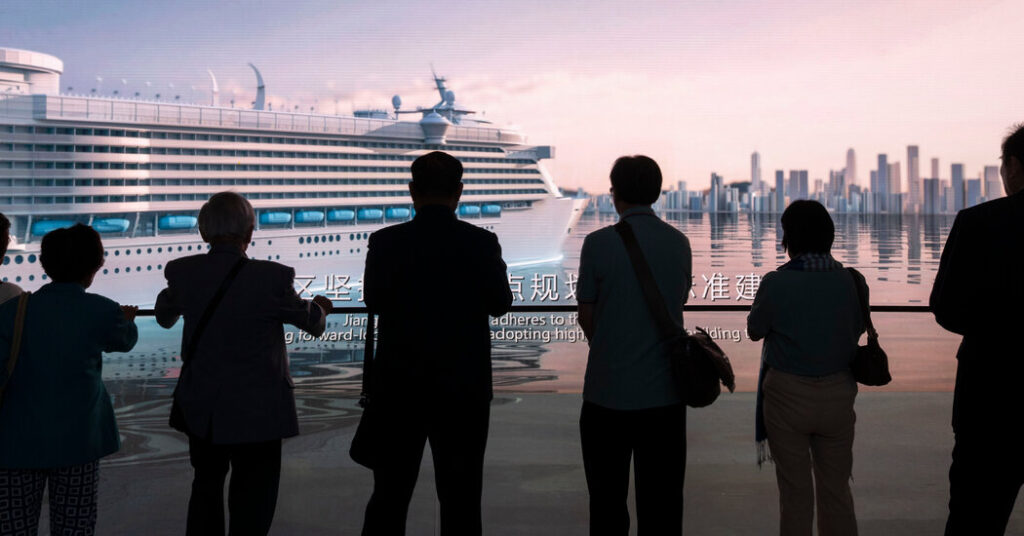
The island of Hainan — a province of China off the country’s southern coast 50 times the size of Singapore — last month scrapped tariffs on most imports, slashed corporate and individual taxes and declared itself the world’s largest “free trade port.” China declared it an emblem of its readiness for two-way trade with the world.
Xi Jinping, China’s top leader, called Hainan “a significant gateway leading China’s opening up in the new era.”
As portrayed by Beijing, Hainan’s experiment with tariff-free trade recalls the spirit of China’s early reform era after the death of Mao Zedong in 1976. The Communist Party ditched socialist dogma and began testing bold free-market policies in certain areas. Those that worked were rolled out more widely.
China’s place in global trade is very different now. The country has grown into the world’s unrivaled manufacturing power and second-largest economy. Mr. Xi has repeatedly called for self-reliance and worked to ensure that China is never dependent on anything foreign. He has shown little interest in altering the high tariffs and export-focused policies that helped give China a gargantuan $1 trillion trade surplus last year.
“There is no sign that Hainan is a forerunner for a broader and more systematic opening up of the national economy,” said Richard McGregor, a senior fellow for East Asia at the Lowy Institute, an Australian research center. “At a time of record trade surpluses,” he added, Hainan’s new role as a free trade entrepôt “has a strong whiff of bait and switch about it in political and P.R. terms.”
Most foreign goods can now flow freely into Hainan, whose 10 million people account for less than 1 percent of China’s total population. But those imports are not allowed to leave the island for other parts of the country unless stringent conditions are met.
The combination of policies is meant to prevent the tariff-free imports to Hainan from seeping into other parts of the country, where high tariffs remain in force.
That China has no plans to abandon its protectionist trade policies was made clear a few days after the Hainan Free Trade Port began working on Dec. 18: The commerce ministry in Beijing imposed tariffs of up to 42.7 percent on dairy imports to China from Europe.
On the last day of the year, the ministry announced what it called “safeguard measures on imported beef,” a system of quotas and tariffs of 55 percent designed to limit imports. And on Tuesday, it said it would put tight controls on exports of goods to Japan that have dual civilian and military uses.
Goods imported to Hainan cannot be shipped to other parts of China duty-free unless they have been processed in ways that increase their value by at least 30 percent.
At Haikou’s New Port, a gigantic passenger and cargo terminal in the provincial capital, ships sail night and day to the neighboring province of Guangdong. But what used to be a domestic transport hub has become in effect an international border. The Chinese customs service controls the flow of goods out of Hainan to elsewhere in China, checking trucks for any duty-free goods that are being smuggled into the rest of the country.
Although highly restricted, the possibility of access to the Chinese market beyond Hainan is already attracting a few foreign companies that would otherwise face high tariffs trying to sell to Guangdong or other Chinese provinces.
Nesredin Hussein, a coffee merchant from Ethiopia, recently rented a warehouse near Haikou to store beans imported to the island duty-free. He plans to buy roasting equipment so he can process coffee brought into Hainan tariff-free and then ship it to other parts of China for sale without paying a tariff or tax.
“For me, this is a very good opportunity” given China’s voracious appetite for coffee, he said, noting that he would otherwise have to pay up to 30 percent in tariffs and other taxes on any beans he imported into mainland China directly. “Here the rate is zero,” he said, after a visit with his wife and three children to the Hainan branch of Harrow School, an elite British boarding school.
Less convinced is Kamthon Wangudom, an ethnic Chinese businessman from Thailand who, invited to Hainan in December to visit a village where his ancestors lived, was taken first to an exhibition center pitching the island’s investment opportunities. He said his renewable energy company in Bangkok had already invested in Taiwan, Japan and the Philippines but was staying away from China because it “is too big and too complicated.” He is skeptical the new tariff regime will change much.
Hainan likes to compare itself to Hawaii for its palm-fringed beaches and resorts; like Hawaii, it is also studded with military facilities. These include a giant naval base near the southern resort town of Sanya that has grown rapidly as China asserted its claims over the South China Sea. Mr. Xi visited Hainan in November to tout the duty-free policies. But his main purpose was to inspect the naval base and attend the commissioning of a new aircraft carrier. Mr. Xi made clear that the strategic importance of Hainan means that security interests must trump economic ambitions.
Communist Party officials have plastered Haikou with red banners praising Mr. Xi and a “new era of openness.” Yet they declined to be interviewed for this article and ordered private companies on the island not to discuss how the new tariff-free regime might help or hurt their business.
Officials have good reason to be jittery. A few days before the tariff-free system began last month, a court in Shanghai sentenced the island’s former longtime Communist Party leader, Luo Baoming, to 15 years in jail for taking more than 113 million yuan (about $16 million) in bribes over a nearly three-decade career.
Mr. Luo was the latest senior Hainan official to be sent to jail in recent years for corruption.
Hainan has a history of big plans that often disappoint, starting with its designation as China’s last but biggest Special Economic Zone in 1988, a high tide of cooperation with foreign business that has receded rapidly since Mr. Xi came to power in 2012.
Unable to match the extraordinary economic growth of rival special zones like Shenzhen, next to Hong Kong, Hainan was for years largely seen as a sunny also-ran. It built up its tourist industry, including medical tourism, and constructed new highways and high-speed railway lines. In the 1990s, it spawned a property crash on the island, the first in China under communism.
Mr. Xi first announced plans to turn Hainan into a free-trade mecca in 2018. The project began with the opening of huge duty-free malls in Haikou and Sanya. This attracted Chinese tourists looking for discounted foreign luxury brands but failed to reverse the economic fortunes of an island still scarred by the impact of the property meltdown.
Today’s development of Hainan’s free port “faces tough reality checks,” according to a study by the Asia Competitiveness Institute at the National University of Singapore. Hainan is far less successful than other Chinese Special Economic Zones and attracts relatively little direct foreign investment, the report said.
For others, however, the importance of Hainan is its role as a test ground for innovative policies that don’t rock the boat.
The free trade port experiment will allow China to try out new approaches to such things as finance, education and taxes, said Lauren Johnson, founder of New South Economics, a consultancy in Melbourne, Australia, “while concurrently protecting the status quo on the mainland.”
Andrew Higgins is the East and Central Europe bureau chief for The Times based in Warsaw, on temporary assignment in Shanghai.
The post China Sells the World on Its Duty-Free Island, Amid a $1 Trillion Trade Surplus appeared first on New York Times.