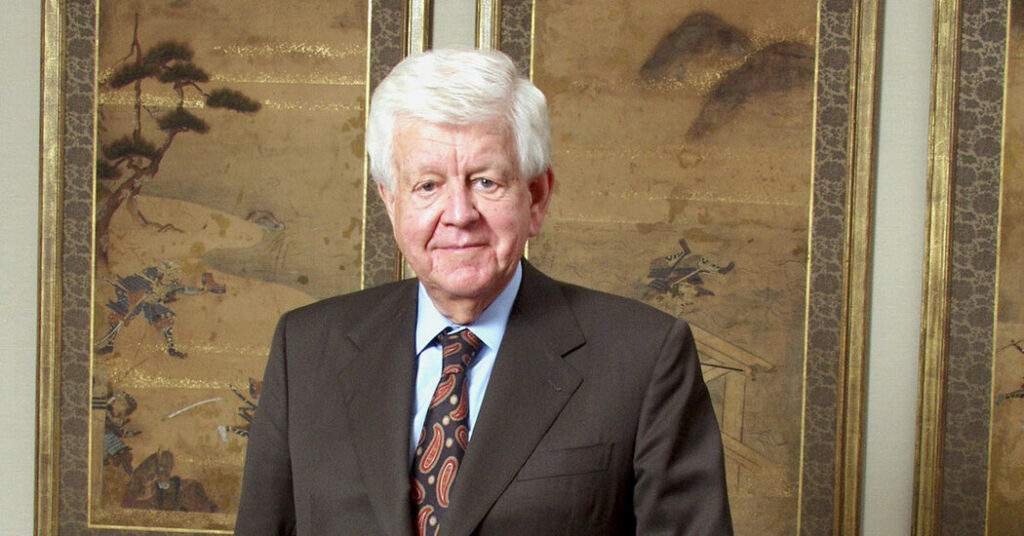
Bruce Crawford, an opera-loving advertising executive who left Madison Avenue to manage the Metropolitan Opera from 1986 to 1989 and who later revitalized Lincoln Center for the Performing Arts as its chairman, died on Dec. 28 at his home in Manhattan. He was 96.
His death was confirmed this week by his granddaughter Catherine De Beer, who said the cause was cancer.
In a renaissance career that embraced soap sales, media strategies, board room intrigues and the glories of Mozart and Wagner, Mr. Crawford spent decades building an ad agency, BBDO International (now BBDO Worldwide), into a global powerhouse, before taking his managerial skills to the troubled, deficit-ridden Met.
After years of indulging his passion for opera as a patron and financial contributor, he joined the Met board in 1976, was elected president in 1984 and two years later gave up his $750,000-a-year advertising life to sign on as general manager of the opera company at an annual salary of about $300,000.
Later, as chairman of Lincoln Center, he was virtually the public face of the nation’s premier performing arts institution, with venues for opera, ballet, music, theater and more on a 16-acre campus on Manhattan’s Upper West Side. By the time he stepped down in 2005, he had overseen the opening of a new jazz space, the Frederick P. Rose Hall; revitalized the Mostly Mozart Festival; expanded the American Songbook series; and begun an ambitious fund-raising campaign for the first phase of a major redevelopment plan, an overhaul of the center’s main cross artery, West 65th Street.
In his time managing the Met, Mr. Crawford, not an opera professional, often found himself in conflict with the company’s artistic director, the conductor James Levine. But he succeeded in cutting the Met’s production costs and eliminated its century-old, money-losing national tours. He also signed new contracts with 780 full-time employees, and cut the work force of part-time musicians, stage hands and clerical personnel to 1,200 from 2,000.
His most controversial decisions sought to balance limited resources with artistic responsibilities, weighing ticket sales to fill the Met’s 3,800-seat theater against programming adventurousness.
“We want a strong box office, but not necessarily the best box office,” he told The New York Times in 1987. “The latter would mean we were filling the house with popular things maybe for three or four years, but to the lasting detriment of the house.”
Thus the Met, in the 1987-88 season, offered such surefire favorites as Puccini’s “Tosca” and “Turandot” and Verdi’s “La Traviata” and “Otello,” but mixed them with more difficult sells, like Alban Berg’s “Lulu,” Mussorgsky’s “Khovanshchina,” Debussy’s “Pelléas et Mélisande” and Mozart’s “The Abduction From the Seraglio.”
The moves drew protests from some critics, fans and even Met personnel. But, with improved ticket sales and fund-raising, the house overcame an $8 million deficit. By the end of Mr. Crawford’s tenure, the Met had restored balance to an $88 million budget (about $235 million in today’s money), the largest of any American performing arts institution.
Mr. Crawford left the Met in early 1989 to become president and chief executive of the Omnicom Group, a marketing, advertising and public relations conglomerate formed in New York in 1986 by the merger of BBDO, the Doyle Dane Bernbach Group and Needham Harper Worldwide.
He was named chairman of Omnicom in 1995, was succeeded as chief executive by John D. Wren in 1997 and retired as chairman in 2019. On his watch, Omnicom grew into one of the world’s largest marketing holding companies, with thousands of clients in more than 100 countries.
Mr. Crawford continued to be active in the Lincoln Center community. He had given up the Met board presidency when he became general manager, but was re-elected president in 1991 and served until 1999. He attended about 25 operas each season with Joseph Volpe, the company’s general manager.
While retaining the Omnicom chairmanship, Mr. Crawford was named chairman of Lincoln Center in 2002. He replaced Beverly Sills, with a mission to stabilize an institution roiled by infighting over the details of a $1.5 billion plan to expand and redevelop the complex.
“These are not luxuries,” Mr. Crawford told The Times in 2003. “Lincoln Center’s theaters and public spaces have to be improved and maintained. You can’t go decades without bringing them up-to-date.”
In addition to overseeing projects like Rose Hall and reinvigorating Lincoln Center’s music programs, there was a consensus that Mr. Crawford had also subdued the infighting among the center’s constituent organizations, which include the Metropolitan Opera, the New York Philharmonic and New York City Ballet.
“He’s gotten everybody to focus on, not just the big picture, but the minutiae of what it takes to do this,” Kate D. Levin, New York City’s cultural affairs commissioner, told The Times when Mr. Crawford stepped down as chairman in 2005. “To make something that seemed so big and many-headed into a process that has obvious next steps and a sense of collegiality that is essential to getting it done.”
Bruce Edgar Crawford was born in West Bridgewater, Mass., on March 16, 1929, to Harry and Nancy (Morrison) Crawford. He began attending opera productions at the old Metropolitan Opera House on Broadway and 39th Street in 1946, when he was 17. He earned a bachelor’s degree in economics from the Wharton School at the University of Pennsylvania in 1952.
In 1958, he married Christine Amelung Wright, an interior designer. She died in 2024. In addition to his granddaughter Ms. De Beer, he is survived by a son, Robert, along with another grandchild, a grandson-in-law and two great-grandchildren.
Mr. Crawford began his advertising career at the New York-based firm Benton & Bowles in 1954 as an account executive for Tide and Camay soaps. In 1958, he joined Ted Bates & Company as a vice president, advertising Kool, Belair and Life cigarettes. He moved to Chesebrough-Ponds in 1961 as the company’s advertising manager for hair tonic accounts.
Mr. Crawford joined Batten, Barton, Durstine & Osborn in 1963 and was put in charge of the American Tobacco account. He was soon named a vice president and then became a board member. He was appointed president of BBDO International in 1975, chief executive in 1977 and chairman in 1985.
By then, Mr. Crawford had been attending operas at the Salzburg and Bayreuth festivals and other European venues for 20 years, was president of the Met’s board and was about to begin his second career as the opera company’s general manager.
He insisted that, despite occasional tensions with Mr. Levine, they were able to find harmony between artistic excellence and financial stability.
“I’m primarily a businessman, but I have a deep enough knowledge of opera, and I care for the Met and will fight hard to get the very best for it,” he told The Times at the outset of his tenure as general manager. “I like and respect Jimmy, but our relationship is intellectually rooted. It’s not, ‘Gee whiz, we get along.’”
Ash Wu contributed reporting.
Robert D. McFadden was a Times reporter for 63 years. In the last decade before his retirement in 2024 he wrote advance obituaries, which are prepared for notable people so they can be published quickly upon their deaths.
The post Bruce Crawford, Arts-Loving Adman Who Led the Met Opera, Dies at 96 appeared first on New York Times.