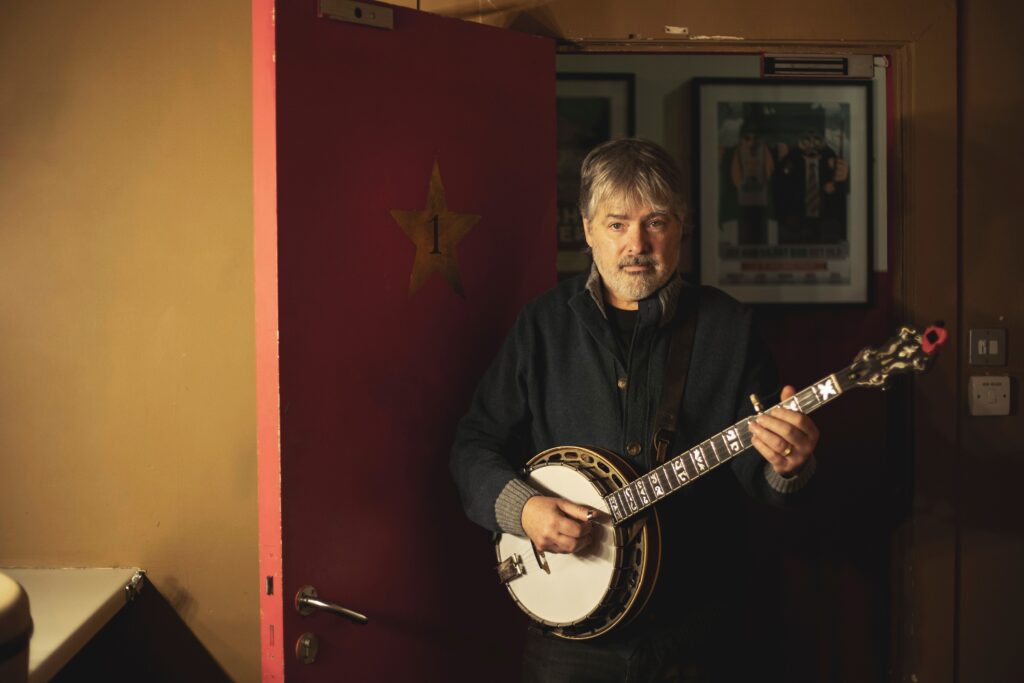
Acclaimed banjoist Béla Fleck announced Tuesday that he had pulled out of a trio of National Symphony Orchestra concerts he was set to participate in at the John F. Kennedy Center for the Performing Arts, saying that appearing there “has become charged and political.” He joins numerous other artists who have canceled appearances since President Donald Trump took over the center last year.
Since 1987, Fleck has earned 43 Grammy nominations and 18 wins by playing his banjo and fusing bluegrass with jazz as a solo artist, with New Grass Revival and leading his band, Béla Fleck and the Flecktones. In other words, he’s the sort of artist the Kennedy Center has traditionally booked — and he’s performed there several times over the years. Fleck even has an upcoming project with opera singer Renée Fleming, a former artistic adviser for the center who quit after the center’s new board firedformer president Deborah Rutter last February.
Fleck planned to perform again next month with the National Symphony Orchestra, participating in a segment of a program called “American Mosaic,” which the Kennedy Center website describes as “a true celebration of American music” that features “video imagery, live narration, and quintessential American melodies to celebrate the land, people, and spirit of the United States for its 250th birthday.”
But it isn’t the same Kennedy Center that Fleck has frequented. It’s now chaired by the sitting president and led by his loyalists. The programming changed. The name changed. To Fleck, it has become politicized.
Fleck does not want his decision to seem politically motivated. He wants to remain as nonpolitical as possible but says he felt like playing at the center would be a political statement. And he didn’t want to make one.
“I have withdrawn from my upcoming performance with the NSO at The Kennedy Center. Performing there has become charged and political, at an institution where the focus should be on the music,” Fleck wrote Tuesday in an Instagram post. “I look forward to playing with the NSO another time in the future when we can together share and celebrate art.”
Kennedy Center President Richard Grenell immediately responded on X, writing to Fleck, “You just made it political and caved to the woke mob who wants you to perform for only Lefties. This mob pressuring you will never be happy until you only play for Democrats. The Trump Kennedy Center believes all people are welcome — Democrats and Republicans and people uninterested in politics. We want performers who aren’t political — who simply love entertaining everyone regardless of who they voted for.”
The next day, as Fleck’s decision was lauded by some fans and peers and criticized by others on social media, The Washington Post spoke to the banjoist by phone about his decision.
This conversation has been edited for length and clarity.
Can you talk about what the center and the NSO mean to you, and how you came to this decision?
The Kennedy Center always seemed like an elite place to play. Every time I’ve gotten to play there has been a special occasion, a career high. It is an elite place to play and a very special opportunity that I was very much looking forward to. I’m also a fan of the orchestra. I’ve been doing classical-oriented collaboration for a while, starting with my first banjo concerto.
I was so thankful when this gig came up and was proposed. I was thrilled. So it’s a big deal to walk away from it.
Can you walk me through the calculus that went into making the decision to withdraw?
I like to play for all kinds of people. I don’t just want to play to people with my own political point of view — which I’m not saying what it is, but it’s probably obvious. I like to play for everybody, and I don’t like to be political. It’s sort of the last thing I want to do because I think the music does its own work.
If you take a political point of view, you just alienate half the potential audience, which has never been my intention — and isn’t my intention now.
When you’re trying to decide what to do about a situation like this, it’s linked to that very feeling of not wanting to choose sides and alienate people, but also not wanting the music to be about that choice. The music should be itself and stand aside from whatever’s happening the world.
[In this program,] it’s just great music from a hundred years ago … a celebration of great music that was made a long time ago and stood the test of time.
I’ve been interested in the idea the new leadership of the Kennedy Center put forth, claiming that the art that was there before they took over was political. The center is not a place where I think of seeing particularly politicized art that often. Sure, sometimes, but not usually.
I don’t know. I’m not an expert on that. That’s the other reason I don’t like to get political, because if I start getting questioned intently by someone who has a different point of view, I have to have the facts and figures to back up my side of the conversation, and I don’t. I haven’t made my life’s work being an expert on the political aspects of each situation. I know what I feel in my heart.
I am an expert at playing the banjo and making music. That’s what I know how to do. So generally, I try to stay as far from politics as possible. I think bluegrass is a kind of music that reaches all kinds of people, and I think the progressive side of my music speaks for itself.
The kinds of music I play with people from different parts of the world is very inclusive and very collaborative, and I want those dialogues with people that are different from me.
When you’re making this decision, was there a particular point where you felt like, now if I play, my music will be politicized in a way that I don’t intend for it to be?
As this Kennedy Center thing became more and more charged, it wasn’t any longer something where I’m under the radar playing this gig. I am actually taking a position by playing at the Kennedy Center now.
By not canceling, I’m taking a position, and I don’t want to take that position.
That’s what it really comes down to: I don’t want to take a position, but whatever I do is taking a position.
Was the name change the final straw, or was this something that had already been weighing on you?
I talked to the folks at the Kennedy Center about stepping out some months ago, and we’ve been having that dialogue. When I made that decision, it didn’t get acted on. It didn’t happen. So I’ve actually been trying to step away for a good while. It just got to a point where it wasn’t happening, and it needed to clearly be done.
I didn’t want to take sides. I know that for a lot of people, this means I’m taking sides.
I’m looking at the crap people say on X. Ninety percent of the people seem to think I’m a woman, so I know there are people who have no idea who I am or what my music is about anyway.
Then the reaction of Richard Grenell is exactly what I’m talking about. That’s what I don’t want to be a part of. Now his point of view is like, “Okay, well, you’re the one who cancels, so you’re taking a side.”
But for me, not canceling is taking a side.
These things tend to snowball in this way, where whatever your original intent, it is kind of lost in the culture war arguments that take place online. Is there anything you want to say to clarify what you’re doing and how you feel?
Some people are saying things like: “If you really wanted to not make a statement, then you wouldn’t have made a statement. You would have quietly canceled and not said anything.”
But the thing is, it went on so long, it’s gotten so close to the gig, and it hasn’t been canceled. So I felt it was important to actually cancel it out loud. Because there are people that thought I was going to be playing there.
The awkward part is there are people that are going to go, “Oh, you know, you’re riding this.” That’s not my intention.
I just don’t think I should be playing there right now in this climate. That’s really all it is. And when it’s not like this, I would love to play there.
And mostly, I’d love to play with this orchestra.
The post Béla Fleck on dropping his Kennedy Center shows: ‘Not canceling is taking a side’ appeared first on Washington Post.