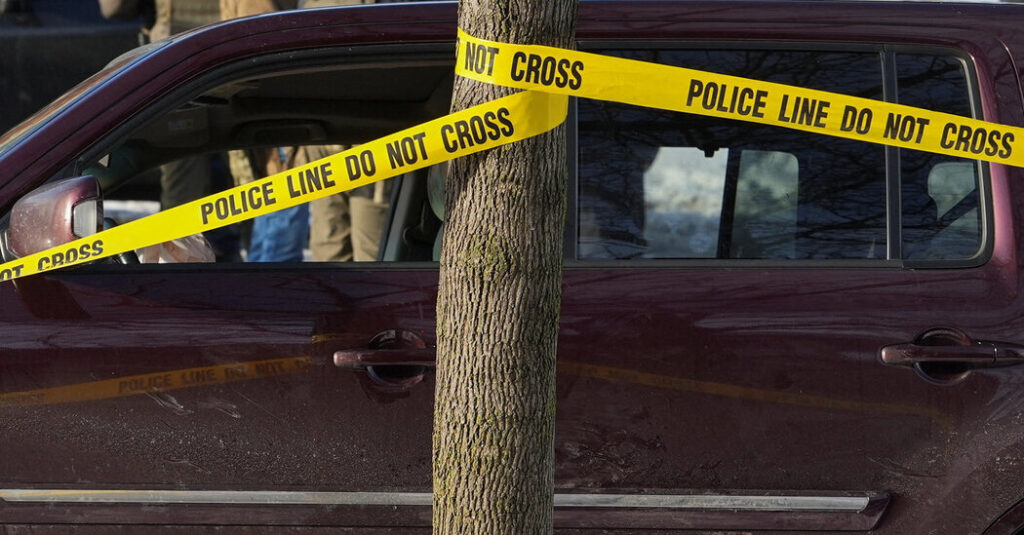
After a federal immigration agent fatally shot a woman in her vehicle in Minneapolis, homeland security officials described the driver as a violent rioter who had “weaponized her vehicle, attempting to run over our law enforcement officers in an attempt to kill them.”
That explanation — which state and local officials have disputed — is not an unusual one from authorities after such incidents. It’s a claim that often has been used as justification for fatal police shootings of otherwise unarmed motorists, a 2021 New York Times investigation found. Often, the motorist was simply trying to get away, trying to edge around officers rather than mow them down.
A video of the moments before and after the Minneapolis shooting, which took place on Wednesday, shows the driver’s vehicle, a maroon Honda Pilot, stopped in the roadway, perpendicular to the flow of traffic. Then a truck with flashing lights pulls up to it and two ICE agents exit.
“Get out of the car,” one agent says in the video, using an expletive as he approaches the vehicle and tries to open the driver’s side door.
As the agent tries to open the door, the vehicle backs up a little and then moves forward, turning to the right and into the flow of traffic as if to leave the scene — but also moving in the direction of another agent standing in the street near the front of the vehicle.
That agent pulls his gun and fires three times at the driver. The car continues forward for a short distance before crashing into a parked vehicle. The driver, a 37-year-old woman, had been fatally shot.
Geoffrey Alpert, an expert on police use of force at the University of South Carolina, reviewed a video that captured the shooting at the request of The New York Times. “The way you evaluate this is you look to see what’s the imminent threat to life, and there is none,” he said. “She’s leaving.”
“Look at the wheels on the car, they are turning to the right, and all he has to do is step out of the way,” he said, referring to the federal agent. “She’s jacking the wheels all the way to the right.”
“This is what we call officer-created jeopardy,” Mr. Alpert added, noting that the first agent to approach the car had escalated the situation, whereas local police officers are generally trained to de-escalate tense confrontations.
Jeremy Bauer, a forensics expert in Seattle who has testified in police shooting cases, also reviewed the video. He noted that the officer who fired his gun is obscured at certain points, making it hard to tell whether the car had ever made contact with him. The officer is positioned in front of the car before it starts to turn, he said. And the street was slippery with ice, giving the officer less control of his footing.
That the officer fired more than once was also significant, Dr. Bauer said. “If you’re able to keep aiming at something that is moving by you, then you have some innate knowledge that it’s moving by you and not running over you,” he said.
The Justice Department has long warned that officers should not fire at moving cars and has encouraged departments to forbid it. The department’s own use-of-force policy says that agents may not fire at a moving car that is threatening them unless “no other objectively reasonable means of defense appear to exist, which includes moving out of the path of the vehicle.”
A Department of Homeland Security use-of-force policy dated 2018, during the first Trump administration, says officers “are prohibited from discharging firearms at the operator of a moving vehicle, vessel, aircraft or other conveyance unless the use of deadly force against the operator is justified.”
The country’s 25 largest cities, including New York and Los Angeles, have barred police officers from shooting at moving cars — New York forbade it more than 50 years ago. Some policies make exceptions for terrorists plowing into crowds, or when officers are being fired upon by the vehicle’s occupants.
Shaila Dewan covers criminal justice — policing, courts and prisons — across the country. She has been a journalist for 25 years.
The post Authorities Often Justify Motorist Shootings by Saying the Vehicle Was a Weapon appeared first on New York Times.