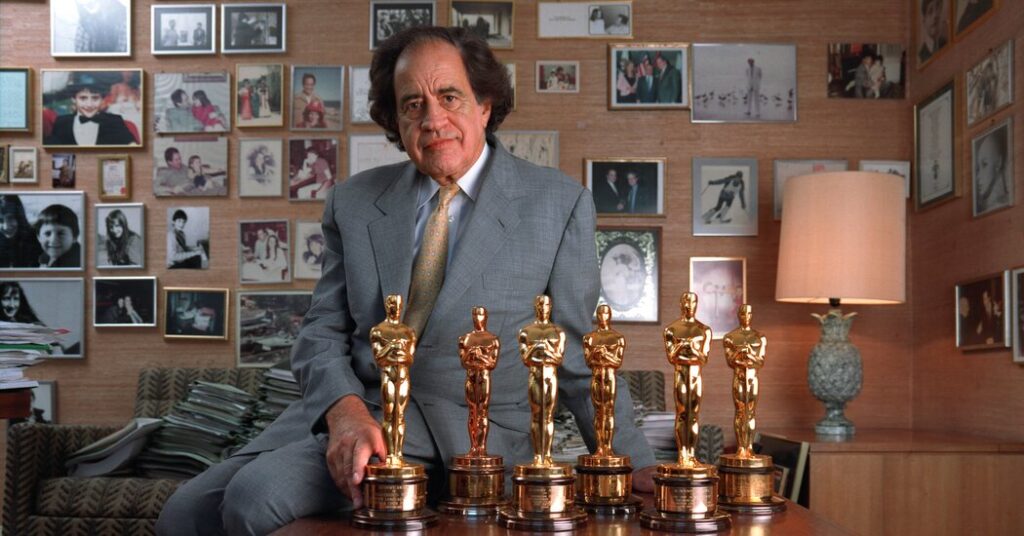
Arthur Cohn, a Swiss producer who took home six Academy Awards over the years for wide-ranging films that included the fascist-era Italian drama “The Garden of the Finzi-Continis” and the U.S. labor-strike documentary “American Dream,” died on Dec. 12 in Jerusalem. He was 98.
His death, in a hospital, was confirmed by his son Emanuel, an actor.
The producer’s chief job is to assemble financing for a movie, but Mr. Cohn was unusual among independent film producers in that he insisted on a free hand in the creative aspects as well, such as editing and in rewriting scripts. In choosing material, he followed his own passions, which included a lifelong preoccupation with antisemitism and the Holocaust.
Mr. Cohn told interviewers that he had been shaped by his upbringing as the son of a prominent Jewish lawyer in neutral wartime Basel, Switzerland, who helped fleeing Jews escape Europe. As a teenager, Mr. Cohn was often dispatched by his father to the forests on the Franco-Swiss border to find refugees.
Tachles, a Swiss magazine of Jewish life, praised Mr. Cohn for making films that “were often uncomfortable, political and morally challenging.”
“The Garden of the Finzi-Continis” (1970), was one of his best-known films, adapted from the novel by Giorgio Bassani about a doomed upper-class Jewish family in Italy in the 1930s and early ’40s. The movie, directed by Vittorio De Sica, won the Academy Award for best foreign-language film (though Mr. Bassani later disavowed it because of what he said was its distortions).
Mr. Cohn also produced “One Day in September” (1999), a documentary about the massacre of 11 Israeli athletes by Palestinian terrorists at the 1972 Summer Olympics in Munich. It included a rare interview with the one surviving perpetrator.
The Israeli secret service had spent years looking for the man, Jamal al-Gashey, who was reputedly living in Africa; the director, Kevin Macdonald, went through middlemen to track him down, with Mr. al-Gashey agreeing after eight months of nettlesome negotiations to go on camera with a wig-and-mustache disguise in a location that would be disclosed only at the last minute. Mr. Cohn found him in Africa and put a camera in front of him. The film won the Oscar for best documentary feature.
The films Mr. Cohn produced were not always obvious box-office draws; indeed, “The Garden of the Finzi-Continis” had been rejected by 31 distributors before it won the Oscar, he said.
“I was told it was too ethnic,” he told The Los Angeles Times in 1985, “and that we’re used to seeing good Jews and bad Germans — whereas the Jews in ‘Finzi-Continis’ are not all good, and the Germans not all bad.”
The reviews were mixed. Vincent Canby of The New York Times criticized the movie’s use of soft focus; it was as if Mr. De Sica “didn’t trust the validity of the emotions” in the script, he wrote. But the film found an international audience and came to be considered one of Mr. De Sica’s most accomplished works.
“I can’t afford to go with the trends because I don’t know if the trends will last as long as it takes me to make my films,” Mr. Cohn said in the Los Angeles Times interview. “So I search for projects that are out of the ordinary, enriching and apt to be remembered for a long time.”
The Cohn-produced 1981 documentary about the Holocaust, “The Yellow Star,” which was nominated for an Academy Award for best documentary feature and directed by Dieter Hildebrandt, predated Claude Lanzmann’s marathon-length Holocaust documentary, “Shoah,” by four years.
Another of Mr. Cohn’s documentaries, “American Dream” (1990), about a bitter strike at a Hormel meatpacking plant in Minnesota in 1985 after the company tried to lower wages, took the Oscar for best documentary feature. Barbara Kopple, Cathy Caplan and Thomas Haneke co-directed.
Broadly defining his responsibilities as producer, Mr. Cohn insisted on being involved in the editing process down to the final cut. This could have salutary results, as he explained to students at the New York Film Academy at the beginning of the 2010s in discussing a 1976 film he co-produced, Jean-Jacques Annaud’s “Black and White in Color,” an antiwar satire set in West Africa during World War I. The film, Mr. Annaud’s feature directorial debut, was initially “a flop,” Mr. Cohn said.
The movie was returned to the studio, and over the next eight months, under Mr. Cohn’s watch, it was tightened and refined. “The film became different through the editing,” he told the students. After “Black and White in Color” was rereleased, it won the Academy Award for best foreign-language film. Le Monde’s eminent critic Jean de Baroncelli called it “caustic, bracing, joyful.”
Mr. Cohn prized authenticity, even in fictional stories: He insisted on reshooting the end of “Finzi-Continis” to show the city of Ferrara’s empty streets after the Jews have been deported, and “Black and White in Color” was made on location in Ivory Coast. “Always shoot at the place where the action takes place,” he said at the film academy.
Arthur Cohn was born in Basel on Feb. 4, 1927, the middle of five children of Marcus Cohn and Rose Cohn-Galewski, a poet from Berlin who contributed to a renowned, antifascist Swiss cabaret, Cabaret Cornichon. His paternal grandfather, also named Arthur Cohn, was chief rabbi in Basel and a friend of the Zionist pioneer Theodor Herzl; Rabbi Cohn helped organize the First Zionist Congress there in 1897.
After high school in Basel, Mr. Cohn worked as a journalist for Swiss state radio, covering sports, politics, the Middle East and Israel’s early years, interviewing Israeli leaders like David Ben-Gurion, one of the country’s founders. He wrote three books about Israel and married Naomi Shapiro, the daughter of another founder, Moshe Haim Shapiro.
Mr. Cohn’s reporter’s “eye for reality,” as he put it, led him into documentary filmmaking in the early 1960s. One project he helped produce, “The Sky Above, the Mud Below,” a 1961 film about a European expedition to uncharted parts of Dutch New Guinea, won the Academy Award for best documentary feature. By the end of the 1960s, he had established a partnership with Mr. De Sica, whom he considered his mentor. He produced six of Mr. De Sica’s final movies before the director’s death in 1974.
Other films he produced included “Dangerous Moves” (1984), a Cold War drama, starring Michel Piccoli, with a chess match as its central theme — it won the Oscar for best foreign-language film — and the Oscar-nominated drama “Central Station” (1998), by the Brazilian director Walter Salles and starring Fernanda Montenegro.
In addition to his son Emanuel, Mr. Cohn is survived by his wife, Naomi Cohn-Shapiro; two other children, Marcus and Nurith Cohn; a brother, Gabriel; and eight grandchildren.
Emanuel Cohn recalled that his father had once rejected a lucrative offer to become a top producer at Metro-Goldwyn-Mayer’s studios in Hollywood.
He preferred to retain his independence.
“My films have one united aspect,” he told the students in New York. “Nobody wanted to do them. My message is, to make memorable films.”
Kitty Bennettand Susan C. Beachy contributed research.
Adam Nossiter has been bureau chief in Kabul, Paris, West Africa and New Orleans and is now a writer on the Obituaries desk.
The post Arthur Cohn, Film Producer With an Oscar-Winning Touch, Dies at 98 appeared first on New York Times.