Good morning. It’s Wednesday. Today we’ll see why the director of the new production of “I Puritani” at the Metropolitan Opera went to see a painting at the Metropolitan Museum of Art. We’ll also get details on crime statistics from 2025 that showed a drop in murders but an increase in reported rapes.
“There she is — oh, my God,” Charles Edwards said when he finally saw the painting for the first time.
It’s a portrait of a 17th-century royal. Edwards had done his own reinterpretations of it, in watercolors and acrylics, long ago, working from images he downloaded at home in London. Then he — and his canvases — came to New York for the Metropolitan Opera’s new production of “I Puritani,” which he directed.
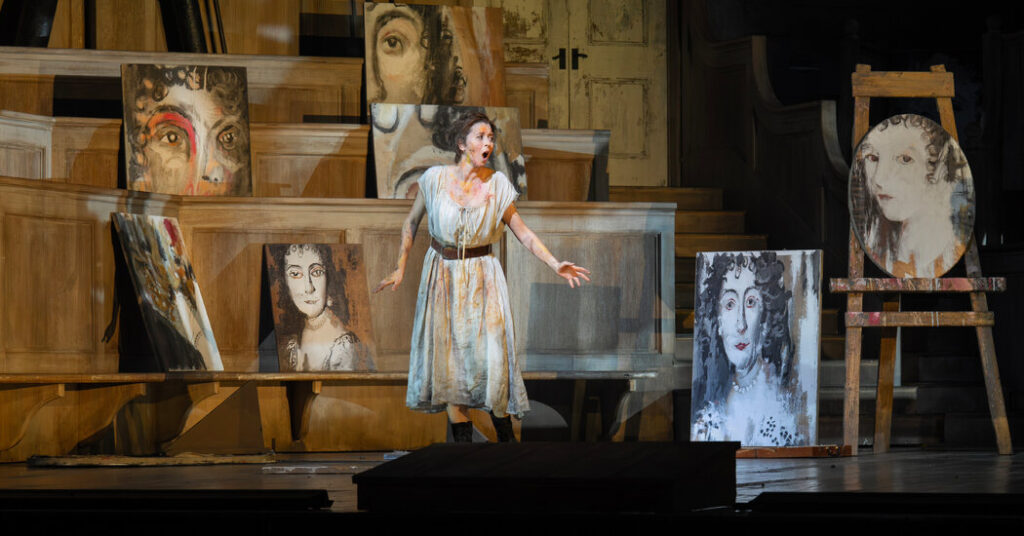
In Act III, it looks as if the heroine, Elvira, has obsessively painted portrait after portrait of the woman she thinks her fiancé had run off with in Act I — on their wedding day, no less.
But the paintings on the stage are Edwards’s.
To see the real thing for the first time, he went to the other Met, the Metropolitan Museum of Art, a few days before “I Puritani” opened. The painting, “Queen Henrietta Maria,” by the Flemish master Anthony van Dyck, is a presence in Gallery 618.
Van Dyck painted more than 30 portraits of her and was well aware that paintings of royals often served as instruments of diplomacy. They were sent as gifts to other royal households. “I mean, this was the Instagram of its time,” Edwards said.
More luminous
Edwards studied the van Dyck closely; there was a moment when a guard came over and told him to step back. “The color is more vivid” than what he had seen online, he said. The yellow of the gown was “much more luminous than it is in any of the reproductions.”
“And the softness — it’s a very tender painting,” he said.
It’s also different from Edwards’s. The van Dyck is formal and carefully proportioned. The face in some of Edwards’s paintings is not, but if they were Elvira’s work, that’s to be expected. She was an “on-again, off-again madwoman,” as the critic Donal Henahan once described her — and when the madness is on, she picks up her palette. She’s also a Puritan.
Henrietta (Enrichetta in “I Puritani”) was French, born in the Louvre, and Catholic. She personified “what wasn’t allowed” in England during the English Civil War as the Protestant Puritans asserted power, Edwards said. “No music in churches,” he said. “No art in churches. No color anywhere.”
Opposites attract, so of course Elvira’s fiancé is a Royalist. When he runs off with Enrichetta, it’s not for love, it’s for the cause.
Edwards’s production shows all this in a way that is “deceptively traditional,” Joshua Barone wrote in reviewing “I Puritani” for The Times. That lets the singing stand out. Barone wrote that the way the soprano Lisette Oropesa as Elvira handled one passage “was like listening to someone run their fingers across the keys of a piano.”
That face
Edwards said the idea of having Elvira paint Enrichetta came from the French play the opera was based on. And van Dyck, he said, “would have had every reason to admire her.”
“The great portrait painters have that capacity to psychoanalyze somebody,” Edwards said, and Van Dyck was an expert in “the psychological probing of the character through just looking into the face.”
“If you really look into those eyes and into that face and you know a little bit about her history,” he said, “it’s like watching a film, a great film actress.” And, he said, “if you look into the face long enough, you see the sadness. She must have been so lonely and unhappy in England.”
Henrietta, on the wall in the museum, has it easier than Edwards’s Enrichettas across town at the opera. By the time final curtain comes down, Elvira has poked her hand through one of the paintings. Then she smashes it over her head. It looks like torn canvas, but it’s only paper — the Met made copies for all the rehearsals and performances.
Weather
Expect a partly sunny day with a slight chance of rain in the morning and a high around 48. It will be partly cloudy tonight and temperatures will drop near 35.
ALTERNATE-SIDE PARKING
In effect until Jan. 19 (Martin Luther King Jr. Day).
QUOTE OF THE DAY
“People are living in fear here and still trying to figure out a way to process all of Donald Trump’s policies,” said Donovan Richards Jr., the Queens borough president, describing the reactions of Venezuelans in New York to the seizure of Nicolás Maduro. “They don’t know whether to be out on the streets.”
The latest New York news
-
New orders on jails and homeless shelters: Mayor Zohran Mamdani directed city agencies to create plans to curtail solitary confinement and bring shelters into compliance with safety rules. One order continued a state of emergency in city jails, including the troubled Rikers Island complex, above.
-
No more “bump”: The mayor filled a notorious pothole known as “the bump” at the Manhattan end of the Williamsburg Bridge. The transportation commissioner, Michael Flynn, said that fixing it was a prelude to completing a $70 million redesign of the area that will untangle bike, car and pedestrian traffic.
-
Goldman prepares to defend his seat: Representative Daniel Goldman, a Democrat running for a third term in a House district in Brooklyn and Manhattan, faces a primary challenge from Brad Lander, a former city official. Lander contends that Goldman’s support for Israel’s war in Gaza diverges from the views of the residents of his district.
-
Conway is running for Congress in N.Y.C.: George Conway, a former conservative lawyer turned critic of President Trump, moved to Manhattan, registered as a Democrat for the first time and jumped into the primary race for a House seat.
-
Cash deals dominate: Almost two-thirds of co-op and condo buyers in Manhattan last year paid with cash, edging out would-be buyers who needed mortgages, according to an appraisal firm.
Fewer murders in 2025, but more reported rapes
The drop in crime in New York City generally continued last year, with 20 percent fewer murders than in 2024. But there were 16 percent more reported rapes. Officials attributed the increase in part to a change in a state law that broadened the definition of sexual assault.
Police Commissioner Jessica Tisch and Mayor Zohran Mamdani announced the numbers, appearing together at a news conference for the first time. Gov. Kathy Hochul also attended.
The drop in crime came during Eric Adams’s last year as mayor, and my colleagues Maia Coleman and Chelsia Rose Marcius write that the numbers set a base line for Mamdani. One way he will be judged is by whether crime continues to fall during his tenure.
In 2025, 856 people were shot, 247 fewer than in 2024 and the lowest number since the Police Department began using its current method of collecting and recording crime data 31 years ago. Tisch credited the decline to a strategy that had deployed “an unprecedented number of officers” to nighttime patrols where crime had been high, including public housing complexes and the subway system. Both saw a 4 percent decrease in major crimes last year compared with 2024.
Mamdani — who during the campaign apologized for having once called New York police officers “racist, anti-queer and a major threat to public safety” — called the crime statistics “a testament to a Police Department that cares about this city and works with this city to remake this city.”
When he and Tisch were asked what they would change about the department’s approach to public safety, he did not directly answer the question. But he said he had kept Tisch on as commissioner — Adams had appointed her in November 2024 — because of the decreases in crime and her changes to the “upper echelons” of the department.
METROPOLITAN diary
Just a glance
Dear Diary:
I was transferring to the L train one day when I saw a woman struggling to climb the stairs with a baby strapped into a stroller.
“Do you need some help?” I asked.
She nodded.
Just as I was about to grab the bottom of the stroller seat, a man stepped in to help but couldn’t because of the bag of takeout food he was carrying.
With a glance that I tacitly understood, he handed me the bag, which he exchanged for the weight of the stroller. Together, the three of us trudged up the stairs.
When we got to the top, I handed the man his food, he set down the stroller and we all walked off on our separate ways.
— Isabel Sung
Illustrated by Agnes Lee. Tell us your New York story here and read more Metropolitan Diary here.
Glad we could get together here. See you tomorrow. — J.B.
Davaughnia Wilson and Ed Shanahan contributed to New York Today. You can reach the team at [email protected].
Sign up here to get this newsletter in your inbox.
James Barron writes the New York Today newsletter, a morning roundup of what’s happening in the city.
The post A Portrait That Was the ‘Instagram of Its Time’ appeared first on New York Times.